QUESTION IMAGE
Question
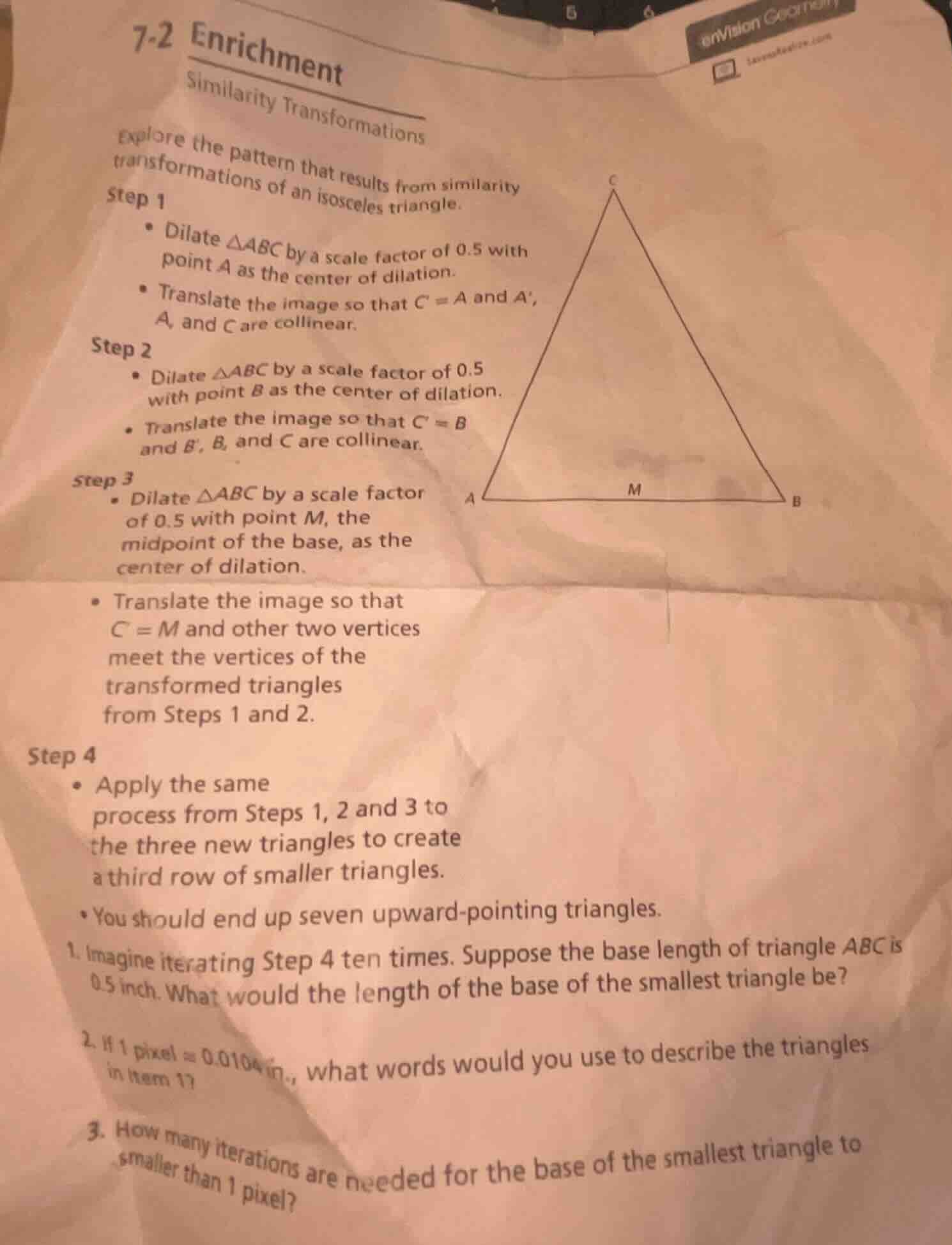
7-2 enrichment similarity transformations explore the pattern that results from similarity transformations of an isosceles triangle. step 1 - dilate △abc by a scale factor of 0.5 with point a as the center of dilation. - translate the image so that c = a and a, a, and c are collinear. step 2 - dilate △abc by a scale factor of 0.5 with point b as the center of dilation. - translate the image so that c = b and b, b, and c are collinear. step 3 - dilate △abc by a scale factor of 0.5 with point m, the midpoint of the base, as the center of dilation. - translate the image so that c = m and other two vertices meet the vertices of the transformed triangles from steps 1 and 2. step 4 - apply the same process from steps 1, 2 and 3 to the three new triangles to create a third row of smaller triangles. - you should end up seven upward-pointing triangles. 1. imagine iterating step 4 ten times. suppose the base length of triangle abc is 0.5 inch. what would the length of the base of the smallest triangle be? 2. if 1 pixel ≈ 0.0104 in., what words would you use to describe the triangles in item 1? 3. how many iterations are needed for the base of the smallest triangle to be smaller than 1 pixel?
Step1: Identify dilation factor per iteration
Each iteration (Step4) applies a scale factor of $0.5$ to the current triangle base length. Starting base length: $L_0 = 0.5$ inch. After $n$ iterations, the base length is $L_n = 0.5 \times (0.5)^n = (0.5)^{n+1}$.
Step2: Calculate for 10 iterations (Q1)
For $n=10$, substitute into the formula:
$L_{10} = (0.5)^{10+1} = (0.5)^{11}$
$L_{10} = \frac{1}{2048} \approx 0.000488$ inch
Step3: Describe triangle size (Q2)
Convert $L_{10}$ to pixels: $\frac{0.000488}{0.0104} \approx 0.047$ pixels. This is far smaller than a single pixel, so the triangle is microscopic or sub-pixel sized.
Step4: Solve for iterations <1 pixel (Q3)
Set $L_n < 0.0104$ inch, so $(0.5)^{n+1} < 0.0104$.
Take log base 0.5 of both sides:
$n+1 > \log_{0.5}(0.0104) = \frac{\ln(0.0104)}{\ln(0.5)} \approx 6.59$
Round up to the next integer: $n+1=7 \implies n=6$.

Snap & solve any problem in the app
Get step-by-step solutions on Sovi AI
Photo-based solutions with guided steps
Explore more problems and detailed explanations
- The base length of the smallest triangle is $\frac{1}{2048}$ inches, or approximately 0.000488 inches.
- The triangles are microscopic (or sub-pixel sized), as their base is smaller than a single pixel.
- 6 iterations are needed for the base to be smaller than 1 pixel.