QUESTION IMAGE
Question
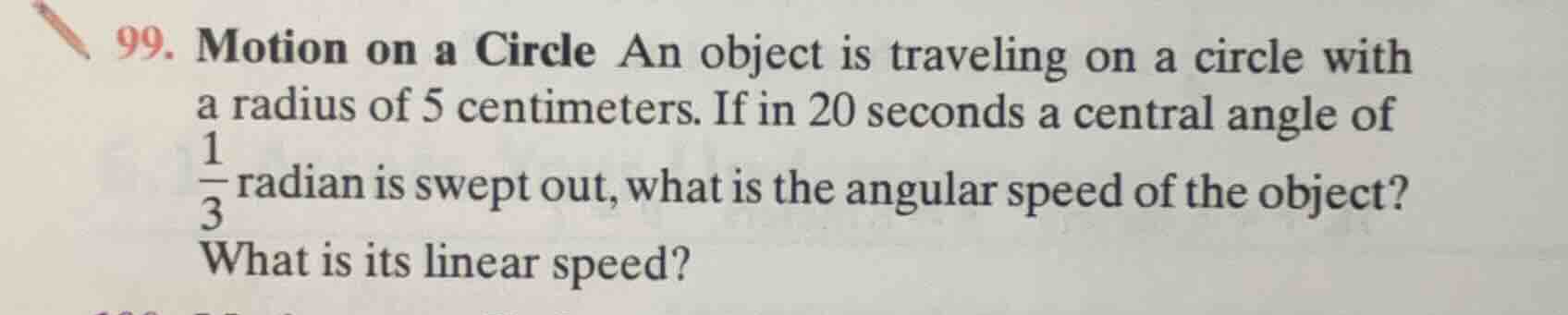
- motion on a circle an object is traveling on a circle with a radius of 5 centimeters. if in 20 seconds a central angle of \\(\frac{1}{3}\\) radian is swept out, what is the angular speed of the object? what is its linear speed?
Step1: Recall the formula for angular speed
Angular speed \(\omega\) is defined as the change in angle \(\theta\) over the change in time \(t\), so \(\omega=\frac{\theta}{t}\).
We know that \(\theta = \frac{1}{3}\) radian and \(t = 20\) seconds.
So, \(\omega=\frac{\frac{1}{3}}{20}\)
Simplify this: \(\omega=\frac{1}{3\times20}=\frac{1}{60}\) radians per second.
Step2: Recall the formula for linear speed
Linear speed \(v\) is related to angular speed \(\omega\) and radius \(r\) by the formula \(v = r\omega\).
We know that \(r = 5\) centimeters and \(\omega=\frac{1}{60}\) radians per second.
So, \(v=5\times\frac{1}{60}\)
Simplify this: \(v=\frac{5}{60}=\frac{1}{12}\) centimeters per second.

Snap & solve any problem in the app
Get step-by-step solutions on Sovi AI
Photo-based solutions with guided steps
Explore more problems and detailed explanations
Angular speed is \(\frac{1}{60}\) radians per second, and linear speed is \(\frac{1}{12}\) centimeters per second.