QUESTION IMAGE
Question
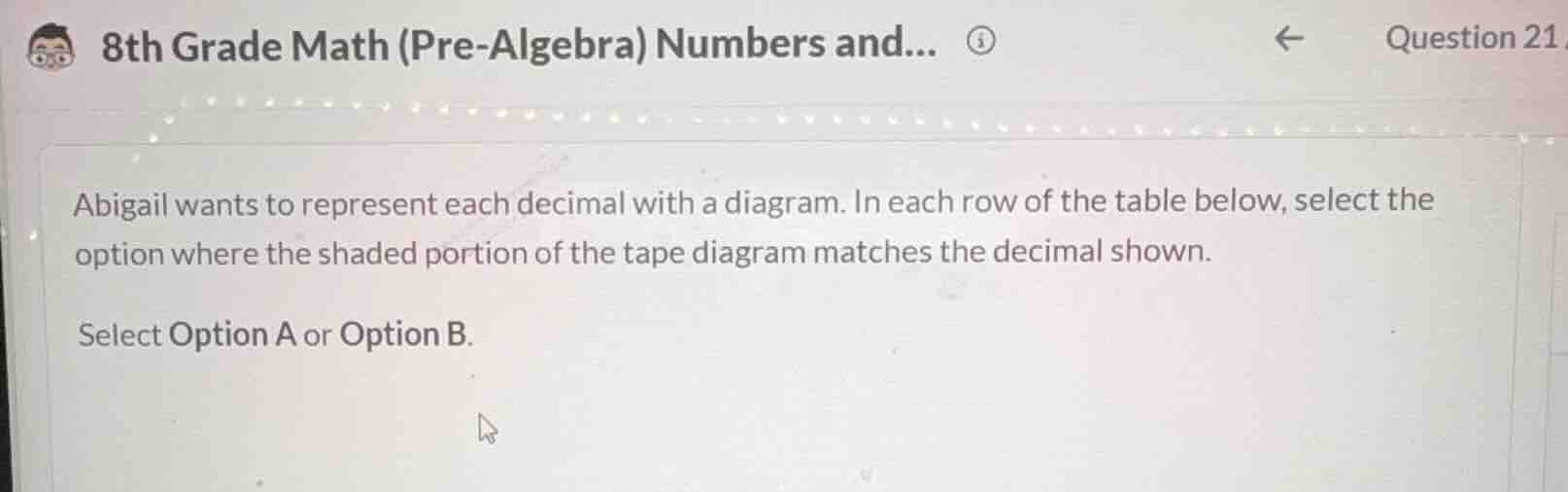
abigail wants to represent each decimal with a diagram. in each row of the table below, select the option where the shaded portion of the tape diagram matches the decimal shown. select option a or option b.
To solve this, we need to analyze the decimal and the corresponding tape diagrams (though the diagrams for Option A and B aren't shown here, we can explain the general approach):
Step 1: Understand the Decimal
First, determine the value of the decimal (e.g., if the decimal is \( 0.3 \), it represents \( \frac{3}{10} \) of a whole).
Step 2: Analyze the Tape Diagrams
A tape diagram (or number line) for a decimal will have the shaded portion equal to the decimal’s value. For example:
- If the decimal is \( 0.5 \), the shaded portion should cover half of the tape.
- If the decimal is \( 0.7 \), the shaded portion should cover \( \frac{7}{10} \) of the tape.
Since the specific decimal and diagrams aren’t provided, here’s how to proceed:
- Identify the decimal value (e.g., \( 0.4 \), \( 0.6 \), etc.).
- Check which diagram (A or B) has a shaded length equal to that decimal (e.g., if the decimal is \( 0.4 \), the shaded part should be \( \frac{4}{10} \) of the total tape length).
For example, if the decimal is \( 0.6 \):
- If Option A’s shaded portion is \( \frac{6}{10} \) of the tape, and Option B’s is \( \frac{4}{10} \), then select Option A.
Once you have the decimal and diagrams, apply this logic to choose the correct option (A or B) where the shaded portion matches the decimal.
If you provide the specific decimal and the diagrams for A/B, we can give a more precise answer!

Snap & solve any problem in the app
Get step-by-step solutions on Sovi AI
Photo-based solutions with guided steps
Explore more problems and detailed explanations
To solve this, we need to analyze the decimal and the corresponding tape diagrams (though the diagrams for Option A and B aren't shown here, we can explain the general approach):
Step 1: Understand the Decimal
First, determine the value of the decimal (e.g., if the decimal is \( 0.3 \), it represents \( \frac{3}{10} \) of a whole).
Step 2: Analyze the Tape Diagrams
A tape diagram (or number line) for a decimal will have the shaded portion equal to the decimal’s value. For example:
- If the decimal is \( 0.5 \), the shaded portion should cover half of the tape.
- If the decimal is \( 0.7 \), the shaded portion should cover \( \frac{7}{10} \) of the tape.
Since the specific decimal and diagrams aren’t provided, here’s how to proceed:
- Identify the decimal value (e.g., \( 0.4 \), \( 0.6 \), etc.).
- Check which diagram (A or B) has a shaded length equal to that decimal (e.g., if the decimal is \( 0.4 \), the shaded part should be \( \frac{4}{10} \) of the total tape length).
For example, if the decimal is \( 0.6 \):
- If Option A’s shaded portion is \( \frac{6}{10} \) of the tape, and Option B’s is \( \frac{4}{10} \), then select Option A.
Once you have the decimal and diagrams, apply this logic to choose the correct option (A or B) where the shaded portion matches the decimal.
If you provide the specific decimal and the diagrams for A/B, we can give a more precise answer!