QUESTION IMAGE
Question
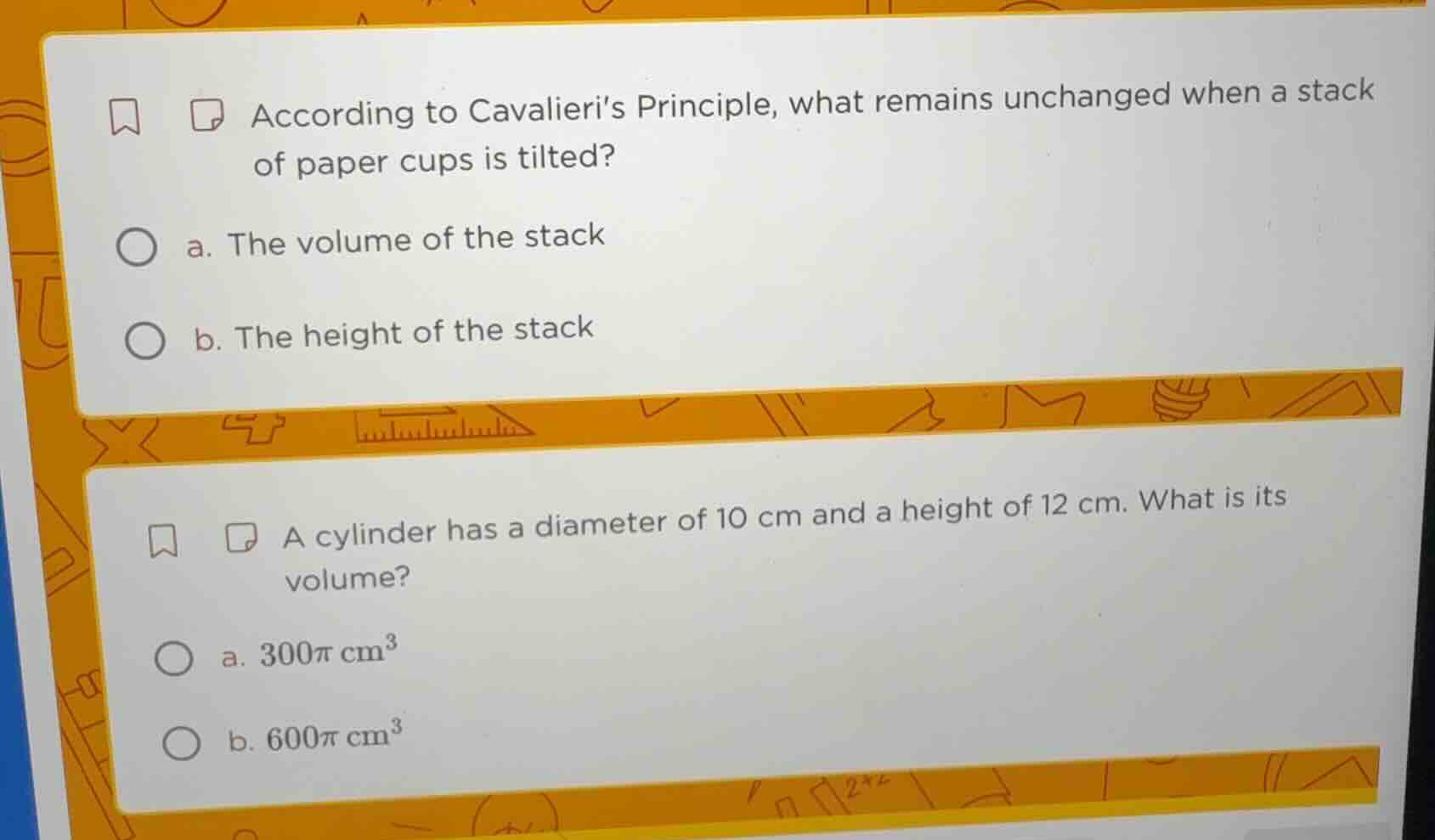
according to cavalieri’s principle, what remains unchanged when a stack of paper cups is tilted?
a. the volume of the stack
b. the height of the stack
a cylinder has a diameter of 10 cm and a height of 12 cm. what is its volume?
a. $300\pi$ $\mathrm{cm}^3$
b. $600\pi$ $\mathrm{cm}^3$
First Sub - Question (Multiple - Choice)
Cavalieri’s Principle states that if two solids have the same height and the same cross - sectional area at every level, they have the same volume. When a stack of paper cups (which can be considered as a solid) is tilted, the height of the stack may change (if we consider the vertical height), but the volume remains the same because the amount of space the stack occupies (the volume) depends on the number of cups and their individual volumes, which don't change with tilting. So the volume of the stack remains unchanged.
Step 1: Find the radius of the cylinder
The diameter \(d = 10\space cm\), and the radius \(r=\frac{d}{2}\). So \(r = \frac{10}{2}=5\space cm\).
Step 2: Use the formula for the volume of a cylinder
The formula for the volume \(V\) of a cylinder is \(V=\pi r^{2}h\), where \(h = 12\space cm\) (the height of the cylinder). Substitute \(r = 5\space cm\) and \(h = 12\space cm\) into the formula:
\(V=\pi\times(5)^{2}\times12=\pi\times25\times12 = 300\pi\space cm^{3}\)

Snap & solve any problem in the app
Get step-by-step solutions on Sovi AI
Photo-based solutions with guided steps
Explore more problems and detailed explanations
a. The volume of the stack