QUESTION IMAGE
Question
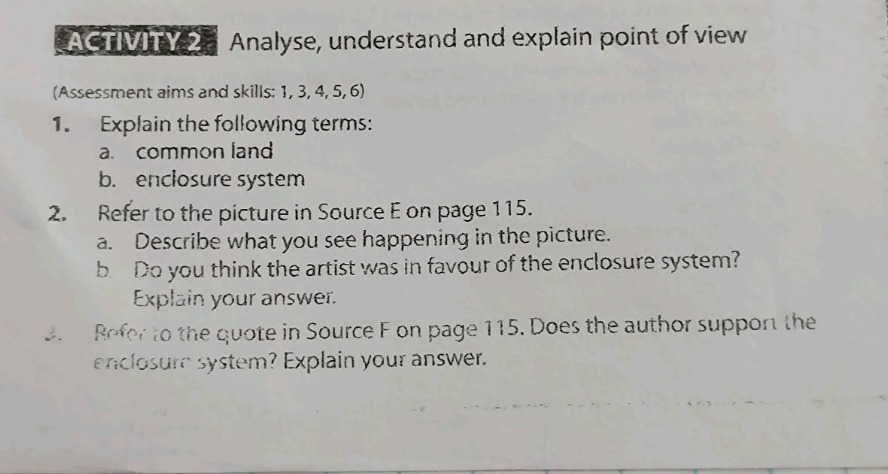
activity 2 analyse, understand and explain point of view (assessment aims and skills: 1, 3, 4, 5, 6) 1. explain the following terms: a. common land b. enclosure system 2. refer to the picture in source e on page 115. a. describe what you see happening in the picture. b do you think the artist was in favour of the enclosure system? explain your answer. 3. refer to the quote in source f on page 115. does the author support the enclosure system? explain your answer.
To address these questions, we'll analyze each part:
1. Explanation of Terms
a. Common Land
Common land refers to land owned by a community or with shared usage rights (e.g., for farming, grazing, or recreation) in pre - industrial or early industrial societies. Peasants, villagers, or small farmers could use it for activities like grazing livestock, collecting firewood, or growing crops, depending on local customs.
b. Enclosure System
The enclosure system was a process (especially in 18th - 19th - century Britain) where open fields and common lands were fenced, hedged, or otherwise enclosed. This converted them into privately owned, individual plots. It was driven by factors like the growth of commercial agriculture, the need for more efficient farming (e.g., for wool production in the textile boom), and the desire of landowners to consolidate and profit from their land. However, it often displaced small farmers and rural workers, as they lost access to common resources.
2. Analyzing Source E (Picture)
a. Describing the Picture (Hypothetical, as the image isn’t shown)
If it’s a typical enclosure - era image, you might see:
- Enclosure in action: Workers (or laborers) fencing or walling off land.
- Displaced people: Peasants or small farmers looking distressed, perhaps with livestock or tools, as they lose access to common land.
- Landowner’s perspective: A landowner (or overseer) directing the enclosure, maybe with a sense of authority.
b. Artist’s Stance on Enclosure
To determine this, look for:
- Visual cues of sympathy/opposition:
- If the displaced are shown as suffering (e.g., ragged clothes, sad expressions) and enclosers as harsh, the artist likely opposed enclosure.
- If enclosers are shown as progressive (e.g., neat fences, “modern” farming) and displaced as “backward,” the artist might favor it.
- Context of the era: Enclosure was controversial—many artists/critics highlighted its social costs (displacement, poverty), so opposition is common in critical depictions.
3. Analyzing Source F (Quote)
To determine if the author supports enclosure, follow these steps:
- Identify key phrases: Look for words like “beneficial,” “harmful,” “progress,” “destruction,” or references to economic/social impacts.
- Analyze tone and argument:
- If the quote praises enclosure (e.g., “increases agricultural productivity,” “modernizes farming,” “boosts wealth”), the author supports it.
- If it criticizes enclosure (e.g., “ruins small farmers,” “causes poverty,” “destroys community”), the author opposes it.
- Contextualize the quote: Consider the era (enclosure was debated for its economic efficiency vs. social justice), so the author’s stance will align with either the “progress” (pro - enclosure, seeing it as modernizing) or “justice” (anti - enclosure, seeing it as exploitative) camp.
For example, if Source F says: “Enclosure has turned our green commons into barren profits, driving the poor from their homes and work”, the author opposes enclosure (focus on harm to the poor). If it says: “Enclosure is the key to England’s agricultural prosperity, turning lazy commoners into productive farmers”, the author supports it (focus on economic progress).
To fully answer, you’d need to:
- Examine the actual quote (from Source F) for keywords, tone, and argument.
- Link it to the historical debate over enclosure (economic efficiency vs. social equity).
These answers require close reading of sources (images/quotes) and contextual knowledg…

Snap & solve any problem in the app
Get step-by-step solutions on Sovi AI
Photo-based solutions with guided steps
Explore more problems and detailed explanations
To address these questions, we'll analyze each part:
1. Explanation of Terms
a. Common Land
Common land refers to land owned by a community or with shared usage rights (e.g., for farming, grazing, or recreation) in pre - industrial or early industrial societies. Peasants, villagers, or small farmers could use it for activities like grazing livestock, collecting firewood, or growing crops, depending on local customs.
b. Enclosure System
The enclosure system was a process (especially in 18th - 19th - century Britain) where open fields and common lands were fenced, hedged, or otherwise enclosed. This converted them into privately owned, individual plots. It was driven by factors like the growth of commercial agriculture, the need for more efficient farming (e.g., for wool production in the textile boom), and the desire of landowners to consolidate and profit from their land. However, it often displaced small farmers and rural workers, as they lost access to common resources.
2. Analyzing Source E (Picture)
a. Describing the Picture (Hypothetical, as the image isn’t shown)
If it’s a typical enclosure - era image, you might see:
- Enclosure in action: Workers (or laborers) fencing or walling off land.
- Displaced people: Peasants or small farmers looking distressed, perhaps with livestock or tools, as they lose access to common land.
- Landowner’s perspective: A landowner (or overseer) directing the enclosure, maybe with a sense of authority.
b. Artist’s Stance on Enclosure
To determine this, look for:
- Visual cues of sympathy/opposition:
- If the displaced are shown as suffering (e.g., ragged clothes, sad expressions) and enclosers as harsh, the artist likely opposed enclosure.
- If enclosers are shown as progressive (e.g., neat fences, “modern” farming) and displaced as “backward,” the artist might favor it.
- Context of the era: Enclosure was controversial—many artists/critics highlighted its social costs (displacement, poverty), so opposition is common in critical depictions.
3. Analyzing Source F (Quote)
To determine if the author supports enclosure, follow these steps:
- Identify key phrases: Look for words like “beneficial,” “harmful,” “progress,” “destruction,” or references to economic/social impacts.
- Analyze tone and argument:
- If the quote praises enclosure (e.g., “increases agricultural productivity,” “modernizes farming,” “boosts wealth”), the author supports it.
- If it criticizes enclosure (e.g., “ruins small farmers,” “causes poverty,” “destroys community”), the author opposes it.
- Contextualize the quote: Consider the era (enclosure was debated for its economic efficiency vs. social justice), so the author’s stance will align with either the “progress” (pro - enclosure, seeing it as modernizing) or “justice” (anti - enclosure, seeing it as exploitative) camp.
For example, if Source F says: “Enclosure has turned our green commons into barren profits, driving the poor from their homes and work”, the author opposes enclosure (focus on harm to the poor). If it says: “Enclosure is the key to England’s agricultural prosperity, turning lazy commoners into productive farmers”, the author supports it (focus on economic progress).
To fully answer, you’d need to:
- Examine the actual quote (from Source F) for keywords, tone, and argument.
- Link it to the historical debate over enclosure (economic efficiency vs. social equity).
These answers require close reading of sources (images/quotes) and contextual knowledge of the enclosure movement’s social, economic, and historical context.