QUESTION IMAGE
Question
activity
part a
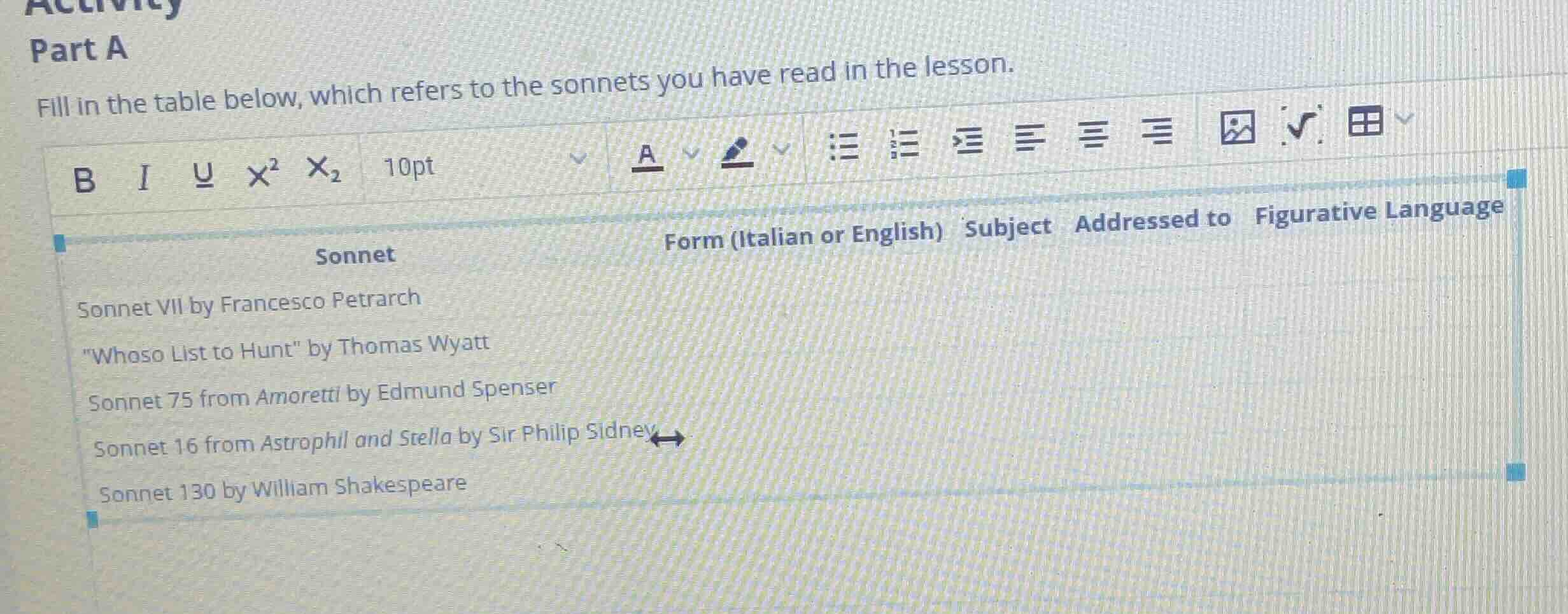
fill in the table below, which refers to the sonnets you have read in the lesson.
sonnet | form (italian or english) | subject | addressed to | figurative language
sonnet vii by francesco petrarch | | | |
\whoso list to hunt\ by thomas wyatt | | | |
sonnet 75 from amoretti by edmund spenser | | | |
sonnet 16 from astrophil and stella by sir philip sidney | | | |
sonnet 130 by william shakespeare | | | |
To fill in the table, we analyze each sonnet:
1. Sonnet VII by Francesco Petrarch
- Form: Italian (Petrarchan sonnet, 14 lines: octave + sestet).
- Subject: Love, time, mortality (reflects on love and the passage of time).
- Addressed to: The poet’s beloved (Laura, in Petrarch’s works).
- Figurative Language: Metaphors (e.g., love as a force), personification (time, love personified).
2. "Whoso List to Hunt" by Thomas Wyatt
- Form: Italian (Petrarchan structure, adapted).
- Subject: Unrequited love, the impossibility of pursuit (using a hunting metaphor).
- Addressed to: A beloved (implied, likely a courtly love object).
- Figurative Language: Extended metaphor (hunting a deer as love pursuit), allusion (to a royal “buck” with a collar).
3. Sonnet 75 from Amoretti by Edmund Spenser
- Form: English (Spenserian sonnet: 14 lines, 3 quatrains + couplet, interlocking rhyme).
- Subject: Love’s immortality (the poet’s attempt to immortalize love through poetry).
- Addressed to: The poet’s beloved (Elizabeth Boyle).
- Figurative Language: Metaphor (love as a permanent mark), personification (time as a destroyer).
4. Sonnet 16 from Astrophil and Stella by Sir Philip Sidney
- Form: English (Petrarchan influence, 14 lines: 3 quatrains + couplet).
- Subject: Love’s conflict (desire vs. reason, or love for Stella).
- Addressed to: Stella (the poet’s beloved).
- Figurative Language: Metaphors (love as a battle, heart as a fortress), personification (love, reason as characters).
5. Sonnet 130 by William Shakespeare
- Form: English (Shakespearean sonnet: 3 quatrains + couplet).
- Subject: Realistic love (rejecting idealized beauty, celebrating genuine affection).
- Addressed to: The poet’s mistress (implied, a real woman).
- Figurative Language: Irony (subverting Petrarchan beauty clichés), simile (e.g., “My mistress’ eyes are nothing like the sun”).
Filled Table (Example):
| Sonnet | Form (Italian or English) | Subject | Addressed to | Figurative Language |
|---|---|---|---|---|
| "Whoso List to Hunt" by Thomas Wyatt | Italian | Unrequited love, pursuit | Beloved (courtly) | Extended metaphor, allusion |
| Sonnet 75 from Amoretti by Edmund Spenser | English | Love’s immortality | Elizabeth Boyle | Metaphor, personification |
| Sonnet 16 from Astrophil and Stella by Sir Philip Sidney | English | Love’s conflict | Stella | Metaphors, personification |
| Sonnet 130 by William Shakespeare | English | Realistic love | Mistress | Irony, simile |
This table synthesizes the key elements of each sonnet based on literary analysis.

Snap & solve any problem in the app
Get step-by-step solutions on Sovi AI
Photo-based solutions with guided steps
Explore more problems and detailed explanations
To fill in the table, we analyze each sonnet:
1. Sonnet VII by Francesco Petrarch
- Form: Italian (Petrarchan sonnet, 14 lines: octave + sestet).
- Subject: Love, time, mortality (reflects on love and the passage of time).
- Addressed to: The poet’s beloved (Laura, in Petrarch’s works).
- Figurative Language: Metaphors (e.g., love as a force), personification (time, love personified).
2. "Whoso List to Hunt" by Thomas Wyatt
- Form: Italian (Petrarchan structure, adapted).
- Subject: Unrequited love, the impossibility of pursuit (using a hunting metaphor).
- Addressed to: A beloved (implied, likely a courtly love object).
- Figurative Language: Extended metaphor (hunting a deer as love pursuit), allusion (to a royal “buck” with a collar).
3. Sonnet 75 from Amoretti by Edmund Spenser
- Form: English (Spenserian sonnet: 14 lines, 3 quatrains + couplet, interlocking rhyme).
- Subject: Love’s immortality (the poet’s attempt to immortalize love through poetry).
- Addressed to: The poet’s beloved (Elizabeth Boyle).
- Figurative Language: Metaphor (love as a permanent mark), personification (time as a destroyer).
4. Sonnet 16 from Astrophil and Stella by Sir Philip Sidney
- Form: English (Petrarchan influence, 14 lines: 3 quatrains + couplet).
- Subject: Love’s conflict (desire vs. reason, or love for Stella).
- Addressed to: Stella (the poet’s beloved).
- Figurative Language: Metaphors (love as a battle, heart as a fortress), personification (love, reason as characters).
5. Sonnet 130 by William Shakespeare
- Form: English (Shakespearean sonnet: 3 quatrains + couplet).
- Subject: Realistic love (rejecting idealized beauty, celebrating genuine affection).
- Addressed to: The poet’s mistress (implied, a real woman).
- Figurative Language: Irony (subverting Petrarchan beauty clichés), simile (e.g., “My mistress’ eyes are nothing like the sun”).
Filled Table (Example):
| Sonnet | Form (Italian or English) | Subject | Addressed to | Figurative Language |
|---|---|---|---|---|
| "Whoso List to Hunt" by Thomas Wyatt | Italian | Unrequited love, pursuit | Beloved (courtly) | Extended metaphor, allusion |
| Sonnet 75 from Amoretti by Edmund Spenser | English | Love’s immortality | Elizabeth Boyle | Metaphor, personification |
| Sonnet 16 from Astrophil and Stella by Sir Philip Sidney | English | Love’s conflict | Stella | Metaphors, personification |
| Sonnet 130 by William Shakespeare | English | Realistic love | Mistress | Irony, simile |
This table synthesizes the key elements of each sonnet based on literary analysis.