QUESTION IMAGE
Question
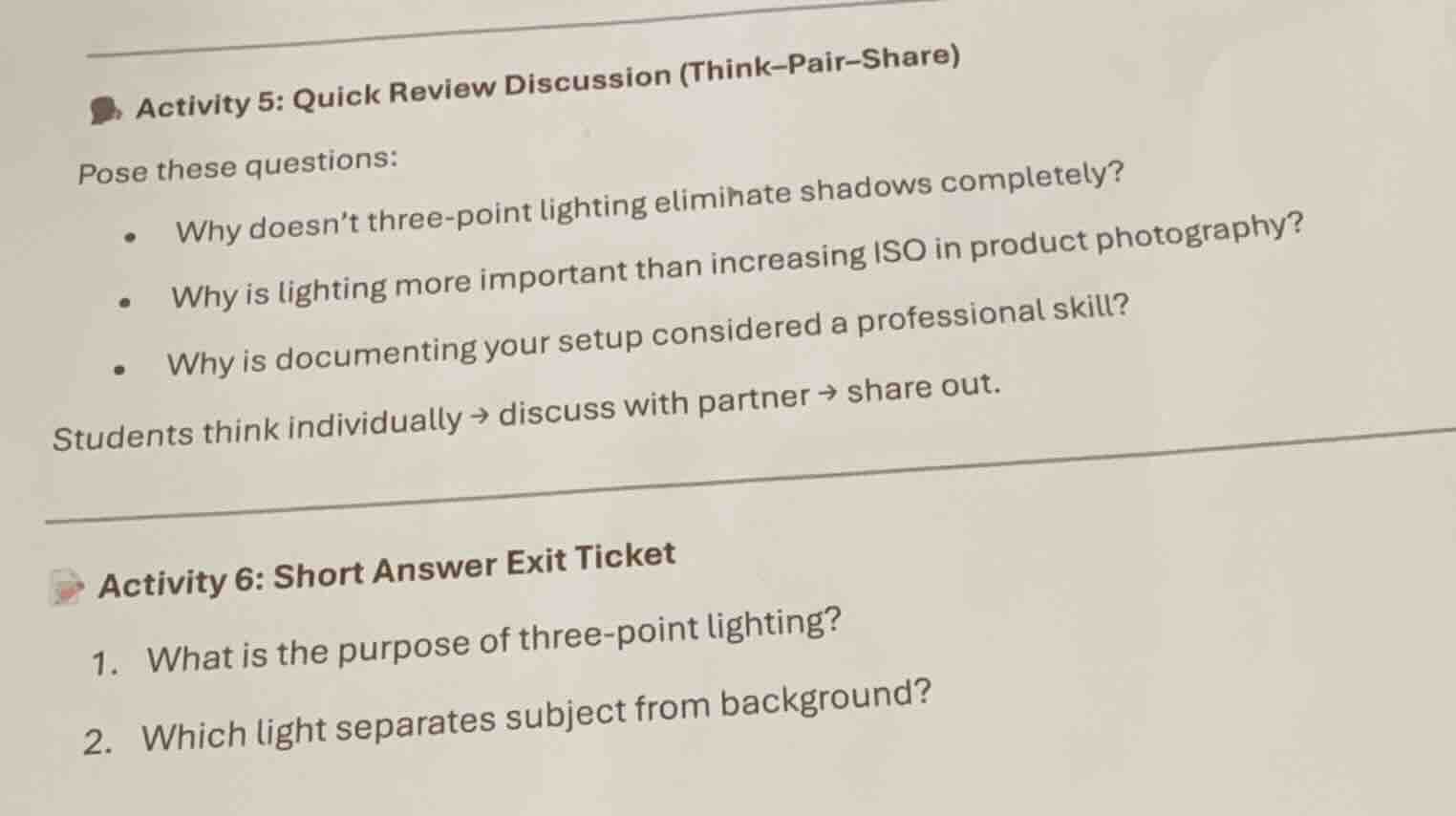
activity 5: quick review discussion (think-pair-share)
pose these questions:
- why doesnt three-point lighting eliminate shadows completely?
- why is lighting more important than increasing iso in product photography?
- why is documenting your setup considered a professional skill?
students think individually → discuss with partner → share out.
activity 6: short answer exit ticket
- what is the purpose of three-point lighting?
- which light separates subject from background?
Brief Explanations
For Activity 5 Questions:
- Three-point lighting uses key, fill, and backlights, but intentional subtle shadows are kept to create depth, dimension, and form for the subject; eliminating all shadows would make the subject look flat and unnatural.
- Increasing ISO introduces digital noise/grain, which degrades image quality, while proper lighting creates clean, sharp, well-exposed product photos with accurate color and detail, which is critical for showcasing products effectively.
- Documenting setups allows for consistent replication of successful shots, helps troubleshoot issues, and enables knowledge sharing with a team, ensuring reliability and professionalism in workflow.
For Activity 6 Questions:
- Three-point lighting's core purpose is to create balanced, dimensional lighting for a subject, reducing harsh shadows while adding depth, highlighting key features, and making the subject look polished and defined.
- The backlight (rim light) creates a subtle outline around the subject, separating it from the background so it does not blend in.

Snap & solve any problem in the app
Get step-by-step solutions on Sovi AI
Photo-based solutions with guided steps
Explore more problems and detailed explanations
Activity 5 Answers:
- To retain subject depth/shape; full shadow elimination makes subjects flat.
- Higher ISO causes image noise; good lighting ensures clear, sharp product shots.
- Enables consistent shot replication and efficient workflow/team collaboration.
Activity 6 Answers:
- To create balanced, dimensional lighting for a subject, adding depth and reducing harsh shadows while highlighting key features.
- Backlight (rim light)