QUESTION IMAGE
Question
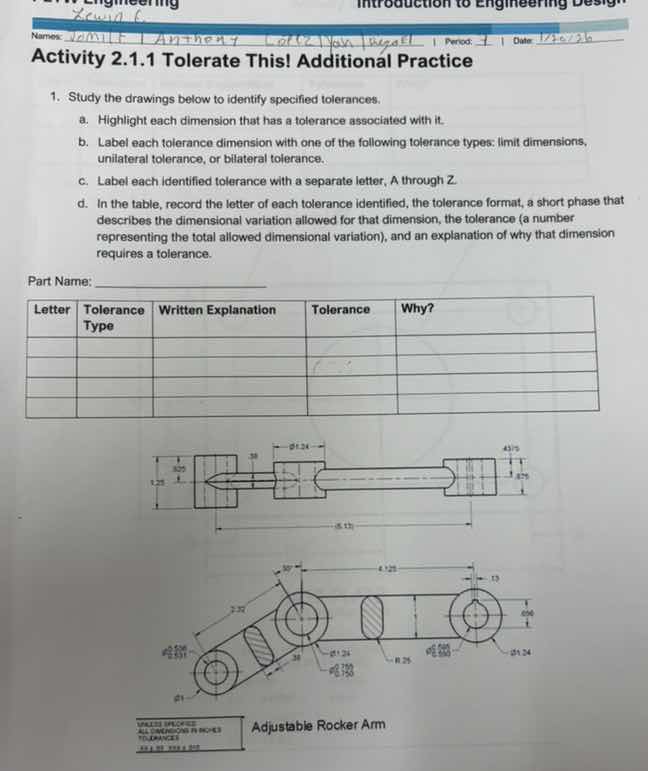
activity 2.1.1 tolerate this! additional practice
- study the drawings below to identify specified tolerances.
a. highlight each dimension that has a tolerance associated with it.
b. label each tolerance dimension with one of the following tolerance types: limit dimensions, unilateral tolerance, or bilateral tolerance.
c. label each identified tolerance with a separate letter, a through z.
d. in the table, record the letter of each tolerance identified, the tolerance format, a short phase that describes the dimensional variation allowed for that dimension, the tolerance (a number representing the total allowed dimensional variation), and an explanation of why that dimension requires a tolerance.
part name:
| letter | tolerance type | written explanation | tolerance | why? |
|---|---|---|---|---|
adjustable rocker arm
To solve this problem related to identifying tolerances in engineering drawings, we follow these steps:
Step 1: Identify Dimensions with Tolerances
Look at each dimension in the "Adjustable Rocker Arm" drawing. Dimensions with tolerances will have a range (e.g., \( \phi 1.25 \pm 0.01 \)) or a limit (e.g., \( 0.500 - 0.502 \)) or a unilateral tolerance (e.g., \( 4.25 + 0.00 / -0.01 \)). For example:
- \( \phi 1.25 \pm 0.01 \) (bilateral)
- \( 0.500 - 0.502 \) (limit dimensions)
- \( 4.25 + 0.00 / -0.01 \) (unilateral)
- \( \phi 1.34 \) (if it has a tolerance, check the drawing)
- \( 2.72 \) (if it has a tolerance, check the drawing)
- \( 0.125 \) (if it has a tolerance, check the drawing)
- \( 0.25 \) (if it has a tolerance, check the drawing)
- \( 4.375 \) (if it has a tolerance, check the drawing)
- \( 0.50 \) (if it has a tolerance, check the drawing)
- \( 0.600 \) (if it has a tolerance, check the drawing)
- \( 0.375 \) (if it has a tolerance, check the drawing)
- \( 0.125 \) (another instance, if any)
Step 2: Classify Tolerance Types
- Limit Dimensions: A dimension with a minimum and maximum value (e.g., \( 0.500 - 0.502 \)). The dimension must be between these two values.
- Unilateral Tolerance: A tolerance where the variation is only in one direction (e.g., \( 4.25 + 0.00 / -0.01 \) – only negative variation allowed, or \( 0.50 + 0.02 / -0.00 \) – only positive variation allowed).
- Bilateral Tolerance: A tolerance where the variation is in both directions (e.g., \( \phi 1.25 \pm 0.01 \) – variation of \( +0.01 \) and \( -0.01 \) from the nominal value).
Step 3: Label with Letters (A to Z)
Assign a unique letter (A, B, C, etc.) to each identified tolerance dimension. For example:
- Let’s take the dimension \( \phi 1.25 \pm 0.01 \): Label it as "A".
- The dimension \( 0.500 - 0.502 \): Label it as "B".
- The dimension \( 4.25 + 0.00 / -0.01 \): Label it as "C".
- And so on for other tolerance dimensions.
Step 4: Record in the Table
For each letter (tolerance), record:
- Tolerance Type: Limit, Unilateral, or Bilateral.
- Written Explanation: A short phrase describing the dimensional variation. For example, for \( \phi 1.25 \pm 0.01 \), the explanation could be "Diameter can vary by ±0.01 from 1.25".
- Tolerance (Total Variation): For limit dimensions, it’s \( \text{Max} - \text{Min} \) (e.g., \( 0.502 - 0.500 = 0.002 \)). For unilateral, it’s the absolute value of the single variation (e.g., \( 0 - (-0.01) = 0.01 \) for \( 4.25 + 0.00 / -0.01 \)). For bilateral, it’s \( 2 \times \text{variation} \) (e.g., \( 2 \times 0.01 = 0.02 \) for \( \phi 1.25 \pm 0.01 \)).
- Why?: Explain why the dimension requires a tolerance (e.g., "To ensure proper fit with mating components", "To account for manufacturing variations", etc.).
Example Table Entry
| Letter | Tolerance Type | Written Explanation | Tolerance (Total Variation) | Why? |
|---|---|---|---|---|
| B | Limit | Dimension between 0.500 and 0.502 | 0.002 | To control thickness for functionality |
| C | Unilateral | Length varies by -0.01 from 4.25 | 0.01 | To ensure clearance with adjacent part |
Final Answer
The final answer involves completing the table with the identified tolerances, their types, explanations, total variation, and reasons. The specific entries will depend on the detailed dimensions in the provided "Adjustable Rocker Arm"…

Snap & solve any problem in the app
Get step-by-step solutions on Sovi AI
Photo-based solutions with guided steps
Explore more problems and detailed explanations
To solve this problem related to identifying tolerances in engineering drawings, we follow these steps:
Step 1: Identify Dimensions with Tolerances
Look at each dimension in the "Adjustable Rocker Arm" drawing. Dimensions with tolerances will have a range (e.g., \( \phi 1.25 \pm 0.01 \)) or a limit (e.g., \( 0.500 - 0.502 \)) or a unilateral tolerance (e.g., \( 4.25 + 0.00 / -0.01 \)). For example:
- \( \phi 1.25 \pm 0.01 \) (bilateral)
- \( 0.500 - 0.502 \) (limit dimensions)
- \( 4.25 + 0.00 / -0.01 \) (unilateral)
- \( \phi 1.34 \) (if it has a tolerance, check the drawing)
- \( 2.72 \) (if it has a tolerance, check the drawing)
- \( 0.125 \) (if it has a tolerance, check the drawing)
- \( 0.25 \) (if it has a tolerance, check the drawing)
- \( 4.375 \) (if it has a tolerance, check the drawing)
- \( 0.50 \) (if it has a tolerance, check the drawing)
- \( 0.600 \) (if it has a tolerance, check the drawing)
- \( 0.375 \) (if it has a tolerance, check the drawing)
- \( 0.125 \) (another instance, if any)
Step 2: Classify Tolerance Types
- Limit Dimensions: A dimension with a minimum and maximum value (e.g., \( 0.500 - 0.502 \)). The dimension must be between these two values.
- Unilateral Tolerance: A tolerance where the variation is only in one direction (e.g., \( 4.25 + 0.00 / -0.01 \) – only negative variation allowed, or \( 0.50 + 0.02 / -0.00 \) – only positive variation allowed).
- Bilateral Tolerance: A tolerance where the variation is in both directions (e.g., \( \phi 1.25 \pm 0.01 \) – variation of \( +0.01 \) and \( -0.01 \) from the nominal value).
Step 3: Label with Letters (A to Z)
Assign a unique letter (A, B, C, etc.) to each identified tolerance dimension. For example:
- Let’s take the dimension \( \phi 1.25 \pm 0.01 \): Label it as "A".
- The dimension \( 0.500 - 0.502 \): Label it as "B".
- The dimension \( 4.25 + 0.00 / -0.01 \): Label it as "C".
- And so on for other tolerance dimensions.
Step 4: Record in the Table
For each letter (tolerance), record:
- Tolerance Type: Limit, Unilateral, or Bilateral.
- Written Explanation: A short phrase describing the dimensional variation. For example, for \( \phi 1.25 \pm 0.01 \), the explanation could be "Diameter can vary by ±0.01 from 1.25".
- Tolerance (Total Variation): For limit dimensions, it’s \( \text{Max} - \text{Min} \) (e.g., \( 0.502 - 0.500 = 0.002 \)). For unilateral, it’s the absolute value of the single variation (e.g., \( 0 - (-0.01) = 0.01 \) for \( 4.25 + 0.00 / -0.01 \)). For bilateral, it’s \( 2 \times \text{variation} \) (e.g., \( 2 \times 0.01 = 0.02 \) for \( \phi 1.25 \pm 0.01 \)).
- Why?: Explain why the dimension requires a tolerance (e.g., "To ensure proper fit with mating components", "To account for manufacturing variations", etc.).
Example Table Entry
| Letter | Tolerance Type | Written Explanation | Tolerance (Total Variation) | Why? |
|---|---|---|---|---|
| B | Limit | Dimension between 0.500 and 0.502 | 0.002 | To control thickness for functionality |
| C | Unilateral | Length varies by -0.01 from 4.25 | 0.01 | To ensure clearance with adjacent part |
Final Answer
The final answer involves completing the table with the identified tolerances, their types, explanations, total variation, and reasons. The specific entries will depend on the detailed dimensions in the provided "Adjustable Rocker Arm" drawing.