QUESTION IMAGE
Question
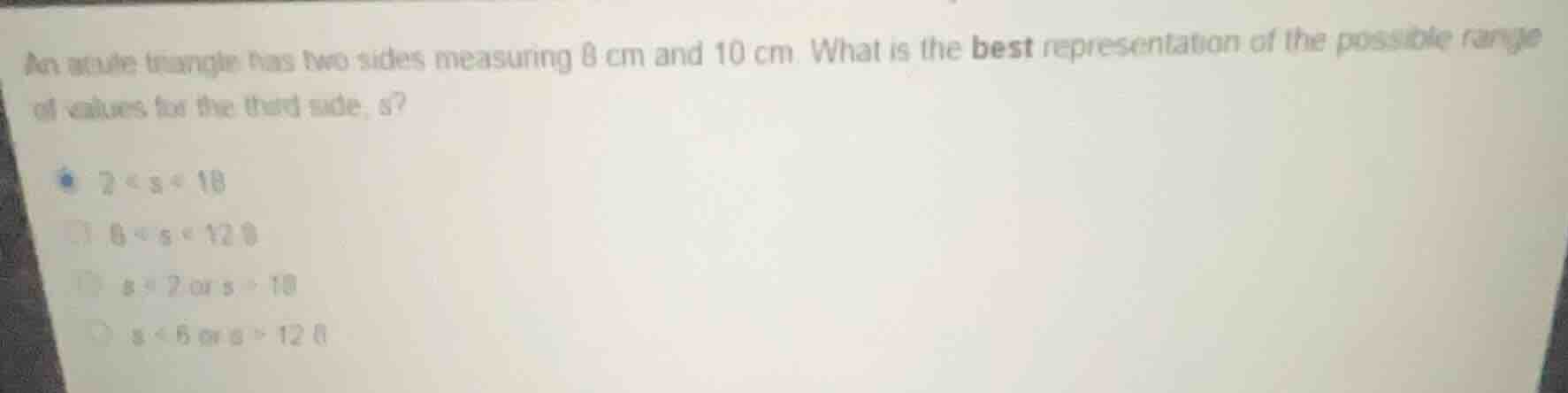
an acute triangle has two sides measuring 8 cm and 10 cm. what is the best representation of the possible range of values for the third side, s?
- ( 2 < s < 10 )
- ( 6 < s < 12.8 )
- ( s < 2 ) or ( s > 10 )
- ( s < 6 ) or ( s > 12.8 )
Step1: Recall Triangle Inequality Theorem
For any triangle, the sum of the lengths of any two sides must be greater than the length of the remaining side. Also, for an acute triangle, we use the Pythagorean inequality. Let's first apply the basic triangle inequality. The difference between the two given sides is \(10 - 8=2\) and the sum is \(10 + 8 = 18\). So by triangle inequality, \(2
First, basic triangle inequality: for a triangle with sides \(a,b,c\), \(|a - b| Case 1: \(s\) is the longest side (\(s\geq10\)): Then \(8^{2}+10^{2}>s^{2}\), \(64 + 100>s^{2}\), \(s^{2}<164\), \(s<\sqrt{164}\approx12.8\). Case 2: \(10\) is the longest side (\(s < 10\)): Then \(8^{2}+s^{2}>10^{2}\), \(64+s^{2}>100\), \(s^{2}>36\), \(s > 6\). Combining these two cases with the basic triangle inequality, we get \(6 < s < 12.8\). But the first option is \(2 < s < 18\) (which is the basic triangle inequality range). Wait, maybe the question has a typo or I misread. Wait, the original options: the first option is \(2 < s < 18\), the second is \(6 < s < 12.8\), the third is \(s < 2\) or \(s>18\), the fourth is \(s < 6\) or \(s>12.8\). Wait, the basic triangle inequality gives \(2 < s < 18\) (since the sum of two sides must be greater than the third, and the difference must be less than the third). The other options: \(s < 2\) or \(s>18\) would not form a triangle. \(s < 6\) or \(s>12.8\) is for non - acute (obtuse) or non - triangle. The option \(6 < s < 12.8\) is for acute, but the first option \(2 < s < 18\) is the range for a valid triangle (including acute, right, and obtuse). But the question says "an acute triangle", but maybe the options are mis - printed. Wait, maybe the first option is the triangle inequality range (valid triangle), and the others are for acute or obtuse. Wait, no, the question is asking for the possible range of the third side for an acute triangle. But let's check the options again. Wait, the first option is \(2 < s < 18\), which is the range for a triangle (by triangle inequality). The option \(s < 2\) or \(s>18\) would not form a triangle (since the sum of two sides must be greater than the third). The option \(s < 6\) or \(s>12.8\) would be for obtuse triangles (because if \(s < 6\), then \(8^{2}+s^{2}<10^{2}\) (obtuse with 10 as the longest side), and if \(s>12.8\), then \(8^{2}+10^{2} Wait, maybe the options are:

Snap & solve any problem in the app
Get step-by-step solutions on Sovi AI
Photo-based solutions with guided steps
Explore more problems and detailed explanations
B. \(6 < s < 12.8\)