QUESTION IMAGE
Question
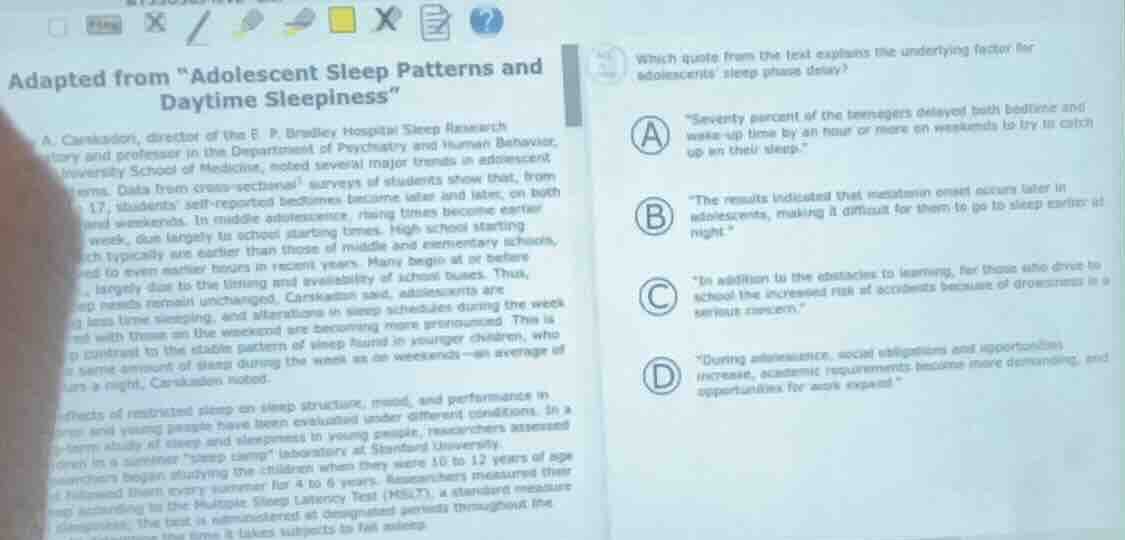
adapted from \adolescent sleep patterns and daytime sleepiness\
a. carskadon, director of the e. p. bradley hospital sleep research center and professor in the department of psychiatry and human behavior, university school of medicine, noted several major trends in adolescent sleep. data from cross - sectional surveys of students show that, from age 11, students self - reported bedtimes become later and later, on both school nights and weekends. in middle adolescence, rising times become earlier on school days, but are later than those of middle and elementary schoolers, which typically are earlier than those of preteens. many begin to feel tired, largely due to the timing and availability of school buses. thus, sleep needs dont unchanged, carskadon said, adolescents during the week get less time sleeping, and alterations to sleep schedules during the week and on weekends are becoming more pronounced. this is in contrast to the sleep pattern of much younger children, who have a similar amount of sleep during the week as on weekends — an average of 9.5 hours a night, carskadon noted.
effects of restricted sleep on sleep structure, mood, and performance in children and young people have been evaluated under different conditions. in a long - term study of sleep and sleepiness in young people, researchers assessed growth in a summer \sleep camp\ laboratory at stanford university. researchers began studying the children when they were 10 to 12 years of age and followed them every summer for 4 to 6 years. researchers measured them according to the multiple sleep latency test (mslt), a standard measure of sleepiness. the test is administered at designated intervals throughout the...
which quote from the text explains the underlying factor for adolescents sleep phase delay?
a \seventy percent of the teenagers delayed both bedtimes and wake - up time by an hour or more on weekends to try to catch up on their sleep.\
b \the results indicated that melatonin onset occurs later in adolescents, making it difficult for them to go to sleep earlier at night.\
c \in addition to the obstacles to learning, for those who drive to school the increased risk of accidents because of drowsiness is a serious concern.\
d \during adolescence, social obligations and opportunities increase, academic requirements become more demanding, and opportunities for work expand.\
To solve this, we analyze each option in the context of the question (finding the quote explaining the underlying factor for adolescents' sleep phase delay):
- Option A: Talks about teenagers delaying bedtimes/ wake - up times on weekends to catch up on sleep. This describes a behavior to compensate for sleep loss, not the underlying factor for sleep phase delay.
- Option B: States that melatonin onset (a key factor in sleep - wake cycles) occurs later in adolescents. Melatonin's timing affects when one feels sleepy. A later melatonin onset makes it hard for them to fall asleep early, which is the underlying biological factor for the sleep phase delay.
- Option C: Discusses the consequences of sleepiness (like learning obstacles and accident risks), not the underlying factor for the sleep phase delay.
- Option D: Mentions social and academic changes in adolescence (more social obligations, academic demands, etc.). These are external factors, but the question is about the underlying (likely biological) factor for sleep phase delay, and this option doesn't address that.

Snap & solve any problem in the app
Get step-by-step solutions on Sovi AI
Photo-based solutions with guided steps
Explore more problems and detailed explanations
B. "The results indicated that melatonin onset occurs later in adolescents, making it difficult for them to go to sleep earlier at night."