QUESTION IMAGE
Question
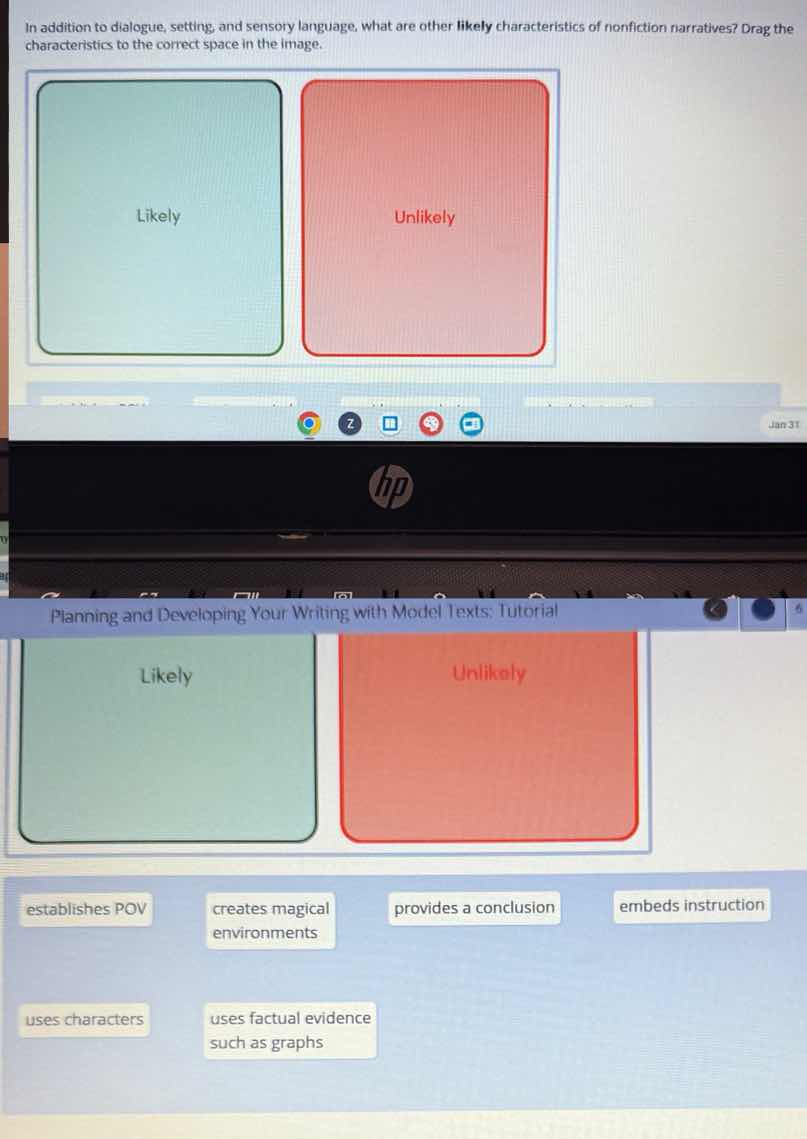
in addition to dialogue, setting, and sensory language, what are other likely characteristics of nonfiction narratives? drag the characteristics to the correct space in the image. likely unlikely planning and developing your writing with model texts: tutorial likely unlikely establishes pov creates magical environments provides a conclusion embeds instruction uses characters uses factual evidence such as graphs
Brief Explanations
To determine the likely and unlikely characteristics of nonfiction narratives, we analyze each option:
- Likely Characteristics (Nonfiction Narratives):
- establishes POV: Nonfiction often has a clear point of view (e.g., author’s perspective in an essay or report).
- provides a conclusion: Nonfiction texts typically wrap up with a conclusion to summarize or finalize the content.
- uses factual evidence such as graphs: Nonfiction relies on facts, and using graphs (or other data) to support claims is common (e.g., in reports, articles).
- uses characters: Nonfiction can include real - life characters (e.g., in biographies, case studies).
- embeds instruction: Some nonfiction (e.g., how - to guides, educational texts) embeds instructions.
- Unlikely Characteristics (Nonfiction Narratives):
- creates magical environments: Magical environments are a key feature of fiction (especially fantasy), as nonfiction deals with real - world or factual content, not imaginary/magical settings.

Snap & solve any problem in the app
Get step-by-step solutions on Sovi AI
Photo-based solutions with guided steps
Explore more problems and detailed explanations
Likely:
- establishes POV
- provides a conclusion
- uses factual evidence such as graphs
- uses characters
- embeds instruction
Unlikely:
- creates magical environments