QUESTION IMAGE
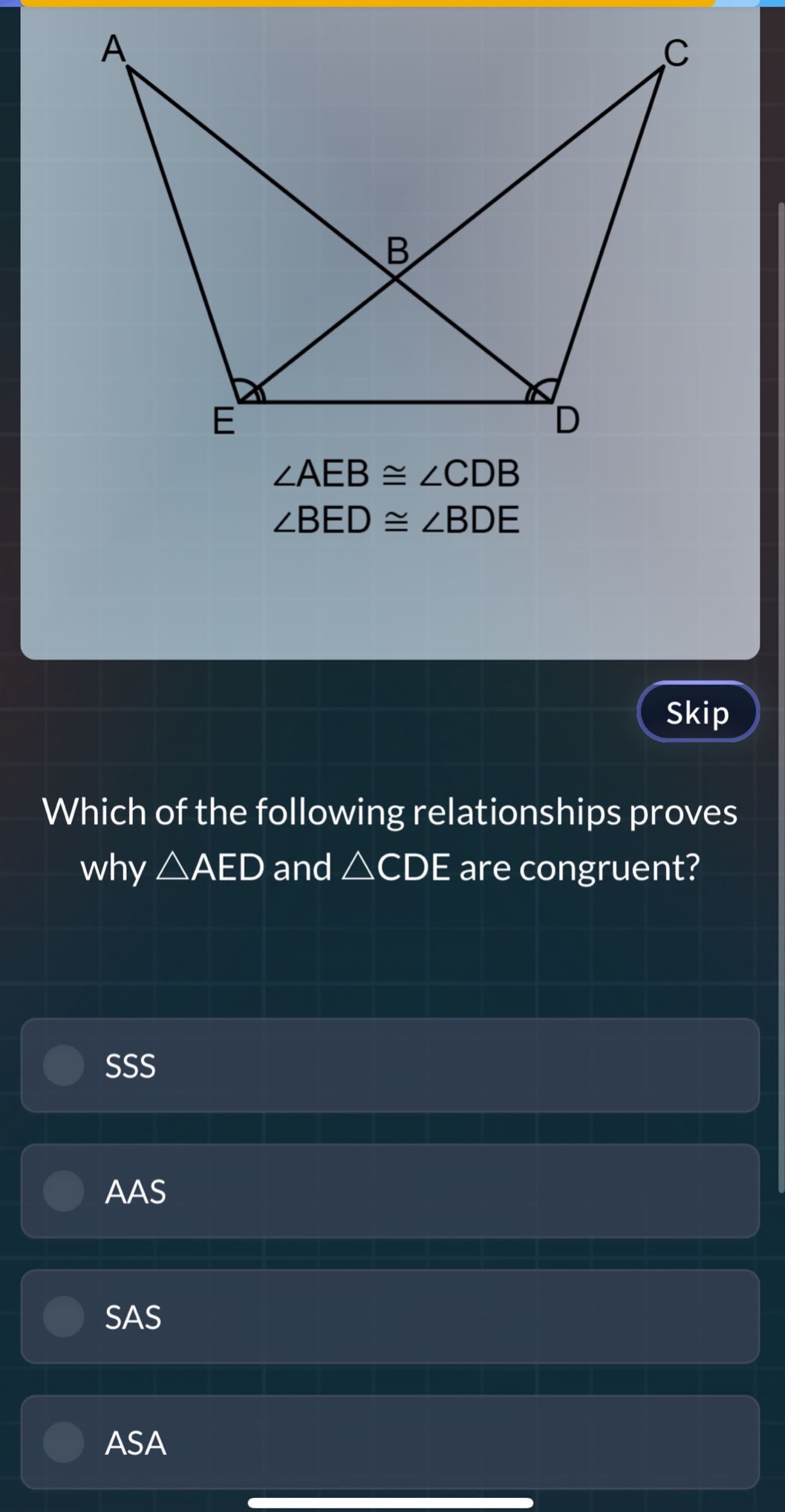
Question
∠aeb ≅ ∠cdb
∠bed ≅ ∠bde
which of the following relationships proves why △aed and △cde are congruent?
sss
aas
sas
asa
Brief Explanations
- First, analyze the given information: We know \( \angle AEB \cong \angle CDB \) and \( \angle BED \cong \angle BDE \). From \( \angle BED \cong \angle BDE \), triangle \( BED \) is isosceles, so \( BE = BD \). Also, \( ED \) is a common side to both \( \triangle AED \) and \( \triangle CDE \).
- Now, let's check the angles: \( \angle AED=\angle AEB + \angle BED \) and \( \angle CDE=\angle CDB+\angle BDE \). Since \( \angle AEB \cong \angle CDB \) and \( \angle BED \cong \angle BDE \), we have \( \angle AED\cong\angle CDE \).
- We also know \( ED = DE \) (common side) and from the isosceles triangle \( BED \), we can infer about the sides or use angle - side - angle. Wait, let's re - evaluate. Wait, actually, let's look at the triangles \( \triangle AED \) and \( \triangle CDE \):
- \( ED \) is common, so \( ED = DE \).
- We have \( \angle AED\cong\angle CDE \) (as shown above).
- Also, from \( \angle BED\cong\angle BDE \), we know that \( \triangle BED \) is isosceles, but more importantly, let's check the other angle. Wait, maybe a better approach: Let's consider the ASA (Angle - Side - Angle) criterion. The ASA criterion states that if two angles and the included side of one triangle are congruent to two angles and the included side of another triangle, the triangles are congruent.
- We have \( \angle AED\cong\angle CDE \), \( ED = DE \) (common side), and we can find another pair of angles. Wait, actually, let's correct: Wait, the triangles \( \triangle AED \) and \( \triangle CDE \):
- \( \angle ADE \) and \( \angle CED \): Wait, no. Wait, let's start over. We know that \( \angle BED\cong\angle BDE \), so \( BE = BD \). Also, \( \angle AEB\cong\angle CDB \), \( \angle ABE\cong\angle CBD \) (vertical angles). So \( \triangle ABE\cong\triangle CBD \) by AAS, which gives \( AE = CD \). Now, in \( \triangle AED \) and \( \triangle CDE \):
- \( AE = CD \) (from \( \triangle ABE\cong\triangle CBD \)).
- \( \angle AED=\angle CDE \) (as \( \angle AEB+\angle BED=\angle CDB + \angle BDE \)).
- \( ED = DE \) (common side).
- So by SAS (Side - Angle - Side), we have two sides and the included angle? Wait, no. Wait, \( AE = CD \), \( ED = DE \), and \( \angle AED=\angle CDE \). So the sides \( AE \) and \( ED \) with included angle \( \angle AED \) in \( \triangle AED \), and sides \( CD \) and \( DE \) with included angle \( \angle CDE \) in \( \triangle CDE \). So that's SAS. Wait, but let's check the options again. Wait, maybe I made a mistake. Wait, the other approach: The ASA (Angle - Side - Angle) criterion: If we have two angles and the included side. Let's see, \( \angle ADE \) and \( \angle CED \): No, maybe the correct way is:
- We know that \( \angle BED\cong\angle BDE \), so \( BE = BD \). Also, \( \angle AEB\cong\angle CDB \), \( \angle ABE\cong\angle CBD \) (vertical angles), so \( \triangle ABE\cong\triangle CBD \) (AAS), so \( AE = CD \). Now, in \( \triangle AED \) and \( \triangle CDE \):
- \( \angle AED=\angle AEB+\angle BED \), \( \angle CDE=\angle CDB + \angle BDE \). Since \( \angle AEB\cong\angle CDB \) and \( \angle BED\cong\angle BDE \), \( \angle AED\cong\angle CDE \).
- \( ED = DE \) (common side).
- \( AE = CD \) (from \( \triangle ABE\cong\triangle CBD \)).
- Wait, no, that's S - A - S? Wait, \( AE = CD \), \( \angle AED=\angle CDE \), \( ED = DE \). So the sides \( AE \) and \( ED \) with included angle \( \angle AED \) in \( \triangle AED \), and sides \( CD \) and \( DE \) with included angle \( \angle CDE \) in \( \triangl…

Snap & solve any problem in the app
Get step-by-step solutions on Sovi AI
Photo-based solutions with guided steps
Explore more problems and detailed explanations
SAS (the option with "SAS" text, e.g., if the option is labeled as "SAS" among the choices, then the answer is the option with "SAS")