QUESTION IMAGE
Question
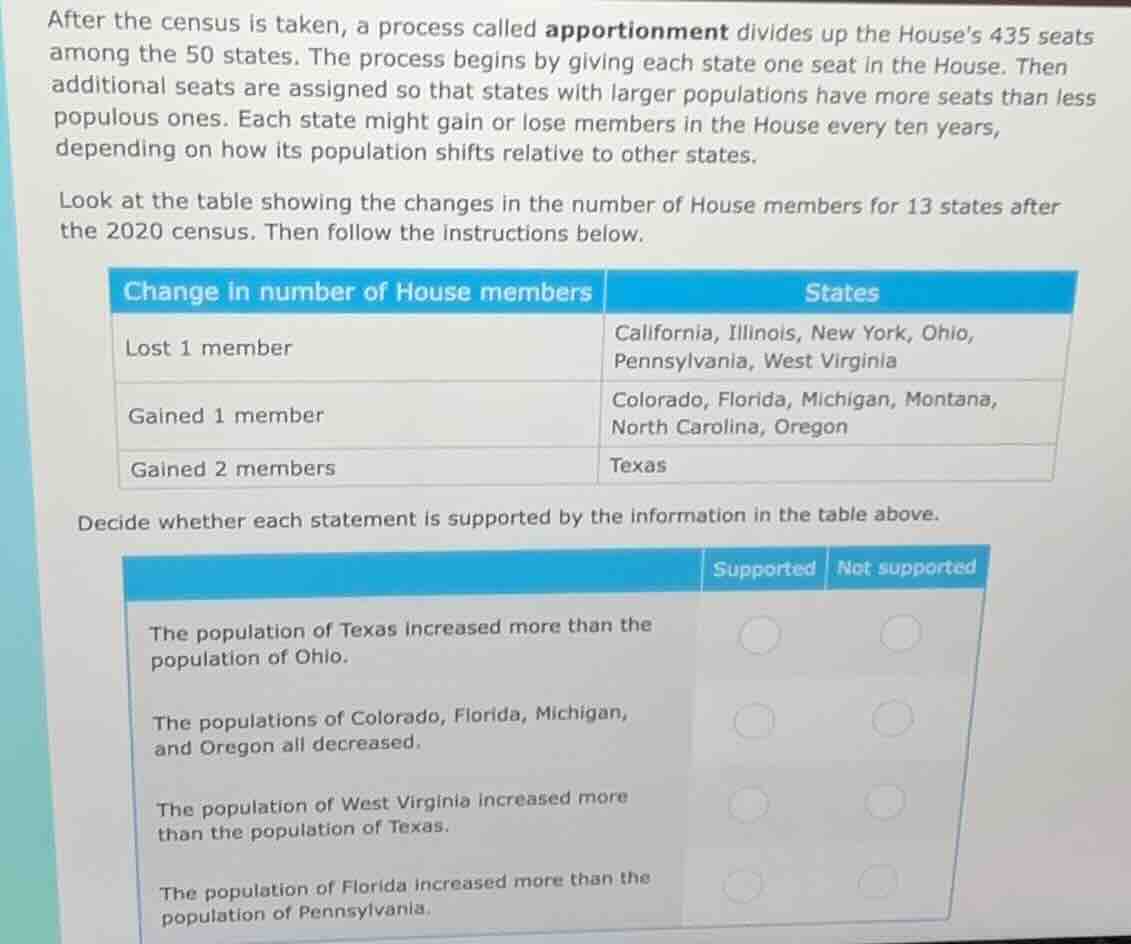
after the census is taken, a process called apportionment divides up the houses 435 seats among the 50 states. the process begins by giving each state one seat in the house. then additional seats are assigned so that states with larger populations have more seats than less populous ones. each state might gain or lose members in the house every ten years, depending on how its population shifts relative to other states. look at the table showing the changes in the number of house members for 13 states after the 2020 census. then follow the instructions below. table: change in number of house members vs states: lost 1 member - california, illinois, new york, ohio, pennsylvania, west virginia; gained 1 member - colorado, florida, michigan, montana, north carolina, oregon; gained 2 members - texas decide whether each statement is supported by the information in the table above. table: statements with supported/not supported columns: 1. the population of texas increased more than the population of ohio. 2. the populations of colorado, florida, michigan, and oregon all decreased. 3. the population of west virginia increased more than the population of texas. 4. the population of florida increased more than the population of pennsylvania.
- For the first statement: Texas gained 2 seats (population grew enough to earn more seats) while Ohio lost 1 seat (population shifted negatively relative to others). This means Texas's population increased more than Ohio's.
- For the second statement: Colorado, Florida, Michigan, and Oregon all gained 1 seat, which indicates their populations increased (not decreased) relative to other states to earn additional seats.
- For the third statement: West Virginia lost 1 seat (population declined/shifted negatively) while Texas gained 2 seats (population grew significantly). West Virginia's population did not increase more than Texas's.
- For the fourth statement: Florida gained 1 seat (population increased) while Pennsylvania lost 1 seat (population shifted negatively). This means Florida's population increased more than Pennsylvania's.

Snap & solve any problem in the app
Get step-by-step solutions on Sovi AI
Photo-based solutions with guided steps
Explore more problems and detailed explanations
- The population of Texas increased more than the population of Ohio.: Supported
- The populations of Colorado, Florida, Michigan, and Oregon all decreased.: Not supported
- The population of West Virginia increased more than the population of Texas.: Not supported
- The population of Florida increased more than the population of Pennsylvania.: Supported