QUESTION IMAGE
Question
ague of nations
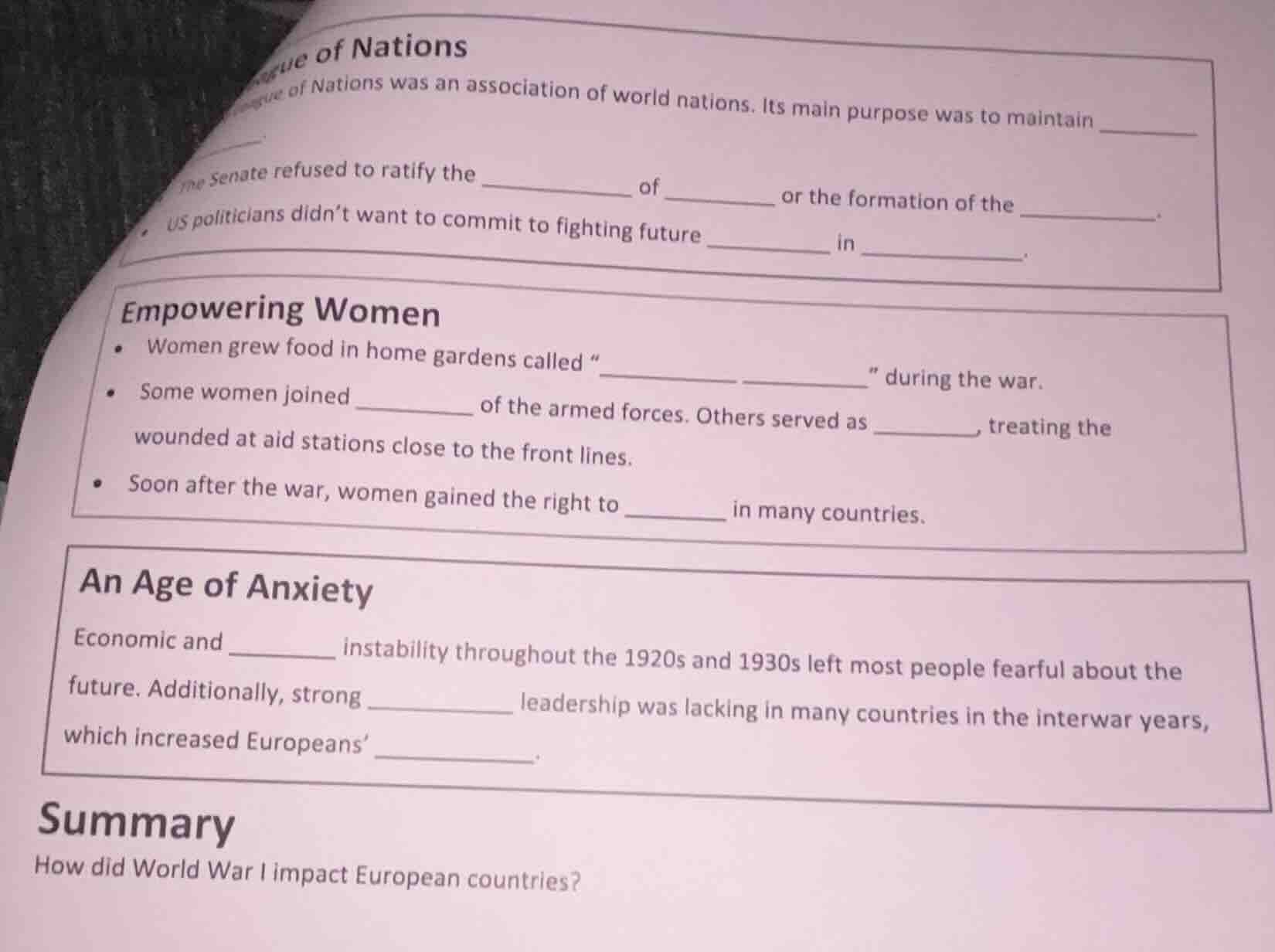
ague of nations was an association of world nations. its main purpose was to maintain ______
the senate refused to ratify the ________ of ___ or the formation of the _______.
us politicians didn’t want to commit to fighting future _______ in ________.
empowering women
women grew food in home gardens called “______ _____” during the war.
some women joined ______ of the armed forces. others served as ______, treating the wounded at aid stations close to the front lines.
soon after the war, women gained the right to _______ in many countries.
an age of anxiety
economic and ______ instability throughout the 1920s and 1930s left most people fearful about the future. additionally, strong ______ leadership was lacking in many countries in the interwar years, which increased europeans’ ________.
summary
how did world war i impact european countries?
League of Nations
- The League of Nations was an association of world nations. Its main purpose was to maintain world peace.
- The Senate refused to ratify the Treaty of Versailles or the formation of the League of Nations.
- US politicians didn’t want to commit to fighting future wars in Europe.
Empowering Women
- Women grew food in home gardens called “victory gardens” during the war.
- Some women joined branches of the armed forces. Others served as nurses, treating the wounded at aid stations close to the front lines.
- Soon after the war, women gained the right to vote in many countries.
An Age of Anxiety
- Economic and political instability throughout the 1920s and 1930s left most people fearful about the future. Additionally, strong democratic leadership was lacking in many countries in the interwar years, which increased Europeans’ anxiety.
Summary: How did World War I impact European countries?
World War I had profound impacts on European countries. Economically, it caused widespread destruction, debt, and inflation. Politically, it led to the collapse of empires (like the Austro - Hungarian, Ottoman, and Russian Empires), the rise of new nations, and political instability. Socially, it changed gender roles as women took on new responsibilities during the war and gained voting rights in many places. It also created a sense of anxiety due to economic and political turmoil in the interwar years, setting the stage for future conflicts and social changes.

Snap & solve any problem in the app
Get step-by-step solutions on Sovi AI
Photo-based solutions with guided steps
Explore more problems and detailed explanations
League of Nations
- The League of Nations was an association of world nations. Its main purpose was to maintain world peace.
- The Senate refused to ratify the Treaty of Versailles or the formation of the League of Nations.
- US politicians didn’t want to commit to fighting future wars in Europe.
Empowering Women
- Women grew food in home gardens called “victory gardens” during the war.
- Some women joined branches of the armed forces. Others served as nurses, treating the wounded at aid stations close to the front lines.
- Soon after the war, women gained the right to vote in many countries.
An Age of Anxiety
- Economic and political instability throughout the 1920s and 1930s left most people fearful about the future. Additionally, strong democratic leadership was lacking in many countries in the interwar years, which increased Europeans’ anxiety.
Summary: How did World War I impact European countries?
World War I had profound impacts on European countries. Economically, it caused widespread destruction, debt, and inflation. Politically, it led to the collapse of empires (like the Austro - Hungarian, Ottoman, and Russian Empires), the rise of new nations, and political instability. Socially, it changed gender roles as women took on new responsibilities during the war and gained voting rights in many places. It also created a sense of anxiety due to economic and political turmoil in the interwar years, setting the stage for future conflicts and social changes.