QUESTION IMAGE
Question
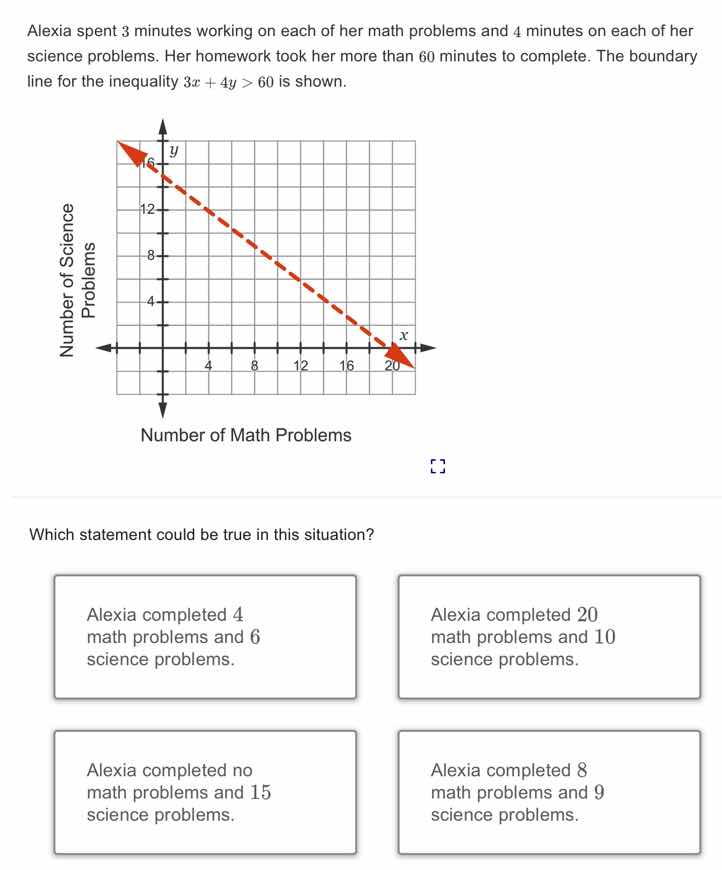
alexia spent 3 minutes working on each of her math problems and 4 minutes on each of her science problems. her homework took her more than 60 minutes to complete. the boundary line for the inequality ( 3x + 4y > 60 ) is shown.
graph: x-axis labeled number of math problems, y-axis labeled number of science problems, dashed line with arrows, y-intercept around 15, x-intercept 20
which statement could be true in this situation?
- alexia completed 4 math problems and 6 science problems.
- alexia completed 20 math problems and 10 science problems.
- alexia completed no math problems and 15 science problems.
- alexia completed 8 math problems and 9 science problems.
Step1: Analyze the first option
For \(x = 4\) (math problems) and \(y=6\) (science problems), substitute into \(3x + 4y\):
\(3(4)+4(6)=12 + 24=36\). Since \(36
ot>60\), this option is false.
Step2: Analyze the second option
For \(x = 20\) and \(y = 10\), substitute into \(3x+4y\):
\(3(20)+4(10)=60 + 40 = 100\). Since \(100>60\), we check if the point is in the solution region. But wait, the boundary line is dashed (since the inequality is \(>\), not \(\geq\)), but let's check the other options too. Wait, no, let's continue.
Step3: Analyze the third option
For \(x = 0\) and \(y=15\), substitute into \(3x + 4y\):
\(3(0)+4(15)=0+60 = 60\). Since the inequality is \(3x + 4y>60\), \(60\) is not greater than \(60\), so this option is false.
Step4: Analyze the fourth option
For \(x = 8\) and \(y = 9\), substitute into \(3x+4y\):
\(3(8)+4(9)=24 + 36=60\). Again, \(60\) is not greater than \(60\), so this is false? Wait, wait, no, wait the second option: \(x = 20\), \(y = 10\): \(3*20+4*10=60 + 40=100>60\). Wait, but let's check the graph. The boundary line is \(3x + 4y=60\), which has \(x\)-intercept at \(x = 20\) (when \(y = 0\)) and \(y\)-intercept at \(y = 15\) (when \(x = 0\)). The solution region is above the dashed line. Now, the second option: \(x = 20\), \(y = 10\): let's see the coordinates. The \(x\)-axis is number of math problems, \(y\)-axis is number of science problems. The point \((20,10)\): when \(x = 20\), the \(y\)-intercept of the line is \(15\), so \(y = 10\) is below the line? Wait, no, the line \(3x+4y=60\) can be rewritten as \(y=-\frac{3}{4}x + 15\). For \(x = 20\), \(y=-\frac{3}{4}(20)+15=-15 + 15=0\). Wait, I made a mistake earlier. Let's re - express the line correctly. \(3x+4y=60\) => \(4y=-3x + 60\) => \(y=-\frac{3}{4}x+15\). So when \(x = 20\), \(y = 0\). So the point \((20,10)\): \(y = 10\) when \(x = 20\), but according to the line, when \(x = 20\), \(y = 0\). So the point \((20,10)\) is above the line? Wait, no, the line at \(x = 20\) is at \(y = 0\), so \(y = 10\) is above. But let's recalculate the value: \(3*20+4*10=60 + 40=100>60\), so the inequality holds. Wait, but let's check the fourth option: \(x = 8\), \(y = 9\). \(3*8+4*9=24 + 36=60\), which is not greater than \(60\), so it's on the line (but the line is dashed, so not included). The third option: \(x = 0\), \(y = 15\): \(3*0+4*15=60\), which is equal to \(60\), not greater. The first option: \(3*4+4*6=36<60\). The second option: \(3*20+4*10=100>60\), so this satisfies the inequality \(3x + 4y>60\). Wait, but let's check the graph again. The \(y\)-axis is number of science problems, \(x\)-axis is number of math problems. The boundary line is from \((20,0)\) to \((0,15)\) (dashed). The solution region is above the line. The point \((20,10)\): let's see, when \(x = 20\), the line is at \(y = 0\), so \(y = 10\) is above the line (since \(y\) increases upwards). So the inequality \(3x + 4y>60\) is satisfied because \(100>60\). Wait, but earlier I thought maybe I made a mistake, but the calculation shows \(3x + 4y = 100>60\). The other options: first option: \(36<60\), third option: \(60\) (not greater), fourth option: \(60\) (not greater). So the second option is true.
Wait, no, wait the fourth option: \(x = 8\), \(y = 9\): \(3*8+4*9=24 + 36=60\), which is not greater than \(60\). The second option: \(3*20+4*10=100>60\), so it satisfies the inequality. So the correct option is the second one.

Snap & solve any problem in the app
Get step-by-step solutions on Sovi AI
Photo-based solutions with guided steps
Explore more problems and detailed explanations
Alexia completed 20 math problems and 10 science problems.