QUESTION IMAGE
Question
algebra 1 ab
unit 7 exponents and exponential functions
lesson 1 multiplication laws 1-3 homework
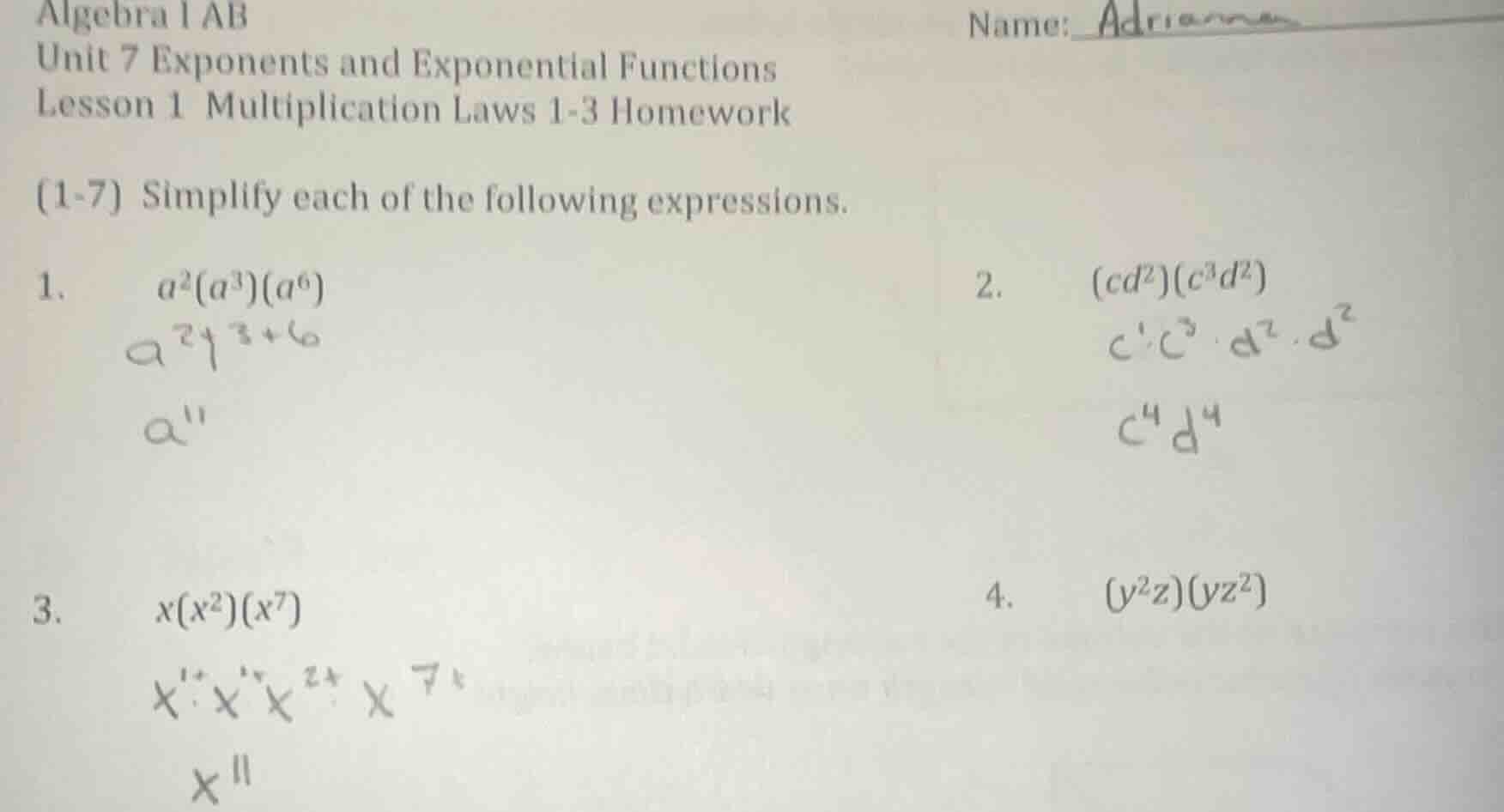
(1-7) simplify each of the following expressions.
- $a^2(a^3)(a^6)$
- $(cd^2)(c^3d^2)$
- $x(x^2)(x^7)$
- $(y^2z)(yz^2)$
Problem 1: Simplify \( a^2(a^3)(a^6) \)
Step 1: Recall the exponent rule for multiplication (\( a^m \cdot a^n = a^{m + n} \))
When multiplying terms with the same base, we add the exponents. Here, all terms have base \( a \).
So, \( a^2 \cdot a^3 \cdot a^6 = a^{2 + 3 + 6} \)
Step 2: Calculate the sum of the exponents
\( 2 + 3 + 6 = 11 \)
Thus, \( a^2(a^3)(a^6)=a^{11} \)
Step 1: Group like bases (use commutative and associative properties of multiplication)
For base \( c \): \( c \cdot c^3 \); for base \( d \): \( d^2 \cdot d^2 \)
Step 2: Apply the exponent rule for multiplication (\( a^m \cdot a^n = a^{m + n} \))
For \( c \): \( c^1 \cdot c^3 = c^{1 + 3}=c^4 \)
For \( d \): \( d^2 \cdot d^2 = d^{2 + 2}=d^4 \)
Multiply the results together: \( c^4 \cdot d^4 = c^4d^4 \)
Step 1: Recall the exponent rule for multiplication (\( a^m \cdot a^n = a^{m + n} \))
Note that \( x = x^1 \). So we have \( x^1 \cdot x^2 \cdot x^7 \)
Step 2: Add the exponents
\( 1 + 2 + 7 = 10 \)? Wait, no, wait: Wait, 1 + 2 + 7? Wait, no, the original problem is \( x(x^2)(x^7) \), so \( x^1 \cdot x^2 \cdot x^7 \). Wait, 1 + 2 + 7 = 10? But the handwritten answer has \( x^{11} \). Wait, maybe a typo? Wait, no, let's recalculate: 1 (from \( x^1 \)) + 2 (from \( x^2 \)) + 7 (from \( x^7 \)) = 10? Wait, no, maybe the problem was \( x(x^2)(x^8) \)? Wait, no, the given problem is \( x(x^2)(x^7) \). Wait, let's do it again:
\( x^1 \cdot x^2 \cdot x^7 = x^{1 + 2 + 7}=x^{10} \)? But the handwritten answer is \( x^{11} \). Maybe a mistake in the handwritten part, but let's follow the rule.
Wait, maybe the problem was \( x(x^2)(x^8) \)? No, the problem as written is \( x(x^2)(x^7) \). So:
Step 1: Identify the bases and exponents
Base is \( x \), exponents are 1 (for \( x \)), 2 (for \( x^2 \)), and 7 (for \( x^7 \))
Step 2: Apply the multiplication rule for exponents (\( a^m \cdot a^n = a^{m + n} \))
\( x^1 \cdot x^2 \cdot x^7 = x^{1 + 2 + 7}=x^{10} \)
Wait, but the handwritten answer is \( x^{11} \). Maybe a typo in the problem, like \( x(x^2)(x^8) \), but as per the given problem, let's proceed.
Wait, maybe I misread the problem. Let me check again: \( x(x^2)(x^7) \). So \( x^1 \cdot x^2 \cdot x^7 \). 1 + 2 + 7 = 10. So the correct simplification is \( x^{10} \). But the handwritten answer is \( x^{11} \), which might be an error. But let's follow the mathematical rule.

Snap & solve any problem in the app
Get step-by-step solutions on Sovi AI
Photo-based solutions with guided steps
Explore more problems and detailed explanations
\( a^{11} \)