QUESTION IMAGE
Question
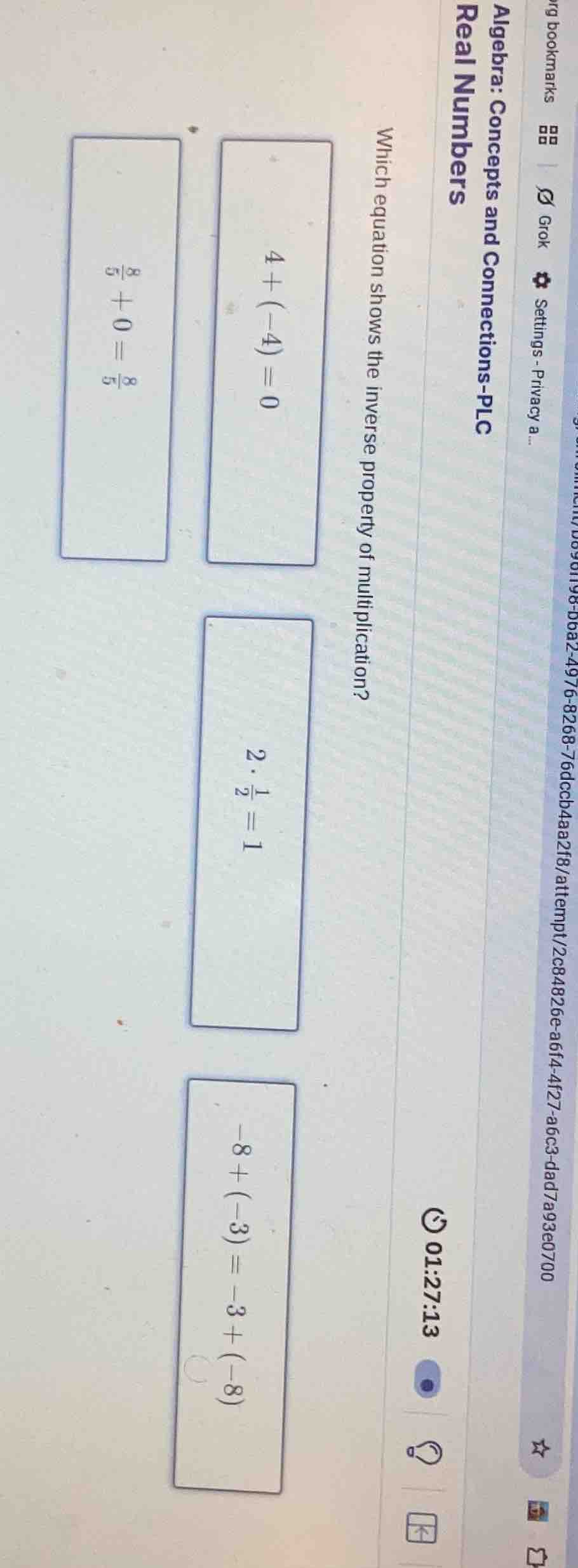
algebra: concepts and connections - plc real numbers which equation shows the inverse property of multiplication? \\(4 + (-4) = 0\\) \\(\frac{8}{5} + 0 = \frac{8}{5}\\) \\(2 \cdot \frac{1}{2} = 1\\) \\(-8 + (-3) = -3 + (-8)\\)
Brief Explanations
The inverse property of multiplication states that a number multiplied by its multiplicative inverse (reciprocal) equals 1. Let's analyze each option:
- $4 + (-4) = 0$: This is the additive inverse property (sum of a number and its additive inverse is 0).
- $\frac{8}{5} + 0 = \frac{8}{5}$: This is the additive identity property (adding 0 to a number leaves it unchanged).
- $2 \cdot \frac{1}{2} = 1$: Here, 2 is multiplied by its reciprocal $\frac{1}{2}$, resulting in 1, which matches the multiplicative inverse property.
- $-8 + (-3) = -3 + (-8)$: This is the commutative property of addition (order of addition does not change the sum).

Snap & solve any problem in the app
Get step-by-step solutions on Sovi AI
Photo-based solutions with guided steps
Explore more problems and detailed explanations
$2 \cdot \frac{1}{2} = 1$