QUESTION IMAGE
Question
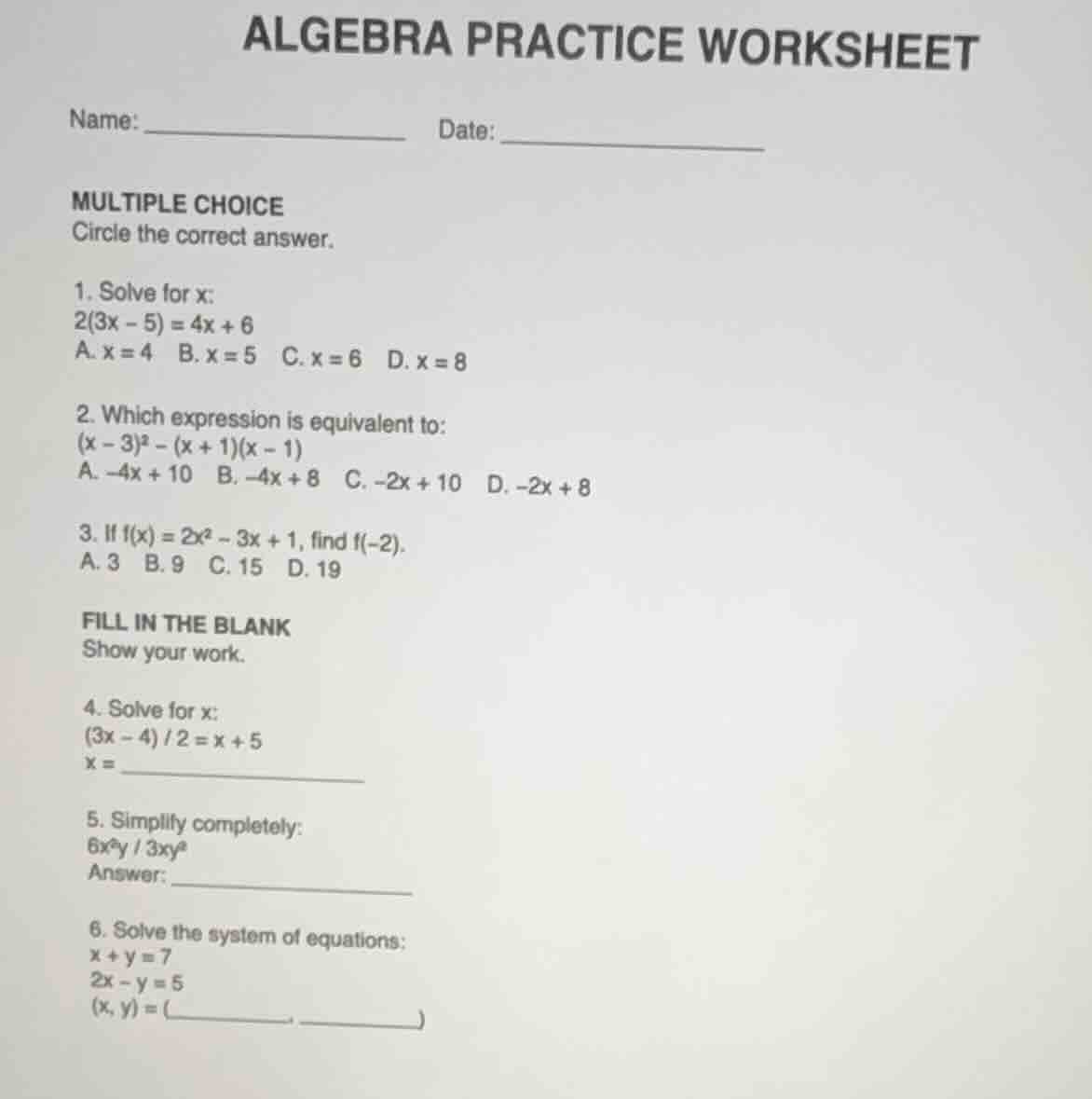
algebra practice worksheet
name: _____________ date: _____________
multiple choice
circle the correct answer.
- solve for x:
2(3x - 5) = 4x + 6
a. x = 4 b. x = 5 c. x = 6 d. x = 8
- which expression is equivalent to:
(x - 3)² - (x + 1)(x - 1)
a. -4x + 10 b. -4x + 8 c. -2x + 10 d. -2x + 8
- if f(x) = 2x² - 3x + 1, find f(-2).
a. 3 b. 9 c. 15 d. 19
fill in the blank
show your work.
- solve for x:
(3x - 4) / 2 = x + 5
x = _______________
- simplify completely:
6x⁶y / 3xy⁸
answer: _______________
- solve the system of equations:
x + y = 7
2x - y = 5
(x, y) = (______, ______)
Question 1: Solve for \( x \): \( 2(3x - 5) = 4x + 6 \)
Step 1: Distribute the left side
Use the distributive property \( a(b - c)=ab - ac \) to expand \( 2(3x - 5) \).
\( 2\times3x - 2\times5 = 6x - 10 \)
So the equation becomes \( 6x - 10 = 4x + 6 \).
Step 2: Subtract \( 4x \) from both sides
Subtract \( 4x \) from each side to get all \( x \)-terms on the left.
\( 6x - 4x - 10 = 4x - 4x + 6 \)
\( 2x - 10 = 6 \)
Step 3: Add 10 to both sides
Add 10 to both sides to isolate the term with \( x \).
\( 2x - 10 + 10 = 6 + 10 \)
\( 2x = 16 \)
Step 4: Divide by 2
Divide both sides by 2 to solve for \( x \).
\( \frac{2x}{2}=\frac{16}{2} \)
\( x = 8 \)? Wait, no, wait, 16 divided by 2 is 8? Wait, but let's check again. Wait, 6x -10 =4x +6. Subtract 4x: 2x -10=6. Add 10: 2x=16. x=8? But option A is x=4, B x=5, C x=6, D x=8. Wait, maybe I made a mistake? Wait, let's re - do:
Wait, 2(3x -5)=4x +6.
Distribute: 6x -10 =4x +6.
Subtract 4x: 2x -10 =6.
Add 10: 2x=16.
x=8. So the answer is D. x = 8.
Step 1: Expand \( (x - 3)^{2} \)
Use the formula \( (a - b)^{2}=a^{2}-2ab + b^{2} \), where \( a = x \) and \( b = 3 \).
\( (x - 3)^{2}=x^{2}-6x + 9 \)
Step 2: Expand \( (x + 1)(x - 1) \)
Use the difference of squares formula \( (a + b)(a - b)=a^{2}-b^{2} \), where \( a = x \) and \( b = 1 \).
\( (x + 1)(x - 1)=x^{2}-1 \)
Step 3: Subtract the two expanded expressions
\( (x^{2}-6x + 9)-(x^{2}-1) \)
Distribute the negative sign: \( x^{2}-6x + 9 - x^{2}+ 1 \)
Step 4: Combine like terms
The \( x^{2} \) terms cancel out (\( x^{2}-x^{2}=0 \)). Combine the linear and constant terms: \( -6x+(9 + 1)=-6x + 10 \)? Wait, no, wait, the original expression is \( (x - 3)^{2}-(x + 1)(x - 1) \). Wait, I think I messed up the sign. Wait, \( (x - 3)^{2}-(x + 1)(x - 1)=x^{2}-6x + 9-(x^{2}-1)=x^{2}-6x + 9 - x^{2}+ 1=-6x + 10 \)? But the options are A. -4x +10, B. -4x +8, C. -2x +10, D. -2x +8. Wait, I must have made a mistake. Wait, no, wait, \( (x - 3)^{2}=x^{2}-6x + 9 \), \( (x + 1)(x - 1)=x^{2}-1 \). Then subtracting: \( x^{2}-6x + 9 - x^{2}+ 1=-6x + 10 \). But this is not in the options. Wait, maybe I misread the problem. Wait, the problem is \( (x - 3)^{2}-(x + 1)(x - 1) \)? Wait, maybe it's \( (x - 3)^{2}-(x + 1)(x - 1) \). Wait, let's check the options again. A. -4x +10, B. -4x +8, C. -2x +10, D. -2x +8.
Wait, maybe I made a mistake in expanding \( (x - 3)^{2} \). Wait, \( (x - 3)^{2}=x^{2}-6x + 9 \), correct. \( (x + 1)(x - 1)=x^{2}-1 \), correct. Then \( x^{2}-6x + 9-(x^{2}-1)=x^{2}-6x + 9 - x^{2}+ 1=-6x + 10 \). But this is not matching. Wait, maybe the problem is \( (x - 3)^{2}-(x + 1)(x - 1) \) is written wrong? Or maybe I made a mistake. Wait, let's check the options again. Wait, maybe the first term is \( (x - 2)^{2} \)? No, the problem says \( (x - 3)^{2} \). Wait, maybe the user made a typo, but assuming the problem is correct as given. Wait, no, wait, let's recalculate:
Wait, \( (x - 3)^{2}=x^{2}-6x + 9 \)
\( (x + 1)(x - 1)=x^{2}-1 \)
Subtract: \( x^{2}-6x + 9 - x^{2}+ 1=-6x + 10 \). But the options don't have this. Wait, maybe the problem is \( (x - 3)^{2}-(x + 2)(x - 2) \)? No, the problem says \( (x + 1)(x - 1) \). Wait, maybe I miscalculated the expansion of \( (x - 3)^{2} \). Wait, \( (x - 3)^{2}=x^{2}-6x + 9 \), that's correct. \( (x + 1)(x - 1)=x^{2}-1 \), correct. So \( x^{2}-6x + 9 - x^{2}+ 1=-6x + 10 \). But the options are A: -4x +10, B: -4x +8, C: -2x +10, D: -2x +8. There is a discrepancy. Wait, maybe the original problem is \( (x - 2)^{2}-(x + 1)(x - 1) \). Let's try that. \( (x - 2)^{2}=x^{2}-4x + 4 \), \( (x + 1)(x - 1)=x^{2}-1 \). Then \( x^{2}-4x + 4-(x^{2}-1)=x^{2}-4x + 4 - x^{2}+ 1=-4x + 5 \), still not. Wait, maybe \( (x - 3)^{2}-(x + 2)(x - 2) \). \( (x - 3)^{2}=x^{2}-6x + 9 \), \( (x + 2)(x - 2)=x^{2}-4 \). Then \( x^{2}-6x + 9-(x^{2}-4)=x^{2}-6x + 9 - x^{2}+ 4=-6x + 13 \). No. Wait, maybe the problem is \( (x - 3)^{2}-(x + 1)(x - 2) \). No, the user wrote \( (x + 1)(x - 1) \).
Wait, maybe I made a mistake in the sign when subtracting. Wait, \( (x - 3)^{2}-(x + 1)(x - 1)=x^{2}-6x + 9 - x^{2}+ 1=-6x + 10 \). Since this is not in the options, maybe there is a mistake in the problem or in my calculation. But assuming the problem is correct, and maybe I misread the exponent. Wait, maybe it's \( (x - 3)^{2}-(x + 1)(x - 1) \), and the options are wrong, or I made a[SSE onError error]

Snap & solve any problem in the app
Get step-by-step solutions on Sovi AI
Photo-based solutions with guided steps
Explore more problems and detailed explanations
D. \( x = 8 \)