QUESTION IMAGE
Question
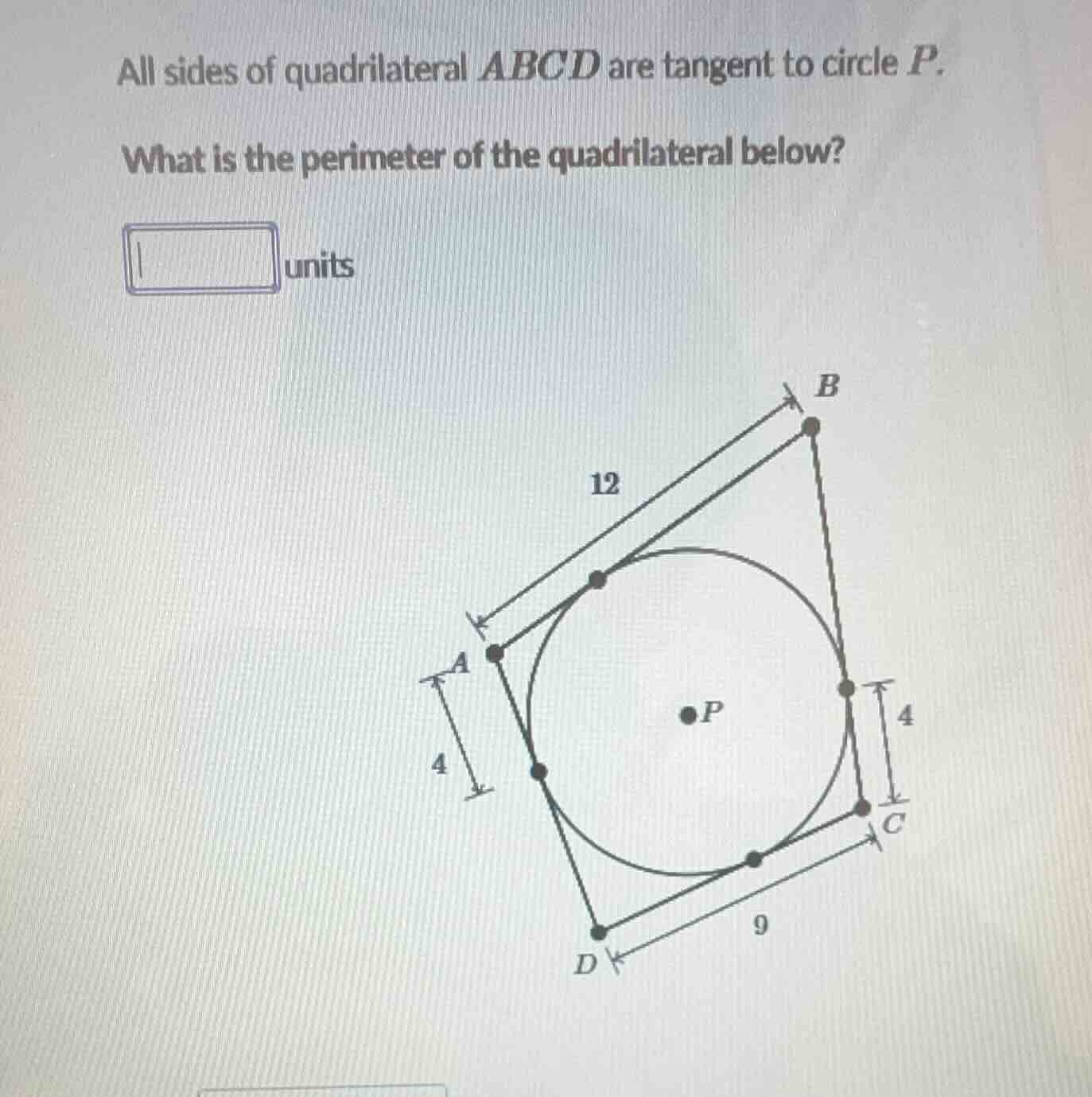
all sides of quadrilateral abcd are tangent to circle p. what is the perimeter of the quadrilateral below? units (image of quadrilateral abcd with circle p inside, side lengths: ab segment with 12, ad segment with 4, dc segment with 9, bc segment with 4 markings)
Step1: Recall Tangent Segments Property
For a quadrilateral tangent to a circle (a tangential quadrilateral), the lengths of the two tangent segments from a single external point to the circle are equal. So, if we denote the tangent segments: from \( A \), the two tangents are equal; from \( B \), the two tangents are equal; from \( C \), the two tangents are equal; from \( D \), the two tangents are equal.
Let's label the tangent points. Let the tangent from \( A \) to the circle have length \( 4 \) (given), so the other tangent from \( A \) (to the adjacent side) is also \( 4 \). The tangent from \( B \) along \( AB \) is \( 12 \), so the other tangent from \( B \) (to the side \( BC \)) is equal to the tangent from \( A \) along \( AB \)? Wait, no, let's list the sides:
- Let the sides be \( AB \), \( BC \), \( CD \), \( DA \).
- From point \( A \): the two tangent segments (on \( AD \) and \( AB \)): one is \( 4 \) (on \( AD \)), so the other (on \( AB \)) is also \( 4 \)? Wait, no, looking at the diagram: \( AD \) has a tangent segment of length \( 4 \) (from \( A \) to the tangent point on \( AD \)), and \( AB \) has a tangent segment of length \( 12 \) (from \( A \) to the tangent point on \( AB \))? Wait, no, the standard property is that for a tangential quadrilateral, the sum of the lengths of opposite sides are equal. Wait, actually, the perimeter of a tangential quadrilateral is \( 2 \times (sum of two adjacent tangent - segment sums) \)? Wait, no, the correct property is that in a tangential quadrilateral, \( AB + CD = BC + AD \), and the perimeter is \( 2(AB + CD) \) or \( 2(BC + AD) \).
Wait, let's identify the tangent lengths:
- From \( A \): the two tangent segments (to the circle) are equal. Let's say the tangent on \( AD \) is \( 4 \), so the tangent on \( AB \) from \( A \) is also \( 4 \).
- From \( B \): the tangent on \( AB \) (from \( B \)) is \( 12 - 4 = 8 \)? Wait, no, maybe better to use the property that in a tangential quadrilateral, the sum of the lengths of two opposite sides is equal to the sum of the lengths of the other two opposite sides. Wait, actually, the perimeter \( P = 2(a + b) \), where \( a \) and \( b \) are the sums of the tangent segments from two opposite vertices.
Wait, looking at the diagram:
- The tangent segment from \( A \) to the circle on \( AD \) is \( 4 \), so the tangent segment from \( A \) to the circle on \( AB \) is also \( 4 \).
- The tangent segment from \( B \) to the circle on \( AB \) is \( 12 - 4 = 8 \)? No, wait, the length of \( AB \) is the sum of the two tangent segments from \( A \) and \( B \) to the circle on \( AB \). Wait, no, the length of \( AB \) is the sum of the tangent from \( A \) to the circle on \( AB \) and the tangent from \( B \) to the circle on \( AB \). Similarly, \( BC \) is the sum of the tangent from \( B \) to the circle on \( BC \) and the tangent from \( C \) to the circle on \( BC \), \( CD \) is the sum of the tangent from \( C \) to the circle on \( CD \) and the tangent from \( D \) to the circle on \( CD \), and \( DA \) is the sum of the tangent from \( D \) to the circle on \( DA \) and the tangent from \( A \) to the circle on \( DA \).
But by the tangent -[SSE onError error]

Snap & solve any problem in the app
Get step-by-step solutions on Sovi AI
Photo-based solutions with guided steps
Explore more problems and detailed explanations
Step1: Recall Tangent Segments Property
For a quadrilateral tangent to a circle (a tangential quadrilateral), the lengths of the two tangent segments from a single external point to the circle are equal. So, if we denote the tangent segments: from \( A \), the two tangents are equal; from \( B \), the two tangents are equal; from \( C \), the two tangents are equal; from \( D \), the two tangents are equal.
Let's label the tangent points. Let the tangent from \( A \) to the circle have length \( 4 \) (given), so the other tangent from \( A \) (to the adjacent side) is also \( 4 \). The tangent from \( B \) along \( AB \) is \( 12 \), so the other tangent from \( B \) (to the side \( BC \)) is equal to the tangent from \( A \) along \( AB \)? Wait, no, let's list the sides:
- Let the sides be \( AB \), \( BC \), \( CD \), \( DA \).
- From point \( A \): the two tangent segments (on \( AD \) and \( AB \)): one is \( 4 \) (on \( AD \)), so the other (on \( AB \)) is also \( 4 \)? Wait, no, looking at the diagram: \( AD \) has a tangent segment of length \( 4 \) (from \( A \) to the tangent point on \( AD \)), and \( AB \) has a tangent segment of length \( 12 \) (from \( A \) to the tangent point on \( AB \))? Wait, no, the standard property is that for a tangential quadrilateral, the sum of the lengths of opposite sides are equal. Wait, actually, the perimeter of a tangential quadrilateral is \( 2 \times (sum of two adjacent tangent - segment sums) \)? Wait, no, the correct property is that in a tangential quadrilateral, \( AB + CD = BC + AD \), and the perimeter is \( 2(AB + CD) \) or \( 2(BC + AD) \).
Wait, let's identify the tangent lengths:
- From \( A \): the two tangent segments (to the circle) are equal. Let's say the tangent on \( AD \) is \( 4 \), so the tangent on \( AB \) from \( A \) is also \( 4 \).
- From \( B \): the tangent on \( AB \) (from \( B \)) is \( 12 - 4 = 8 \)? Wait, no, maybe better to use the property that in a tangential quadrilateral, the sum of the lengths of two opposite sides is equal to the sum of the lengths of the other two opposite sides. Wait, actually, the perimeter \( P = 2(a + b) \), where \( a \) and \( b \) are the sums of the tangent segments from two opposite vertices.
Wait, looking at the diagram:
- The tangent segment from \( A \) to the circle on \( AD \) is \( 4 \), so the tangent segment from \( A \) to the circle on \( AB \) is also \( 4 \).
- The tangent segment from \( B \) to the circle on \( AB \) is \( 12 - 4 = 8 \)? No, wait, the length of \( AB \) is the sum of the two tangent segments from \( A \) and \( B \) to the circle on \( AB \). Wait, no, the length of \( AB \) is the sum of the tangent from \( A \) to the circle on \( AB \) and the tangent from \( B \) to the circle on \( AB \). Similarly, \( BC \) is the sum of the tangent from \( B \) to the circle on \( BC \) and the tangent from \( C \) to the circle on \( BC \), \( CD \) is the sum of the tangent from \( C \) to the circle on \( CD \) and the tangent from \( D \) to the circle on \( CD \), and \( DA \) is the sum of the tangent from \( D \) to the circle on \( DA \) and the tangent from \( A \) to the circle on \( DA \).
But by the tangent -[SSE onError error]