QUESTION IMAGE
Question
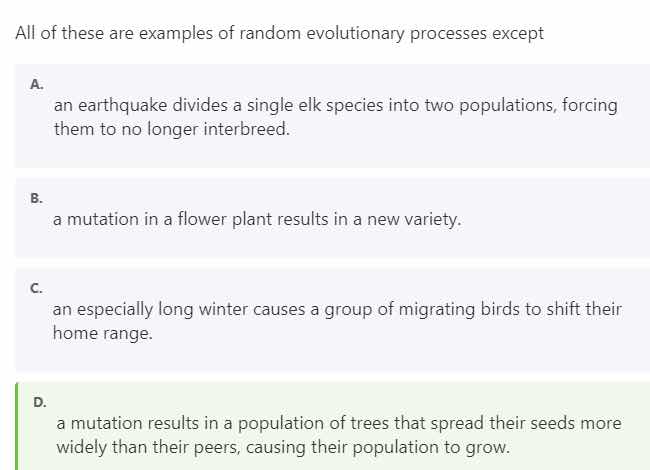
all of these are examples of random evolutionary processes except
a.
an earthquake divides a single elk species into two populations, forcing
them to no longer interbreed.
b.
a mutation in a flower plant results in a new variety.
c.
an especially long winter causes a group of migrating birds to shift their
home range.
d.
a mutation results in a population of trees that spread their seeds more
widely than their peers, causing their population to grow.
Random evolutionary processes are driven by chance events, not traits that provide a survival/reproductive advantage.
- Option A: The earthquake is a random geographic barrier, a random process.
- Option B: Mutations are random genetic changes, a random process.
- Option C: The long winter is a random environmental event causing range shift, a random process.
- Option D: The mutation leads to better seed dispersal, which increases the population because the trait is advantageous. This is natural selection, a non-random evolutionary process as it favors beneficial traits.

Snap & solve any problem in the app
Get step-by-step solutions on Sovi AI
Photo-based solutions with guided steps
Explore more problems and detailed explanations
D. a mutation results in a population of trees that spread their seeds more widely than their peers, causing their population to grow.