QUESTION IMAGE
Question
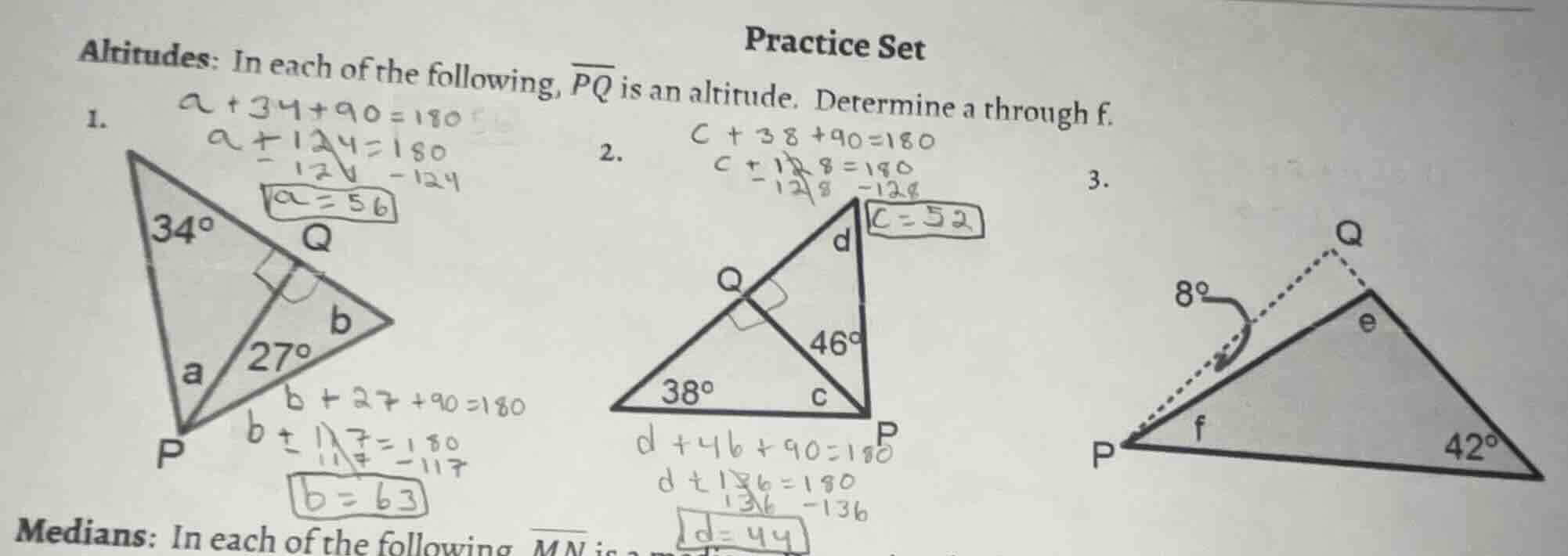
altitudes: in each of the following, \\(\overline{pq}\\) is an altitude. determine a through f. practice set 1. 2. 3. medians: in each of the following \\(\overline{mn}\\) is a
Problem 1 (First Triangle with \( \overline{PQ} \) as Altitude)
Step 1: Find \( a \)
We know that the sum of angles in a triangle is \( 180^\circ \), and \( \overline{PQ} \) is an altitude, so one angle is \( 90^\circ \). The given angle is \( 34^\circ \).
\[
a + 34 + 90 = 180
\]
\[
a + 124 = 180
\]
Subtract \( 124 \) from both sides:
\[
a = 180 - 124 = 56
\]
Step 2: Find \( b \)
In the smaller right triangle with angle \( 27^\circ \) and \( 90^\circ \):
\[
b + 27 + 90 = 180
\]
\[
b + 117 = 180
\]
Subtract \( 117 \) from both sides:
\[
b = 180 - 117 = 63
\]
Problem 2 (Second Triangle with \( \overline{PQ} \) as Altitude)
Step 1: Find \( c \)
Sum of angles in a triangle is \( 180^\circ \), with angles \( 38^\circ \) and \( 90^\circ \):
\[
c + 38 + 90 = 180
\]
\[
c + 128 = 180
\]
Subtract \( 128 \) from both sides:
\[
c = 180 - 128 = 52
\]
Step 2: Find \( d \)
In the right triangle with angle \( 46^\circ \) and \( 90^\circ \):
\[
d + 46 + 90 = 180
\]
\[
d + 136 = 180
\]
Subtract \( 136 \) from both sides:
\[
d = 180 - 136 = 44
\]
Problem 3 (Third Triangle with \( \overline{PQ} \) as Altitude)
Step 1: Find \( f \)
The angle marked \( 8^\circ \) and \( f \) are related (since \( \overline{PQ} \) is an altitude, maybe a right angle or supplementary? Wait, looking at the diagram, the angle \( 8^\circ \) and \( f \) – maybe \( f = 8^\circ \)? Wait, no, let's think again. Wait, the triangle has angles \( f \), \( 42^\circ \), and \( e \). Also, the dashed line \( PQ \) makes an \( 8^\circ \) angle. Wait, maybe \( f = 8^\circ \)? Wait, no, let's check the sum of angles. Wait, maybe the angle at \( P \) is \( f \), and the other angle is \( 42^\circ \), and \( e \) is the third angle. Wait, but there's an \( 8^\circ \) angle with the dashed line. Wait, maybe \( f = 8^\circ \)? Wait, no, let's re - examine. Wait, the problem says \( \overline{PQ} \) is an altitude, so \( \angle PQ \) related angle is \( 90^\circ \). Wait, maybe the angle \( f \) is equal to \( 8^\circ \)? Wait, maybe the diagram shows that the angle between \( PQ \) (dashed) and the side is \( 8^\circ \), so \( f = 8^\circ \). Then, to find \( e \):
Sum of angles in a triangle is \( 180^\circ \), so:
\[
e+ f + 42=180
\]
If \( f = 8^\circ \):
\[
e + 8+42 = 180
\]
\[
e+50 = 180
\]
\[
e=180 - 50=130^\circ
\]
Wait, but maybe I misinterpret \( f \). Wait, maybe the \( 8^\circ \) angle is equal to \( f \), so \( f = 8^\circ \), and then \( e=180-(8 + 42)=130^\circ \)
Final Answers
- For the first triangle: \( a=\boldsymbol{56^\circ} \), \( b=\boldsymbol{63^\circ} \)
- For the second triangle: \( c=\boldsymbol{52^\circ} \), \( d=\boldsymbol{44^\circ} \)
- For the third triangle: \( f=\boldsymbol{8^\circ} \), \( e=\boldsymbol{130^\circ} \)

Snap & solve any problem in the app
Get step-by-step solutions on Sovi AI
Photo-based solutions with guided steps
Explore more problems and detailed explanations
Problem 1 (First Triangle with \( \overline{PQ} \) as Altitude)
Step 1: Find \( a \)
We know that the sum of angles in a triangle is \( 180^\circ \), and \( \overline{PQ} \) is an altitude, so one angle is \( 90^\circ \). The given angle is \( 34^\circ \).
\[
a + 34 + 90 = 180
\]
\[
a + 124 = 180
\]
Subtract \( 124 \) from both sides:
\[
a = 180 - 124 = 56
\]
Step 2: Find \( b \)
In the smaller right triangle with angle \( 27^\circ \) and \( 90^\circ \):
\[
b + 27 + 90 = 180
\]
\[
b + 117 = 180
\]
Subtract \( 117 \) from both sides:
\[
b = 180 - 117 = 63
\]
Problem 2 (Second Triangle with \( \overline{PQ} \) as Altitude)
Step 1: Find \( c \)
Sum of angles in a triangle is \( 180^\circ \), with angles \( 38^\circ \) and \( 90^\circ \):
\[
c + 38 + 90 = 180
\]
\[
c + 128 = 180
\]
Subtract \( 128 \) from both sides:
\[
c = 180 - 128 = 52
\]
Step 2: Find \( d \)
In the right triangle with angle \( 46^\circ \) and \( 90^\circ \):
\[
d + 46 + 90 = 180
\]
\[
d + 136 = 180
\]
Subtract \( 136 \) from both sides:
\[
d = 180 - 136 = 44
\]
Problem 3 (Third Triangle with \( \overline{PQ} \) as Altitude)
Step 1: Find \( f \)
The angle marked \( 8^\circ \) and \( f \) are related (since \( \overline{PQ} \) is an altitude, maybe a right angle or supplementary? Wait, looking at the diagram, the angle \( 8^\circ \) and \( f \) – maybe \( f = 8^\circ \)? Wait, no, let's think again. Wait, the triangle has angles \( f \), \( 42^\circ \), and \( e \). Also, the dashed line \( PQ \) makes an \( 8^\circ \) angle. Wait, maybe \( f = 8^\circ \)? Wait, no, let's check the sum of angles. Wait, maybe the angle at \( P \) is \( f \), and the other angle is \( 42^\circ \), and \( e \) is the third angle. Wait, but there's an \( 8^\circ \) angle with the dashed line. Wait, maybe \( f = 8^\circ \)? Wait, no, let's re - examine. Wait, the problem says \( \overline{PQ} \) is an altitude, so \( \angle PQ \) related angle is \( 90^\circ \). Wait, maybe the angle \( f \) is equal to \( 8^\circ \)? Wait, maybe the diagram shows that the angle between \( PQ \) (dashed) and the side is \( 8^\circ \), so \( f = 8^\circ \). Then, to find \( e \):
Sum of angles in a triangle is \( 180^\circ \), so:
\[
e+ f + 42=180
\]
If \( f = 8^\circ \):
\[
e + 8+42 = 180
\]
\[
e+50 = 180
\]
\[
e=180 - 50=130^\circ
\]
Wait, but maybe I misinterpret \( f \). Wait, maybe the \( 8^\circ \) angle is equal to \( f \), so \( f = 8^\circ \), and then \( e=180-(8 + 42)=130^\circ \)
Final Answers
- For the first triangle: \( a=\boldsymbol{56^\circ} \), \( b=\boldsymbol{63^\circ} \)
- For the second triangle: \( c=\boldsymbol{52^\circ} \), \( d=\boldsymbol{44^\circ} \)
- For the third triangle: \( f=\boldsymbol{8^\circ} \), \( e=\boldsymbol{130^\circ} \)