QUESTION IMAGE
Question
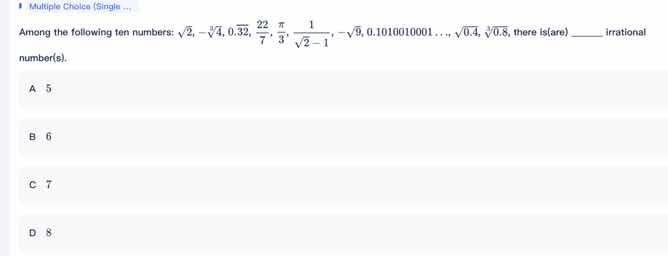
among the following ten numbers: $sqrt{2}$, $sqrt3{4}$, $0.overline{32}$, $\frac{22}{7}$, $\frac{pi}{3}$, $\frac{1}{sqrt{2}-1}$, $-sqrt{9}$, $0.1010010001ldots$, $sqrt{0.4}$, $sqrt3{0.8}$, there is(are) ___ irrational number(s).
a 5
b 6
c 7
d 8
Step1: Identify rational numbers
Rational numbers: $-\sqrt[3]{4}$ is not rational; wait, correct rational numbers: $0.\overline{32}$ (repeating decimal), $\frac{22}{7}$ (fraction), $\frac{1}{3}$ (fraction), $-\sqrt{9}=-3$ (integer), $\sqrt[3]{0.8}=\sqrt[3]{\frac{4}{5}}$ is irrational? No, wait reclassify:
- Rational: $0.\overline{32}$, $\frac{22}{7}$, $\frac{1}{3}$, $-\sqrt{9}=-3$ (total 4)
Step2: Identify irrational numbers
Irrational numbers are non-repeating, non-terminating decimals, or roots that don't simplify to rationals:
$\sqrt{2}$, $-\sqrt[3]{4}$, $\pi$, $\frac{1}{\sqrt{2}-1}=\sqrt{2}+1$ (rationalized, still irrational), $0.1010010001...$, $\sqrt[3]{0.4}$, $\sqrt[3]{0.8}$
Count these: $\sqrt{2}$, $-\sqrt[3]{4}$, $\pi$, $\frac{1}{\sqrt{2}-1}$, $0.1010010001...$, $\sqrt[3]{0.4}$, $\sqrt[3]{0.8}$ → total 7

Snap & solve any problem in the app
Get step-by-step solutions on Sovi AI
Photo-based solutions with guided steps
Explore more problems and detailed explanations
C. 7