QUESTION IMAGE
Question
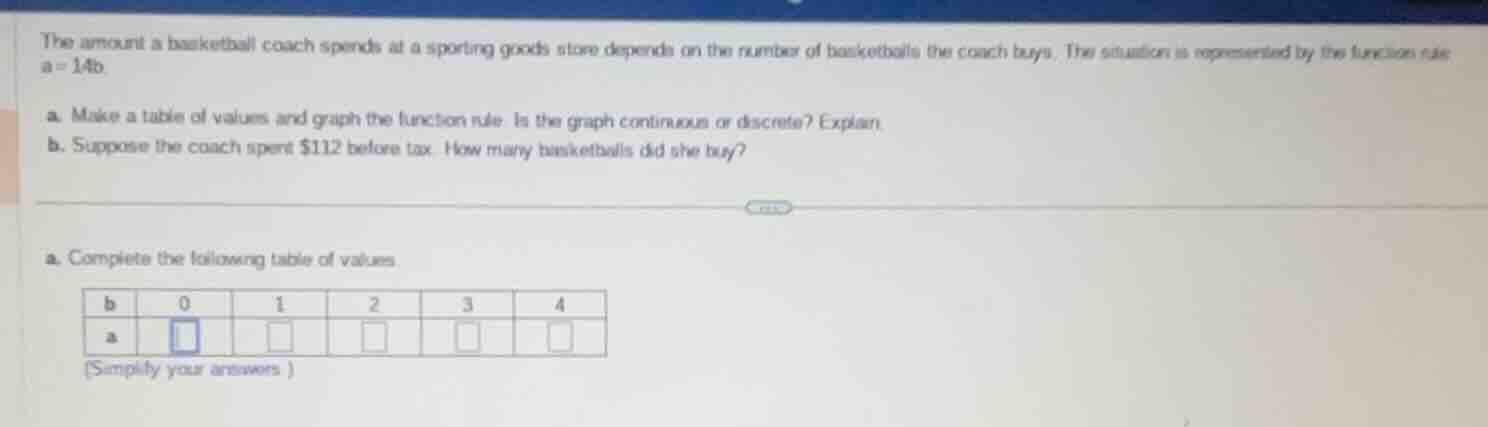
the amount a basketball coach spends at a sporting goods store depends on the number of basketballs the coach buys. the situation is represented by the function rule $a = 14b$
a. make a table of values and graph the function rule. is the graph continuous or discrete? explain.
b. suppose the coach spent $112 before tax. how many basketballs did she buy?
a. complete the following table of values
(simplify your answers )
Step1: Calculate a for b=0
Substitute $b=0$ into $a=14b$:
$a=14\times0=0$
Step2: Calculate a for b=1
Substitute $b=1$ into $a=14b$:
$a=14\times1=14$
Step3: Calculate a for b=2
Substitute $b=2$ into $a=14b$:
$a=14\times2=28$
Step4: Calculate a for b=3
Substitute $b=3$ into $a=14b$:
$a=14\times3=42$
Step5: Calculate a for b=4
Substitute $b=4$ into $a=14b$:
$a=14\times4=56$
Step6: Analyze graph type
You can only buy whole number basketballs, so the graph is discrete (points only, no connected line, since non-integer values of b don't make sense here).
Step7: Solve for b when a=112
Set $a=112$ in $a=14b$, solve for $b$:
$112=14b$
$b=\frac{112}{14}=8$

Snap & solve any problem in the app
Get step-by-step solutions on Sovi AI
Photo-based solutions with guided steps
Explore more problems and detailed explanations
Completed Table:
| b | 0 | 1 | 2 | 3 | 4 |
|---|
Part a Graph Analysis:
The graph is discrete. You cannot buy a fraction of a basketball, so only whole-number values of $b$ (number of basketballs) are valid, meaning the graph consists of separate points, not a continuous line.
Part b:
8 basketballs