QUESTION IMAGE
Question
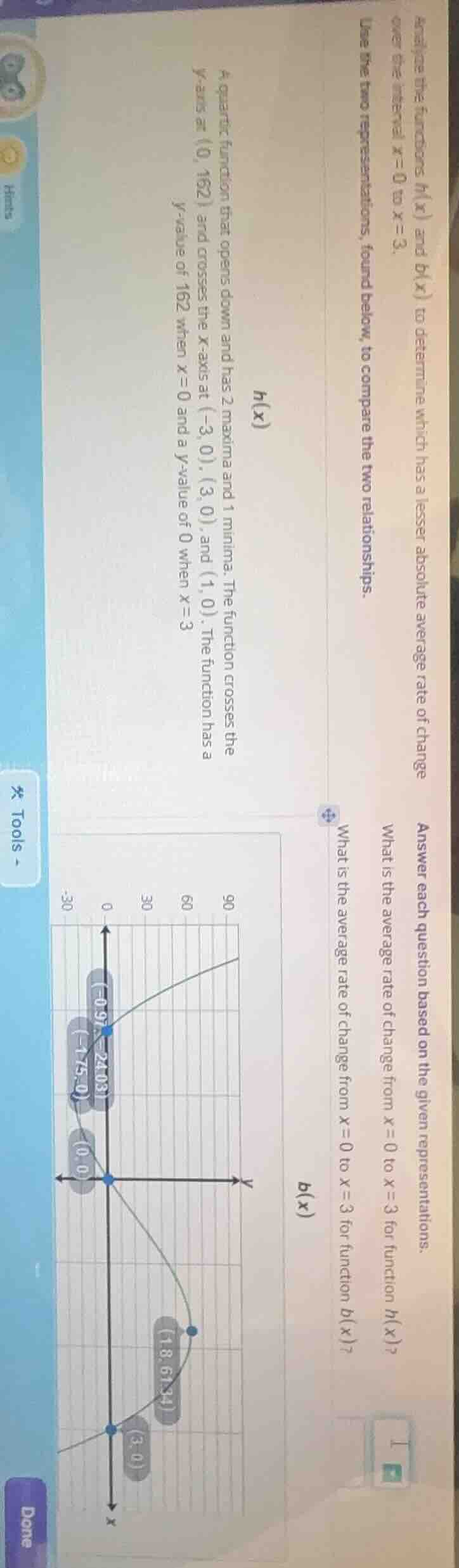
analyze the functions ( h(x) ) and ( b(x) ) to determine which has a lesser absolute average rate of change over the interval ( x = 0 ) to ( x = 3 ).
use the two representations, found below, to compare the two relationships.
( h(x) )
a quartic function that opens down and has 2 maxima and 1 minima. the function crosses the ( y )-axis at ( (0, 162) ) and crosses the ( x )-axis at ( (-3, 0) ), ( (3, 0) ), and ( (1, 0) ). the function has a ( y )-value of 162 when ( x = 0 ) and a ( y )-value of 0 when ( x = 3 ).
( b(x) ) graph with points ( (-0.97, -24.03) ), ( (-1.75, 0) ), ( (0, 0) ), ( (1.8, 61.34) ), ( (3, 0) )
answer each question based on the given representations.
what is the average rate of change from ( x = 0 ) to ( x = 3 ) for function ( h(x) )?
what is the average rate of change from ( x = 0 ) to ( x = 3 ) for function ( b(x) )?
Step1: Recall average rate of change formula
The average rate of change of a function $f(x)$ from $x=a$ to $x=b$ is $\frac{f(b)-f(a)}{b-a}$.
Step2: Calculate for $h(x)$
We know $h(0)=162$ and $h(3)=0$.
$\text{Average rate of change} = \frac{h(3)-h(0)}{3-0} = \frac{0-162}{3-0} = \frac{-162}{3} = -54$
Step3: Calculate for $b(x)$
We know $b(0)=0$ and $b(3)=0$.
$\text{Average rate of change} = \frac{b(3)-b(0)}{3-0} = \frac{0-0}{3-0} = 0$
Step4: Compare absolute values
Absolute value of $h(x)$'s rate: $|-54|=54$
Absolute value of $b(x)$'s rate: $|0|=0$
$0 < 54$, so $b(x)$ has lesser absolute rate.

Snap & solve any problem in the app
Get step-by-step solutions on Sovi AI
Photo-based solutions with guided steps
Explore more problems and detailed explanations
- The average rate of change from $x=0$ to $x=3$ for function $h(x)$ is $-54$
- The average rate of change from $x=0$ to $x=3$ for function $b(x)$ is $0$
- Function $b(x)$ has a lesser absolute average rate of change over the interval $x=0$ to $x=3$