QUESTION IMAGE
Question
analyze
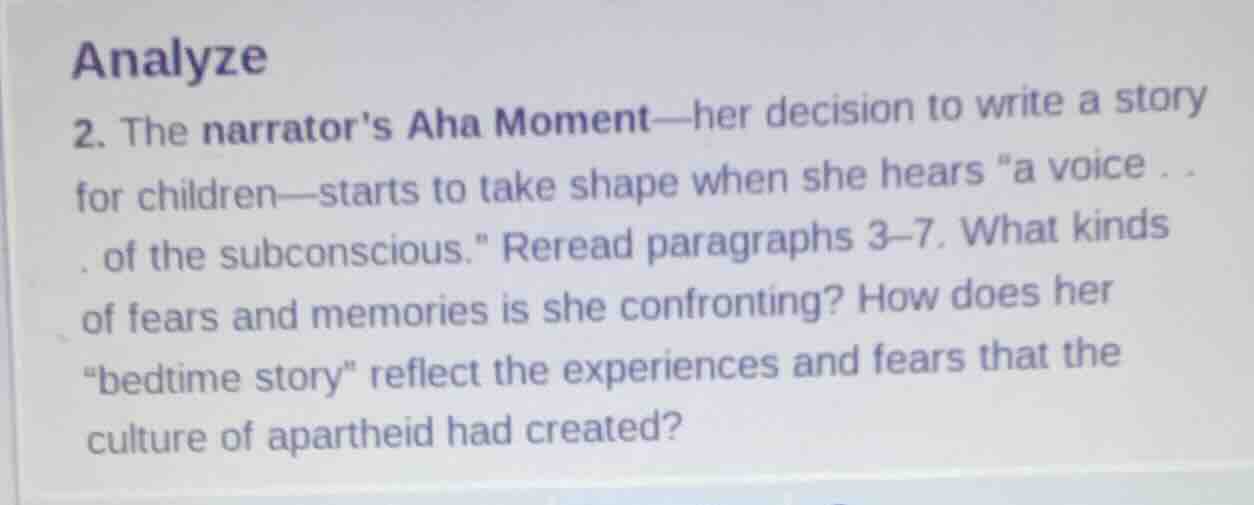
- the narrators aha moment—her decision to write a story for children—starts to take shape when she hears \a voice... of the subconscious.\ reread paragraphs 3–7. what kinds of fears and memories is she confronting? how does her \bedtime story\ reflect the experiences and fears that the culture of apartheid had created?
To answer this, we analyze the text (assuming it's from a work about apartheid - influenced experiences):
Step 1: Identify Fears/Memories (Paragraphs 3–7)
The narrator likely confronts fears of racial division, oppression, and loss of identity (due to apartheid’s segregation). Memories may include personal or collective traumas of discrimination, family/community struggles, or the psychological weight of living under a racist system.
Step 2: Analyze the “Bedtime Story”
The story probably mirrors apartheid - era anxieties: themes of separation (like racial segregation), fear of the “other,” or the struggle for safety/self - worth. It reflects how apartheid created a culture of fear (of authority, of being different) and fragmented experiences (broken communities, lost heritage).
(Note: For a precise answer, the actual text of paragraphs 3–7 is needed. This is a general analysis based on apartheid’s context.)
If we assume the text is from a work like “Once Upon a Time” by Nadine Gordimer (a common apartheid - themed story):
- Fears: Fear of “the outside” (racial “others”), fear of violence, fear of losing safety (driven by apartheid’s racial tensions).
- Memories: Memories of a divided society, maybe personal experiences of discrimination or witnessing injustice.
- Bedtime Story Reflection: The story’s themes (e.g., a family fortifying their home, fearing intruders) reflect apartheid’s culture of segregation, paranoia, and the dehumanizing effect of racial hierarchy (treating others as threats, building walls—literal and metaphorical—against them).

Snap & solve any problem in the app
Get step-by-step solutions on Sovi AI
Photo-based solutions with guided steps
Explore more problems and detailed explanations
To answer this, we analyze the text (assuming it's from a work about apartheid - influenced experiences):
Step 1: Identify Fears/Memories (Paragraphs 3–7)
The narrator likely confronts fears of racial division, oppression, and loss of identity (due to apartheid’s segregation). Memories may include personal or collective traumas of discrimination, family/community struggles, or the psychological weight of living under a racist system.
Step 2: Analyze the “Bedtime Story”
The story probably mirrors apartheid - era anxieties: themes of separation (like racial segregation), fear of the “other,” or the struggle for safety/self - worth. It reflects how apartheid created a culture of fear (of authority, of being different) and fragmented experiences (broken communities, lost heritage).
(Note: For a precise answer, the actual text of paragraphs 3–7 is needed. This is a general analysis based on apartheid’s context.)
If we assume the text is from a work like “Once Upon a Time” by Nadine Gordimer (a common apartheid - themed story):
- Fears: Fear of “the outside” (racial “others”), fear of violence, fear of losing safety (driven by apartheid’s racial tensions).
- Memories: Memories of a divided society, maybe personal experiences of discrimination or witnessing injustice.
- Bedtime Story Reflection: The story’s themes (e.g., a family fortifying their home, fearing intruders) reflect apartheid’s culture of segregation, paranoia, and the dehumanizing effect of racial hierarchy (treating others as threats, building walls—literal and metaphorical—against them).