QUESTION IMAGE
Question
analyze setting
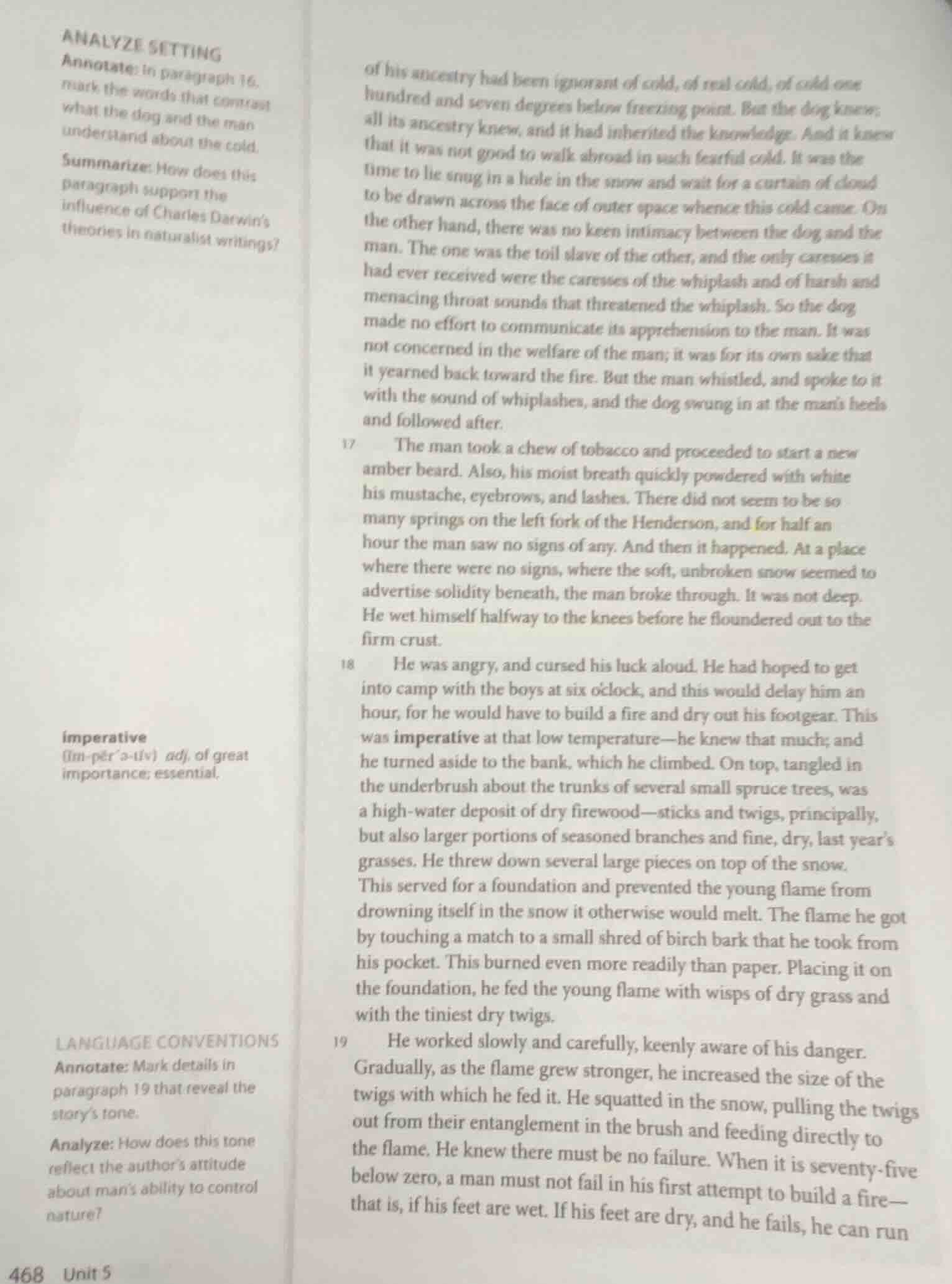
annotate: in paragraph 16, mark the words that contrast what the dog and the man understand about the cold.
summarize: how does this paragraph support the influence of charles darwin’s theories in naturalist writings?
imperative
(im - per - a - tiv) adj. of great importance; essential.
language conventions
annotate: mark details in paragraph 19 that reveal the story’s tone.
analyze: how does this tone reflect the author’s attitude about man’s ability to control nature?
of his ancestry had been ignorant of cold, of real cold, of cold one hundred and seven degrees below freezing point. but the dog knew; all its ancestry knew, and it had inherited the knowledge. and it knew that it was not good to walk abroad in such fearful cold. it was the time to lie snug in a hole in the snow and wait for a curtain of cloud to be drawn across the face of outer space whence this cold came. on the other hand, there was no keen intimacy between the dog and the man. the one was the toil slave of the other, and the only caresses it had ever received were the caresses of the whiplash and of harsh and menacing throat sounds that threatened the whiplash. so the dog made no effort to communicate its apprehension to the man. it was not concerned in the welfare of the man; it was for its own sake that it yearned back toward the fire. but the man whistled, and spoke to it with the sound of whiplashes, and the dog swung in at the man’s heels and followed after.
17 the man took a chew of tobacco and proceeded to start a new amber beard. also, his moist breath quickly powdered with white his mustache, eyebrows, and lashes. there did not seem to be so many springs on the left fork of the henderson, and for half an hour the man saw no signs of any. and then it happened. at a place where there were no signs, where the soft, unbroken snow seemed to advertise solidity beneath, the man broke through. it was not deep. he wet himself halfway to the knees before he floundered out to the firm crust.
18 he was angry, and cursed his luck aloud. he had hoped to get into camp with the boys at six o’clock, and this would delay him an hour, for he would have to build a fire and dry out his footgear. this was imperative at that low temperature—he knew that much; and he turned aside to the bank, which he climbed. on top, tangled in the underbrush about the trunks of several small spruce trees, was a high - water deposit of dry firewood—sticks and twigs, principally, but also larger portions of seasoned branches and fine, dry, last year’s grasses. he threw down several large pieces on top of the snow. this served for a foundation and prevented the young flame from drowning itself in the snow it otherwise would melt. the flame he got by touching a match to a small shred of birch bark that he took from his pocket. this burned even more readily than paper. placing it on the foundation, he fed the young flame with wisps of dry grass and with the tiniest dry twigs.
19 he worked slowly and carefully, keenly aware of his danger. gradually, as the flame grew stronger, he increased the size of the twigs with which he fed it. he squatted in the snow, pulling the twigs out from their entanglement in the brush and feeding directly to the flame. he knew there must be no failure. when it is seventy - five below zero, a man must not fail in his first attempt to build a fire—that is, if his feet are wet. if his feet are dry, and he fails, he can run
First Question (Analyze Setting - Darwin's Influence)
This paragraph reflects Darwin's theory of instinct/innate traits: the dog has inherited knowledge of cold (a survival trait from its ancestry), while the man lacks this inherited understanding, relying only on his limited personal experience. Naturalist writing often uses Darwinian ideas about evolution, innate survival instincts, and the gap between human rationality and animal instinct to show nature's unforgiving power and the hierarchy of adaptive traits.
Paragraph 19 uses formal, precise, and urgent language (e.g., "slowly and carefully," "keenly aware of his danger," "must not fail"). This tone is detached yet tense, emphasizing the man's precarity. The author's attitude is that man's ability to control nature is fragile: the man must follow strict, careful steps to survive, and even small mistakes (like wet feet) can lead to disaster, framing nature as a force that demands perfect, humble adherence to its rules.

Snap & solve any problem in the app
Get step-by-step solutions on Sovi AI
Photo-based solutions with guided steps
Explore more problems and detailed explanations
The paragraph supports Darwin's theories by highlighting innate, inherited survival knowledge (the dog's instinct to fear extreme cold, passed down through its ancestry) versus the man's lack of this evolutionary wisdom. This aligns with naturalist focus on evolutionary adaptation, the role of instinct in survival, and nature's indifference to human hubris—key elements of Darwin-influenced naturalist writing.
---