QUESTION IMAGE
Question
analyzing historical details to support a claim
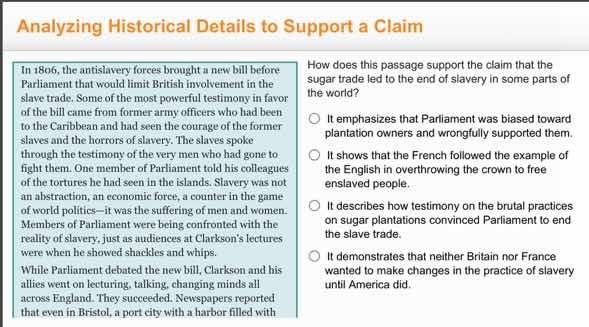
in 1806, the antislavery forces brought a new bill before parliament that would limit british involvement in the slave trade. some of the most powerful testimony in favor of the bill came from former army officers who had been to the caribbean and had seen the courage of the former slaves and the horrors of slavery. the slaves who spoke through the testimony of the very men who had gone to fight them. one member of parliament told his colleagues of the torture he had seen in the islands. slavery was not an abstraction, an economic force, a counter in the game of world politics—it was the suffering of men and women. members of parliament were being confronted with the reality of slavery, just as audiences at clarkson’s lectures were when he showed the shackles and whips.
while parliament debated the new bill, clarkson and his allies went on lecturing, talking, changing minds all across england. they succeeded. newspapers reported that even in bristol, a port city with a harbor filled with.
how does this passage support the claim that the sugar trade led to the end of slavery in some parts of the world?
it emphasizes that parliament was biased toward plantation owners and wrongfully supported them.
it shows that the french followed the example of the english in overthrowing the crown to free enslaved people.
it describes how testimony on the brutal practices on sugar plantations convinced parliament to end the slave trade.
it demonstrates that neither britain nor france wanted to make changes in the practice of slavery until america did.
To solve this multiple - choice question about how a passage supports a claim, we analyze each option:
Option 1
The passage does not emphasize that Parliament was biased toward plantation owners and wrongly supported them. Instead, it shows Parliament being convinced to limit British involvement in the slave trade, so this option is incorrect.
Option 2
The passage is about Britain's Parliament and the slave trade, not about the French overthrowing the crown to free the enslaved. There is no mention of the French in this context, so this option is incorrect.
Option 3
The passage states that former army officers who had been in the Caribbean and former slaves gave testimony about the brutal practices of slavery on sugar plantations. This testimony, along with Clarkson's lectures, helped change minds in Parliament as they debated the new bill to limit British involvement in the slave trade. This option accurately describes how the passage supports the claim that the sugar trade led to the end of slavery in some parts of the world.
Option 4
The passage does not discuss the timing of when Britain or France made changes related to slavery in comparison to America. It focuses on Britain's Parliament and the influence of testimony about the sugar trade's brutal practices on ending slavery, so this option is incorrect.

Snap & solve any problem in the app
Get step-by-step solutions on Sovi AI
Photo-based solutions with guided steps
Explore more problems and detailed explanations
C. It describes how testimony on the brutal practices on sugar plantations convinced Parliament to end the slave trade. (Here we assume the options are labeled A - D in the standard way, and this option corresponds to the third option we analyzed above)