QUESTION IMAGE
Question
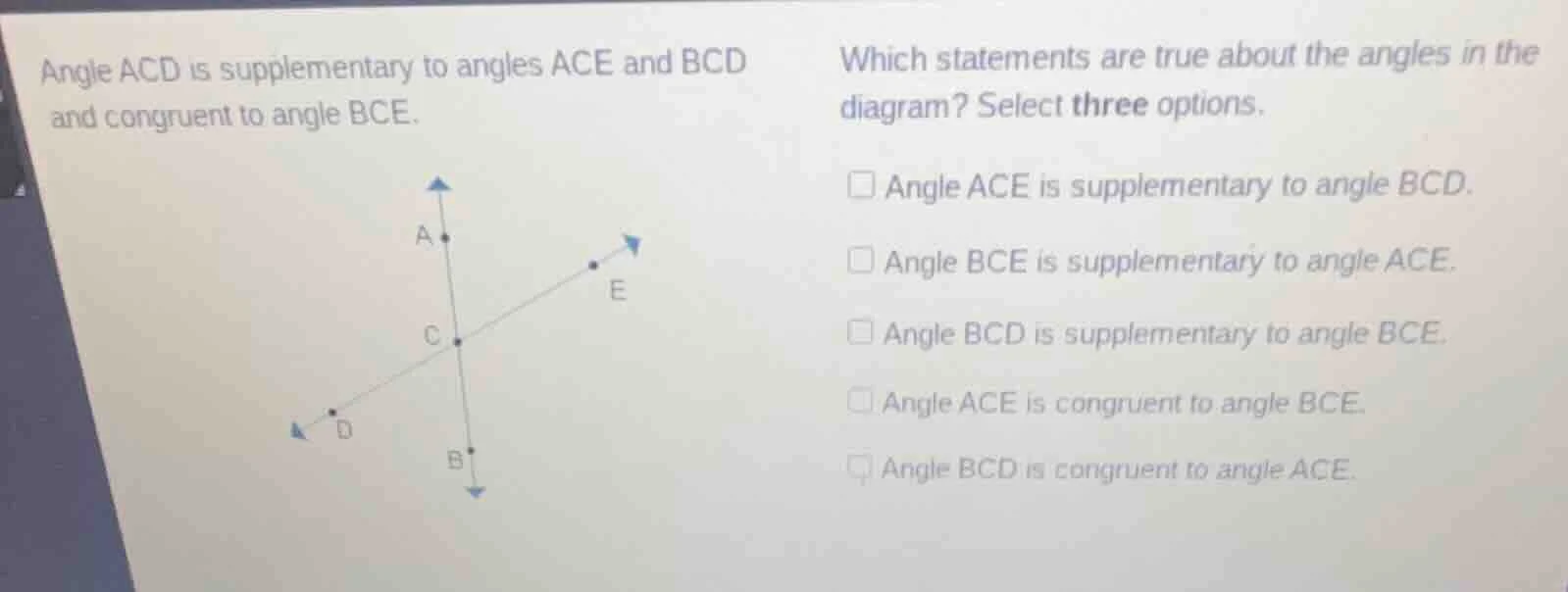
angle acd is supplementary to angles ace and bcd and congruent to angle bce. which statements are true about the angles in the diagram? select three options. angle ace is supplementary to angle bcd. angle bce is supplementary to angle ace. angle bcd is supplementary to angle bce. angle ace is congruent to angle bce. angle bcd is congruent to angle ace.
Brief Explanations
- Given that ∠ACD is supplementary to ∠ACE and ∠BCD, and ∠ACD ≅ ∠BCE.
- For "Angle ACE is supplementary to angle BCD": Since ∠ACD is supplementary to both ∠ACE and ∠BCD, ∠ACE and ∠BCD have the same supplementary angle (∠ACD), so ∠ACE + ∠BCD ≠ 180°? Wait, no—wait, if ∠ACD + ∠ACE = 180° and ∠ACD + ∠BCD = 180°, then ∠ACE = ∠BCD (congruent), not supplementary. Wait, maybe I misread. Wait the first statement: "Angle ACE is supplementary to angle BCD"—no, actually, since ∠ACD is supplementary to ∠ACE (∠ACD + ∠ACE = 180°) and ∠ACD is supplementary to ∠BCD (∠ACD + ∠BCD = 180°), then ∠ACE = ∠BCD (they are congruent, not supplementary). Wait, maybe the second option: "Angle BCE is supplementary to angle ACE"—since ∠ACD ≅ ∠BCE, and ∠ACD + ∠ACE = 180°, so ∠BCE + ∠ACE = 180°, so this is true.
- Third option: "Angle BCD is supplementary to angle BCE"—since ∠ACD ≅ ∠BCE, and ∠ACD + ∠BCD = 180°? No, wait ∠ACD and ∠BCD: are they adjacent? Wait the diagram: A and B are on a vertical line, D and E on a diagonal line, intersecting at C. So ∠ACD and ∠BCE are congruent (vertical angles? Wait no, ∠ACD and ∠BCE: ∠ACD and ∠BCE—wait the problem says ∠ACD is congruent to ∠BCE. Then ∠BCD: let's see, ∠BCD and ∠ACE—since ∠ACD is supplementary to ∠ACE, and ∠ACD ≅ ∠BCE, so ∠BCE is supplementary to ∠ACE (so second option is true). Then "Angle BCD is supplementary to angle BCE": since ∠ACD ≅ ∠BCE, and ∠ACD + ∠BCD = 180°? Wait no, ∠ACD and ∠BCD: are they adjacent? Wait, ∠ACD and ∠BCD—if C is the intersection, then ∠ACD and ∠BCD: wait, A-C-B is a straight line (vertical), D-C-E is a straight line (diagonal). So ∠ACD and ∠BCE are vertical angles? Wait, ∠ACD and ∠BCE: when two lines intersect, vertical angles are congruent. Wait, maybe I messed up. Let's re-express:
Given:
- ∠ACD is supplementary to ∠ACE (∠ACD + ∠ACE = 180°)
- ∠ACD is supplementary to ∠BCD (∠ACD + ∠BCD = 180°)
- ∠ACD ≅ ∠BCE (∠ACD = ∠BCE)
So:
- Angle ACE is supplementary to angle BCD: ∠ACE + ∠BCD. From ∠ACD + ∠ACE = 180 and ∠ACD + ∠BCD = 180, so ∠ACE = ∠BCD (they are congruent, not supplementary). So first option is false.
- Angle BCE is supplementary to angle ACE: Since ∠ACD ≅ ∠BCE, and ∠ACD + ∠ACE = 180°, so ∠BCE + ∠ACE = 180° (supplementary). So this is true.
- Angle BCD is supplementary to angle BCE: Since ∠ACD ≅ ∠BCE, and ∠ACD + ∠BCD = 180°? Wait no, ∠ACD and ∠BCD: are they adjacent? Wait, ∠ACD and ∠BCD—if C is the intersection, then ∠ACD and ∠BCD: let's see, ∠BCD and ∠ACE—wait ∠BCD and ∠ACE: from ∠ACD + ∠ACE = 180, and ∠ACD ≅ ∠BCE, so ∠BCE + ∠ACE = 180. Then ∠BCD: since ∠ACD ≅ ∠BCE, and ∠ACD + ∠BCD = 180? No, ∠ACD and ∠BCD: are they forming a linear pair? Wait, A-C-B is a straight line, so ∠ACB is 180°. ∠ACD and ∠BCD: ∠ACD + ∠BCD = ∠ACB? No, ∠ACD is part of D-C-E, and ∠BCD is adjacent to ∠ACD? Wait maybe I made a mistake. Wait the third option: "Angle BCD is supplementary to angle BCE"—since ∠ACD ≅ ∠BCE, and ∠ACD + ∠BCD = 180°? No, ∠ACD and ∠BCD: if ∠ACD and ∠BCD are adjacent, then ∠ACD + ∠BCD = ∠AC D + ∠BCD—wait, maybe ∠BCD and ∠BCE: ∠BCD + ∠BCE = 180°? Let's see, ∠BCE is congruent to ∠ACD, and ∠ACD + ∠BCD = 180°? No, ∠ACD and ∠BCD: are they supplementary? Wait, A-C-B is a straight line (180°), and D-C-E is a straight line (180°). So ∠ACD + ∠ACE = 180° (linear pair), ∠BCD + ∠BCE = 180° (linear pair). And since ∠ACD ≅ ∠BCE (given), then ∠BCD ≅ ∠ACE (because ∠ACD + ∠ACE = 180, ∠BCE + ∠BCD = 180, and ∠ACD = ∠BCE, so ∠ACE = ∠BCD).
Now let's check each option:
- Option 1: Angle ACE is supplementary to angle BCD. Since ∠ACE = ∠BCD (from above), supplementary would mean their sum is 180, but i…

Snap & solve any problem in the app
Get step-by-step solutions on Sovi AI
Photo-based solutions with guided steps
Explore more problems and detailed explanations
B. Angle BCE is supplementary to angle ACE, C. Angle BCD is supplementary to angle BCE, E. Angle BCD is congruent to angle ACE