QUESTION IMAGE
Question
angle and segment relationships
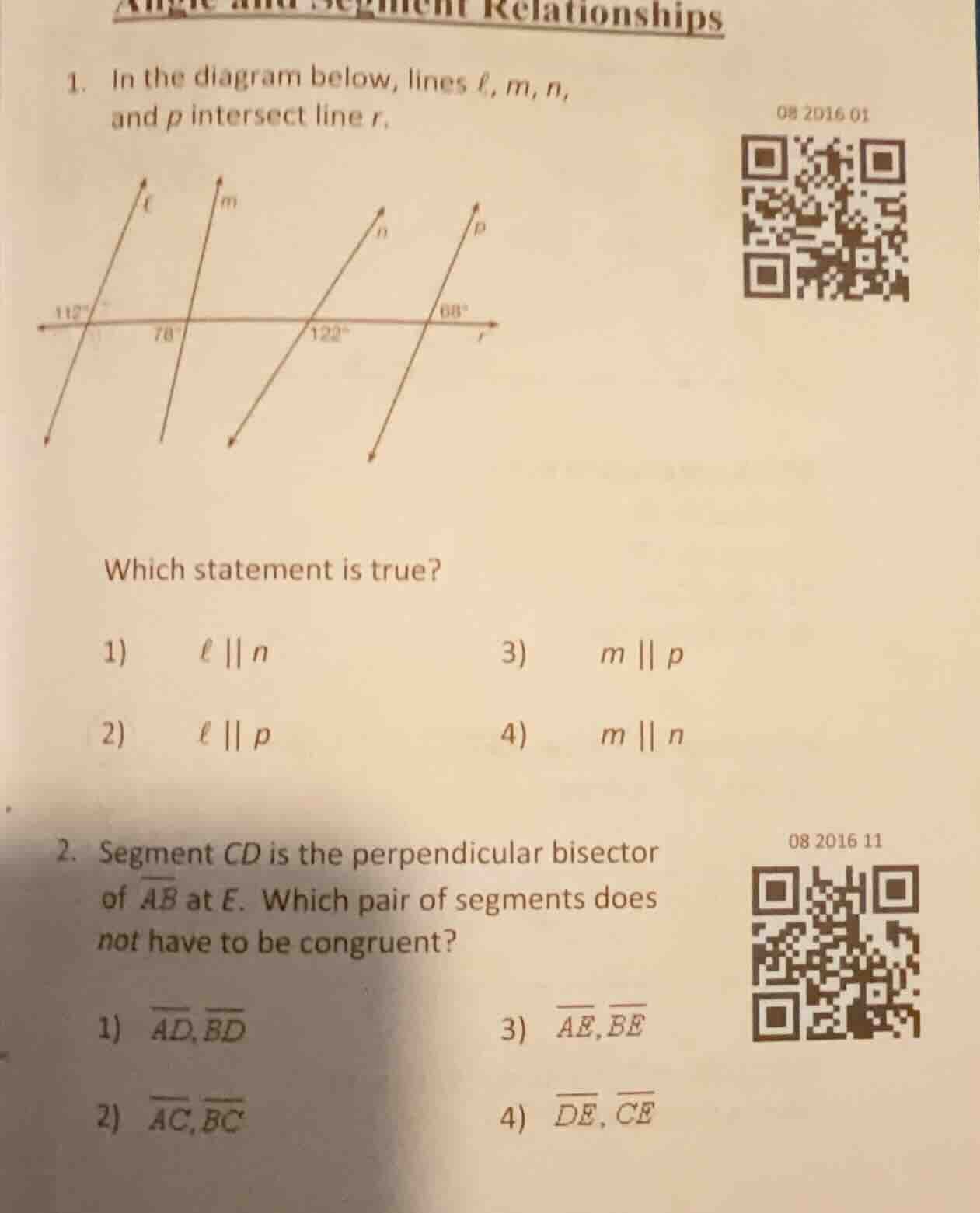
- in the diagram below, lines ( ell ), ( m ), ( n ), and ( p ) intersect line ( r ).
which statement is true?
- ( ell parallel n )
- ( m parallel p )
- ( ell parallel p )
- ( m parallel n )
- segment ( cd ) is the perpendicular bisector of ( overline{ab} ) at ( e ). which pair of segments does not have to be congruent?
- ( overline{ad}, overline{bd} )
- ( overline{ae}, overline{be} )
- ( overline{ac}, overline{bc} )
- ( overline{de}, overline{ce} )
Question 1 Step1: Find $\ell$'s corresponding angle
The 112° angle for $\ell$ has a supplementary angle on line $r$: $180^\circ - 112^\circ = 68^\circ$. The corresponding angle for line $n$ on $r$ is $180^\circ - 122^\circ = 68^\circ$.
Question 1 Step2: Match equal corresponding angles
Since $\ell$ and $n$ have equal corresponding angles ($68^\circ$), $\ell \parallel n$.
Question 2 Step1: Recall perpendicular bisector properties
A perpendicular bisector of $\overline{AB}$ at $E$ means $\overline{AE}=\overline{BE}$, and any point on $CD$ is equidistant from $A$ and $B$, so $\overline{AD}=\overline{BD}$, $\overline{AC}=\overline{BC}$.
Question 2 Step2: Identify non-congruent segments
There is no rule that requires $\overline{DE}$ and $\overline{CE}$ to be congruent; $E$ is the midpoint of $\overline{AB}$, not necessarily of $\overline{CD}$.

Snap & solve any problem in the app
Get step-by-step solutions on Sovi AI
Photo-based solutions with guided steps
Explore more problems and detailed explanations
- 1) $\ell \parallel n$
- 4) $\overline{DE}, \overline{CE}$