QUESTION IMAGE
Question
angles and triangles - unit test a
watsonkb84r@grpsed.org switch account
not shared
- indicates required question
question 17
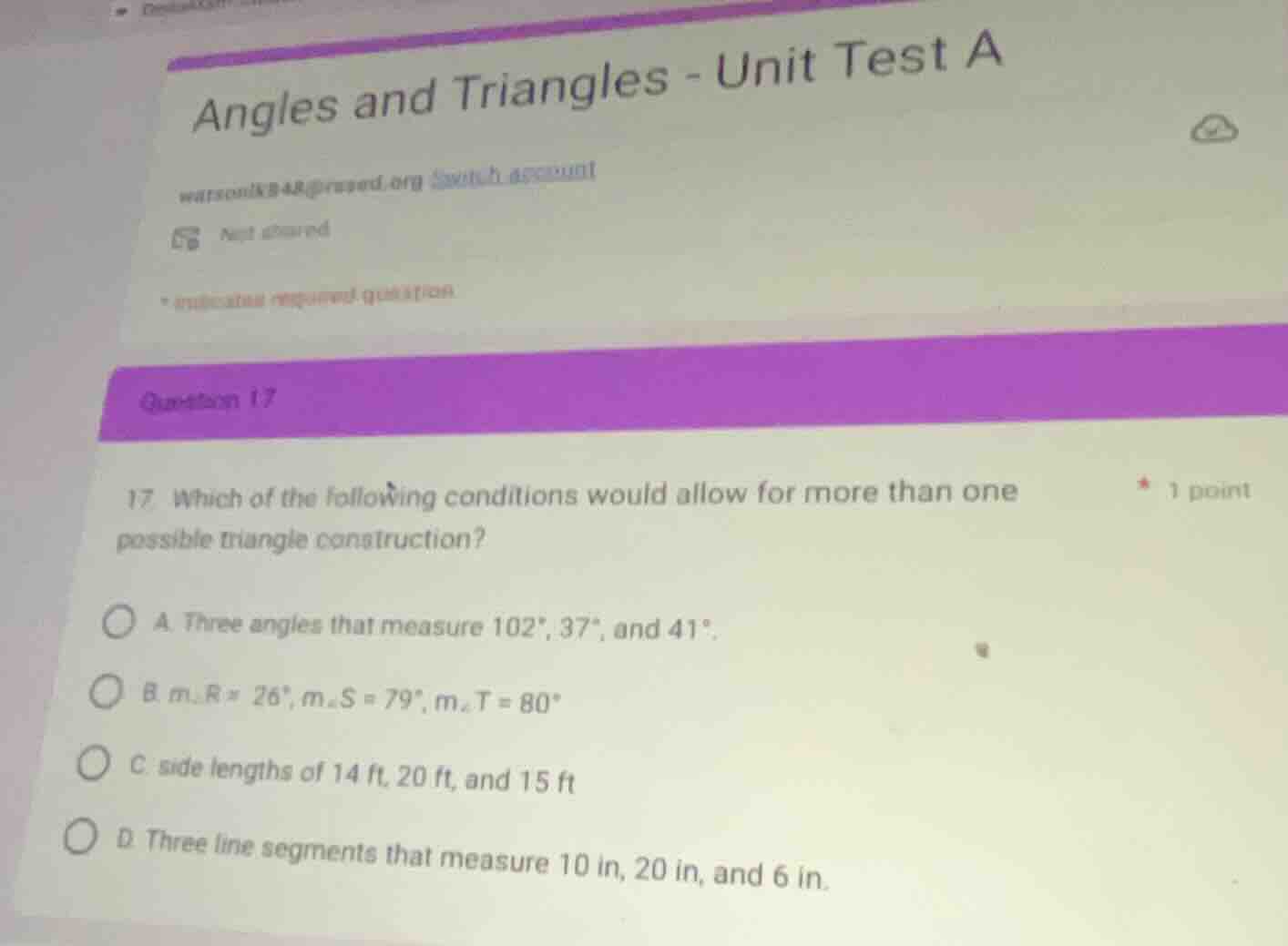
17 which of the following conditions would allow for more than one possible triangle construction?
- 1 point
a. three angles that measure 102°, 37°, and 41°.
b. m∠r = 26°, m∠s = 79°, m∠t = 80°
c. side lengths of 14 ft, 20 ft, and 15 ft
d. three line segments that measure 10 in, 20 in, and 6 in.
To determine which condition allows more than one triangle construction, we analyze each option:
- Option A: Three angles (102°, 37°, 41°) sum to 180° (102 + 37 + 41 = 180). However, knowing only angles (AAA) defines similar triangles, but the side lengths can vary (infinite similar triangles, but the problem likely refers to non - similar, unique - shaped triangles. Wait, no—actually, when only angles are given, the triangle is determined up to similarity, but if we consider constructing a triangle with those angles, we can have triangles of different sizes (but same shape). But let's check other options.
- Option B: Angles sum to 26+79 + 80=185≠180. So this is not a valid triangle, so no triangle can be constructed.
- Option C: For side lengths 14 ft, 20 ft, 15 ft, we check the triangle inequality: 14 + 15>20 (29>20), 14+20>15 (34>15), 15 + 20>14 (35>14). A triangle with three given side lengths (SSS) has a unique shape and size (congruent triangles), so only one triangle can be constructed. Wait, maybe I made a mistake with Option A. Wait, no—actually, when we have three angles (AAA), the triangle is determined up to similarity, meaning there are infinitely many triangles with those angle measures (different side lengths), so more than one triangle (of different sizes) can be constructed. Wait, but let's re - evaluate:
Wait, the question is about "more than one possible triangle construction" (i.e., non - congruent triangles). Let's re - check each option:
- Option A: Angles sum to 180. With AAA, we can have triangles of different side lengths (similar triangles), so multiple triangles (different sizes) can be constructed.
- Option B: Angles sum to 26 + 79+80 = 185, which is not 180, so no triangle.
- Option C: SSS (14, 20, 15) gives a unique triangle (by SSS congruence criterion), so only one triangle.
- Option D: Check triangle inequality: 6+10 = 16<20, so no triangle can be constructed.
Wait, but maybe the initial analysis of Option A was wrong. Wait, the problem says "more than one possible triangle construction" (i.e., different triangles, not just similar). Wait, no—if we are constructing a triangle with given angles, we can choose any side length, so we can have multiple triangles (different sizes) with those angles. So Option A allows for more than one triangle (of different sizes) to be constructed.
Wait, but let's check again:
- Option A: Angles sum to 180. So it's a valid set of angles. When we know three angles, the triangle is determined up to similarity, so there are infinitely many triangles with those angles (different side lengths), so more than one triangle can be constructed.
- Option B: Angles don't sum to 180, so no triangle.
- Option C: SSS, unique triangle.
- Option D: Fails triangle inequality, no triangle.
So the correct answer is A.

Snap & solve any problem in the app
Get step-by-step solutions on Sovi AI
Photo-based solutions with guided steps
Explore more problems and detailed explanations
A. Three angles that measure \(102^{\circ}\), \(37^{\circ}\), and \(41^{\circ}\)