QUESTION IMAGE
Question
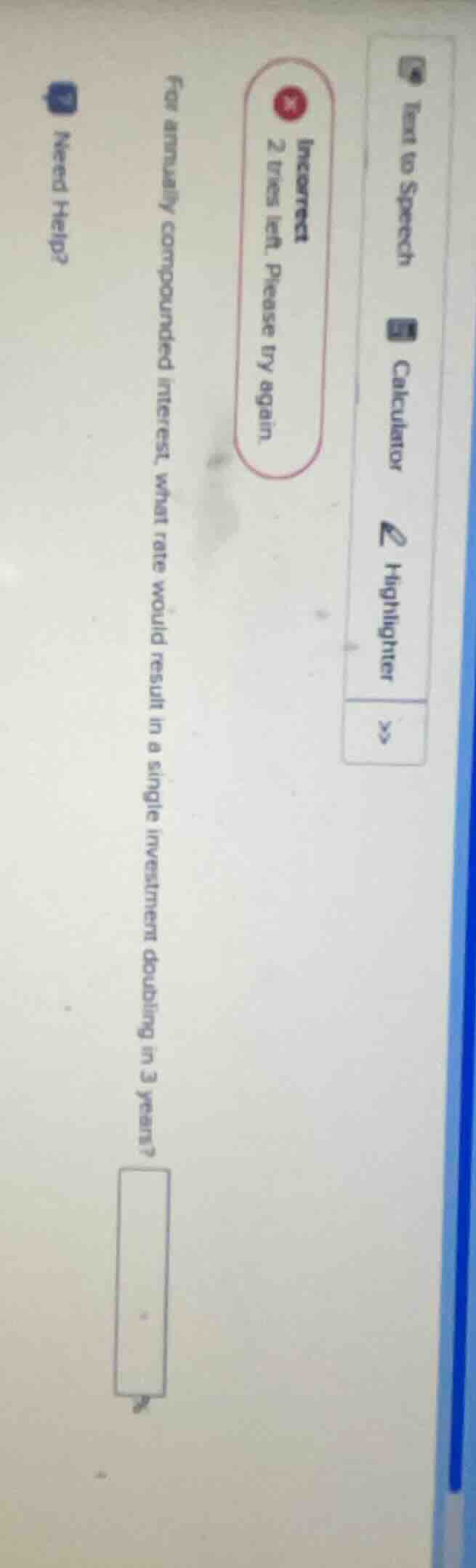
for annually compounded interest, what rate would result in a single investment doubling in 3 years?
Step1: Recall compound interest formula
The formula for annual compound interest is $A = P(1 + r)^t$, where $A$ is the amount, $P$ is the principal, $r$ is the annual interest rate (in decimal), and $t$ is the time in years. We want the investment to double, so $A = 2P$, and $t = 3$ years. Substituting these into the formula: $2P = P(1 + r)^3$.
Step2: Solve for \( r \)
Divide both sides by \( P \) (since \( P
eq 0 \)): $2=(1 + r)^3$. Then take the cube root of both sides: $1 + r=\sqrt[3]{2}$. Calculate $\sqrt[3]{2}\approx1.26$. Then subtract 1: $r\approx1.26 - 1 = 0.26$. To convert to a percentage, multiply by 100: $r\approx26\%$. (More precisely, using the formula $r = 2^{\frac{1}{t}}-1$, for $t = 3$, $r=2^{\frac{1}{3}}-1\approx1.2599 - 1 = 0.2599\approx26\%$)

Snap & solve any problem in the app
Get step-by-step solutions on Sovi AI
Photo-based solutions with guided steps
Explore more problems and detailed explanations
The annual interest rate is approximately \( 26\% \) (or more precisely \( 25.99\% \)).