QUESTION IMAGE
Question
another example!
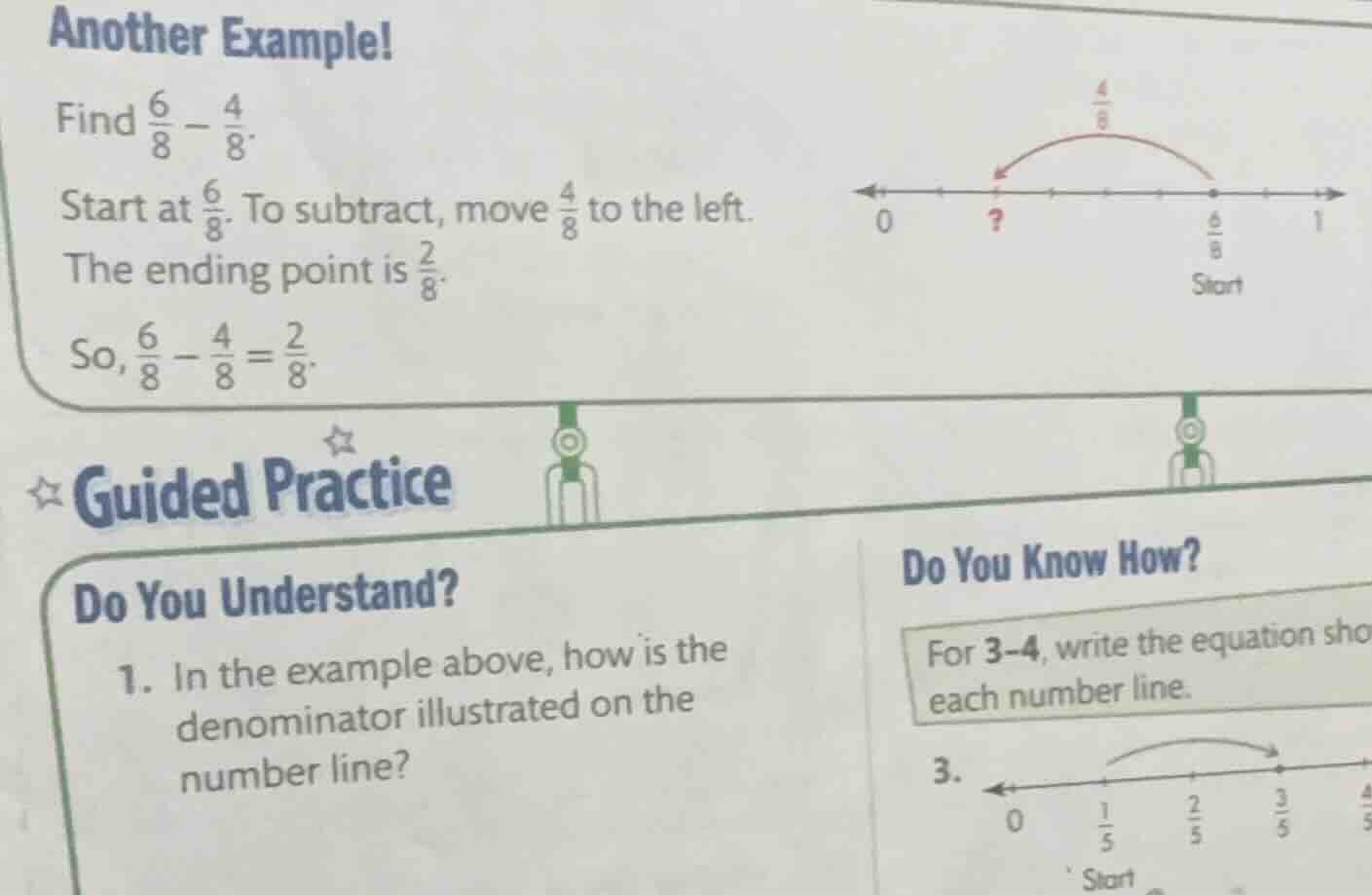
find \\(\frac{6}{8} - \frac{4}{8}\\).
start at \\(\frac{6}{8}\\). to subtract, move \\(\frac{4}{8}\\) to the left.
the ending point is \\(\frac{2}{8}\\).
so, \\(\frac{6}{8} - \frac{4}{8} = \frac{2}{8}\\).
guided practice
do you understand?
- in the example above, how is the denominator illustrated on the number line?
do you know how?
for 3–4, write the equation sho
each number line.
3.
start
Do You Understand? 1
The denominator is 8. On the number line, the interval from 0 to 1 is divided into 8 equal - length segments (or parts). This is because when dealing with fractions with a denominator of 8, like \(\frac{6}{8}\), \(\frac{4}{8}\), and \(\frac{2}{8}\), the number line is partitioned into 8 equal parts to represent these eighths. Each part of the number line corresponds to \(\frac{1}{8}\) of the whole (the interval from 0 to 1), so the denominator 8 is shown by dividing the unit (0 - 1) into 8 equal sections.
Step 1: Identify the start and end points and the movement
The start point on the number line is \(\frac{1}{5}\), and the end point is \(\frac{3}{5}\). The length of the arrow (the movement) is \(\frac{3}{5}-\frac{1}{5}\).
Step 2: Calculate the difference
We know that for fractions with the same denominator, we subtract the numerators. So \(\frac{3}{5}-\frac{1}{5}=\frac{3 - 1}{5}=\frac{2}{5}\). So the equation represented by the number line is \(\frac{1}{5}+\frac{2}{5}=\frac{3}{5}\) (since we start at \(\frac{1}{5}\) and move \(\frac{2}{5}\) to the right to reach \(\frac{3}{5}\)).

Snap & solve any problem in the app
Get step-by-step solutions on Sovi AI
Photo-based solutions with guided steps
Explore more problems and detailed explanations
The interval from 0 to 1 on the number line is divided into 8 equal parts, and each part represents \(\frac{1}{8}\), which illustrates the denominator 8.