QUESTION IMAGE
Question
answer all questions in this part.
directions (1–28): for each statement or question, record on your separate answer sheet the number o
the word or expression that, of those given, best completes the statement or answers the question.
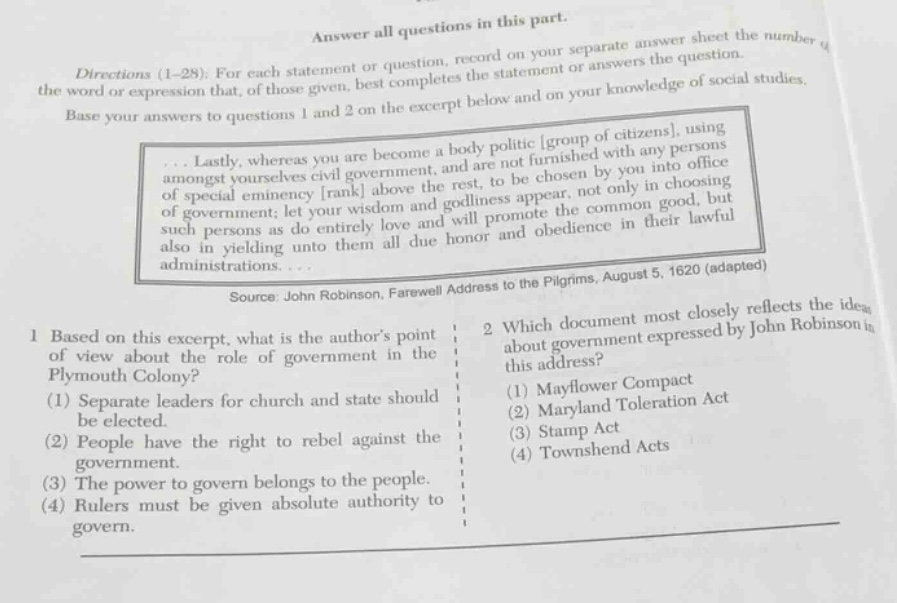
base your answers to questions 1 and 2 on the excerpt below and on your knowledge of social studies.
... lastly, whereas you are become a body politic group of citizens, using
amongst yourselves civil government, and are not furnished with any persons
of special eminency rank above the rest, to be chosen by you into office
of government; let your wisdom and godliness appear, not only in choosing
such persons as do entirely love and will promote the common good, but
also in yielding unto them all due honor and obedience in their lawful
administrations. ...
source: john robinson, farewell address to the pilgrims, august 5, 1620 (adapted)
1 based on this excerpt, what is the author’s point of view about the role of government in the plymouth colony?
(1) separate leaders for church and state should be elected.
(2) people have the right to rebel against the government.
(3) the power to govern belongs to the people.
(4) rulers must be given absolute authority to govern.
2 which document most closely reflects the ideas about government expressed by john robinson in this address?
(1) mayflower compact
(2) maryland toleration act
(3) stamp act
(4) townshend acts
Question 1
- Analyze option (1): The excerpt doesn't mention separating church and state leaders, so eliminate.
- Analyze option (2): No mention of right to rebel, eliminate.
- Analyze option (3): The excerpt says people should choose those who love the common good, implying power to govern is with people. This fits.
- Analyze option (4): The excerpt says to choose leaders who promote common good, not give absolute authority, eliminate.
- Analyze Mayflower Compact: It was an agreement by Pilgrims to govern themselves, reflecting people - centered government, matching Robinson's ideas.
- Analyze Maryland Toleration Act: It was about religious tolerance, not about government structure as per Robinson's address.
- Analyze Stamp Act: It was a tax act, not related to government ideas in the address.
- Analyze Townshend Acts: Also tax acts, not related to the government ideas here.

Snap & solve any problem in the app
Get step-by-step solutions on Sovi AI
Photo-based solutions with guided steps
Explore more problems and detailed explanations
(3) The power to govern belongs to the people.