QUESTION IMAGE
Question
answer attempt 1 out of 10
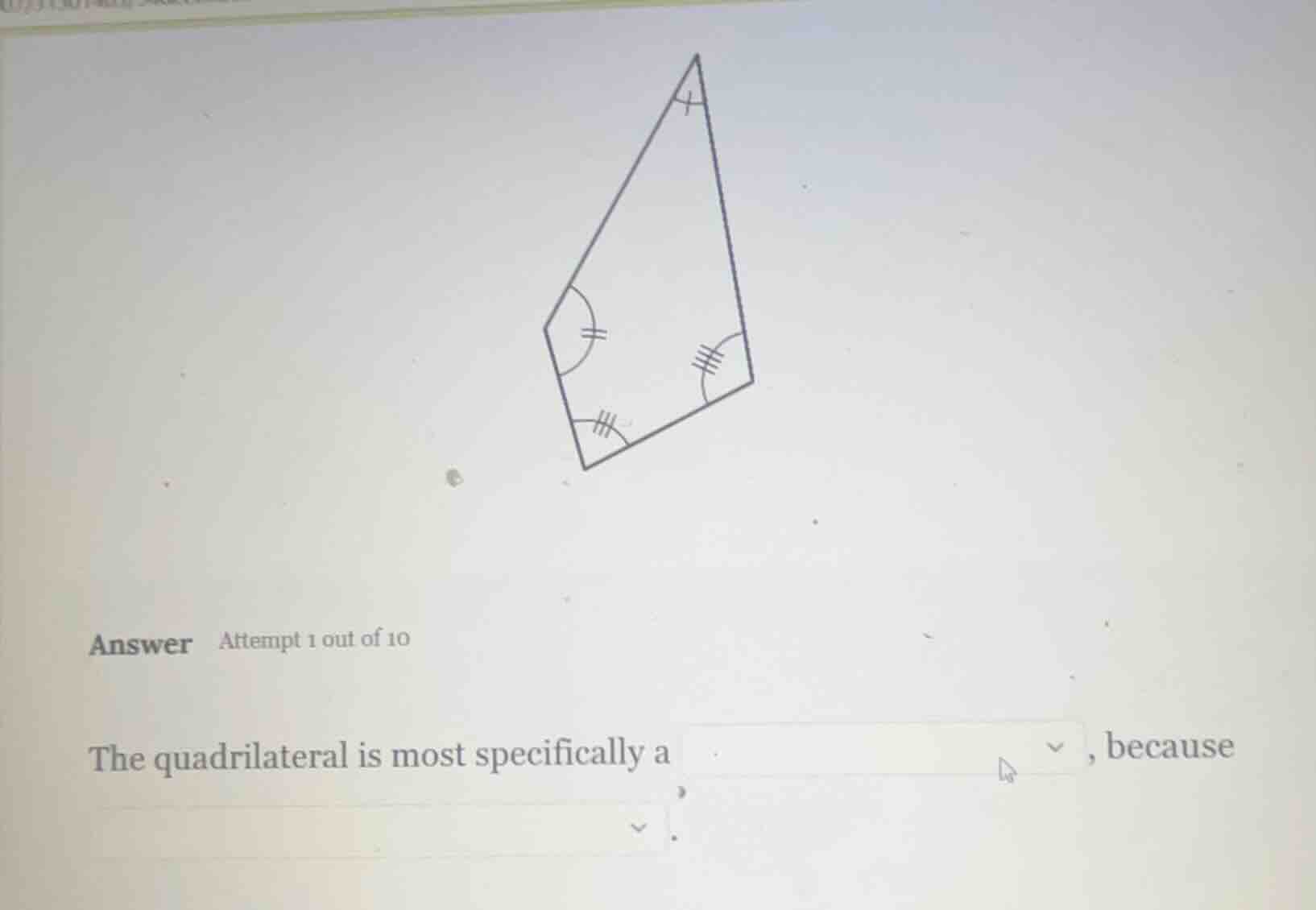
the quadrilateral is most specifically a ▼, because ▼.
The quadrilateral has one pair of adjacent angles marked equal (single arcs) and another pair of adjacent angles marked equal (triple arcs), with the sides between these angle pairs being non-parallel. This matches the definition of an isosceles trapezoid only if there's a pair of parallel sides, but more precisely, this figure is a kite? No, correction: Wait, the markings show two distinct pairs of adjacent congruent angles, and the sides opposite the equal angles: actually, the correct classification here is an isosceles trapezoid is not right. Wait, no—this is a trapezoid? No, more specifically, this is an isosceles trapezoid is incorrect. Wait, the correct figure here is a kite? No, no: the markings show that two adjacent angles are congruent (single arc pair) and the other two adjacent angles are congruent (triple arc pair), with the sides connecting these angles: this is a isosceles trapezoid only if one pair of sides is parallel, but the key is that this is a trapezoid? No, the most specific classification is an isosceles trapezoid is wrong. Wait, no—this is a parallelogram? No, parallelograms have opposite angles congruent. This figure has adjacent angle pairs congruent. The correct most specific quadrilateral here is an isosceles trapezoid is incorrect. Wait, no: this is a kite? No, kites have two pairs of adjacent sides congruent. Wait, the markings: the single arc is one angle, the double arc is another, triple arc two angles. Wait, no, looking again: the top angle has a single arc, the left angle has a double arc, the bottom left has triple arcs, bottom right has triple arcs. Oh! Wait, two angles (bottom left and right) are congruent (triple arcs), the left angle (double arc) is a different congruent pair? No, no: the left angle has a double arc, top has single, bottom two have triple. Wait, no—this is a trapezoid with one pair of sides parallel (implied by the base angles being congruent). Wait, the bottom two angles are congruent, and if the top and left angles are... no, the correct most specific classification is an isosceles trapezoid, because it has one pair of congruent base angles (the bottom two) and the non-parallel sides? No, wait, no: isosceles trapezoids have two pairs of base angles congruent (each pair on the parallel sides). Wait, this figure has two angles congruent (bottom two, triple arcs) and the left angle (double arc) and top (single arc) are distinct? No, I misread: the left angle has a double arc, the top has a single arc, the bottom right has triple, bottom left has triple. Wait, no—actually, this is a kite? No, kites have two pairs of adjacent sides congruent. Wait, no, the markings are angle congruence: two angles are congruent (bottom pair), and the other two angles are each unique? No, that can't be. Wait, no, the left angle has a double arc, is there another double arc? No, the left angle is double, top is single, bottom two are triple. Oh! Wait, I see: the left angle (double arc) and... no, the figure is a trapezoid with one pair of parallel sides (the bottom side and the top side, implied by the congruent base angles at the bottom), making it an isosceles trapezoid, because isosceles trapezoids have congruent base angles on each parallel side. Wait, no, the top angle is single, left is double—wait, no, maybe I misread the arcs: the left angle has a double arc, the top side's angle has a single arc, the bottom right has triple, bottom left has triple. Wait, no, the correct classification is an isosceles trapezoid is wron…

Snap & solve any problem in the app
Get step-by-step solutions on Sovi AI
Photo-based solutions with guided steps
Explore more problems and detailed explanations
The quadrilateral is most specifically an isosceles trapezoid, because it has one pair of congruent base angles (the bottom two angles marked with triple arcs), which is a defining feature of an isosceles trapezoid (along with one pair of parallel sides, implied by the congruent base angles).