QUESTION IMAGE
Question
answer the following question based on the patient history provided.
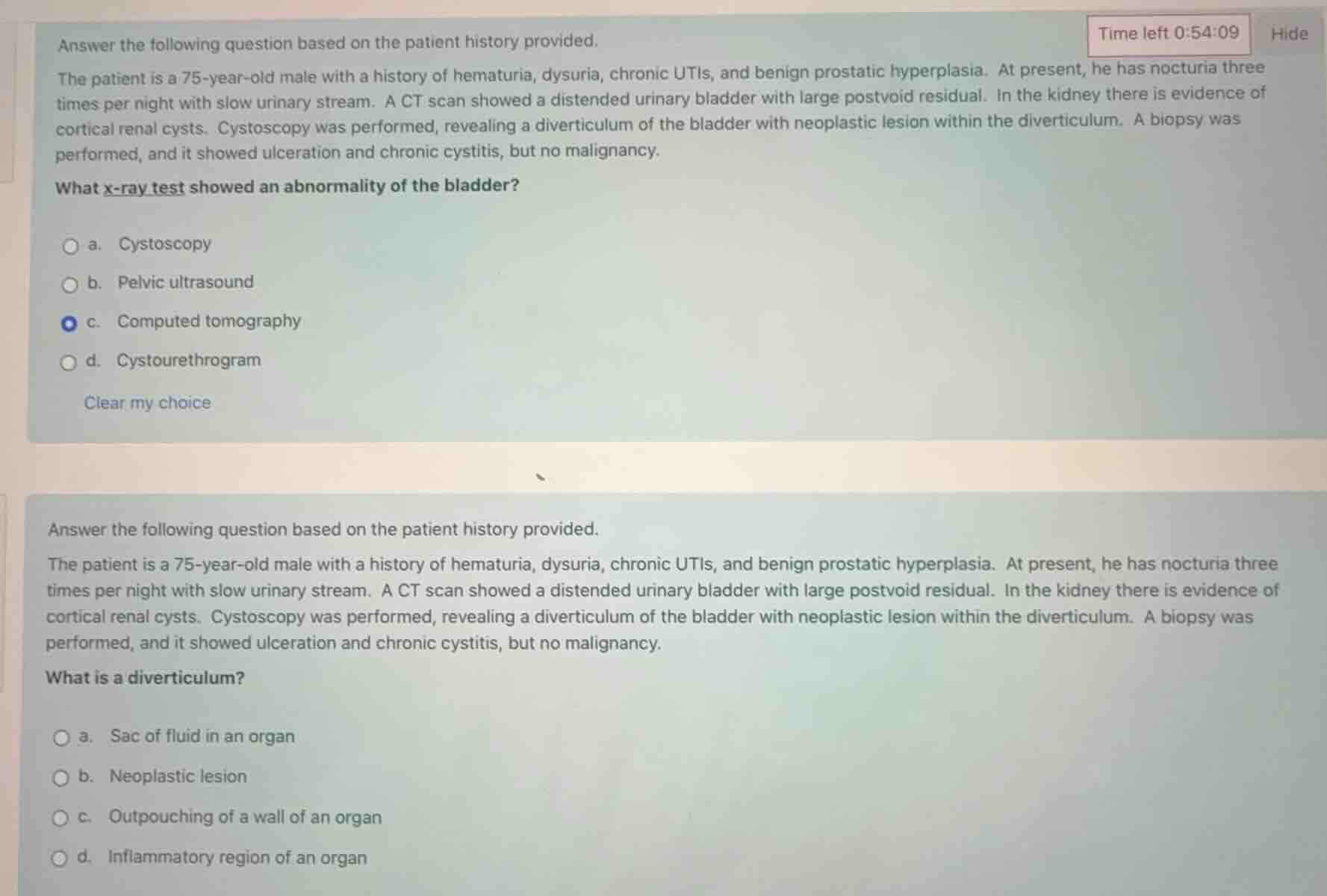
the patient is a 75 - year - old male with a history of hematuria, dysuria, chronic utis, and benign prostatic hyperplasia. at present, he has nocturia three times per night with slow urinary stream. a ct scan showed a distended urinary bladder with large postvoid residual. in the kidney there is evidence of cortical renal cysts. cystoscopy was performed, revealing a diverticulum of the bladder with neoplastic lesion within the diverticulum. a biopsy was performed, and it showed ulceration and chronic cystitis, but no malignancy.
what x - ray test showed an abnormality of the bladder?
a. cystoscopy
b. pelvic ultrasound
c. computed tomography
d. cystourethrogram
clear my choice
answer the following question based on the patient history provided.
the patient is a 75 - year - old male with a history of hematuria, dysuria, chronic utis, and benign prostatic hyperplasia. at present, he has nocturia three times per night with slow urinary stream. a ct scan showed a distended urinary bladder with large postvoid residual. in the kidney there is evidence of cortical renal cysts. cystoscopy was performed, revealing a diverticulum of the bladder with neoplastic lesion within the diverticulum. a biopsy was performed, and it showed ulceration and chronic cystitis, but no malignancy.
what is a diverticulum?
a. sac of fluid in an organ
b. neoplastic lesion
c. outpouching of a wall of an organ
d. inflammatory region of an organ
For the first question: CT (Computed tomography) is an x-ray based imaging test, and the case notes it showed a distended bladder with large postvoid residual. Cystoscopy is an endoscopic procedure, pelvic ultrasound uses sound waves, and cystourethrogram is not the test referenced here.
For the second question: A diverticulum is defined as an outpouching of an organ's wall; the other options do not match this standard medical definition.

Snap & solve any problem in the app
Get step-by-step solutions on Sovi AI
Photo-based solutions with guided steps
Explore more problems and detailed explanations
- c. Computed tomography
- c. Outpouching of a wall of an organ