QUESTION IMAGE
Question
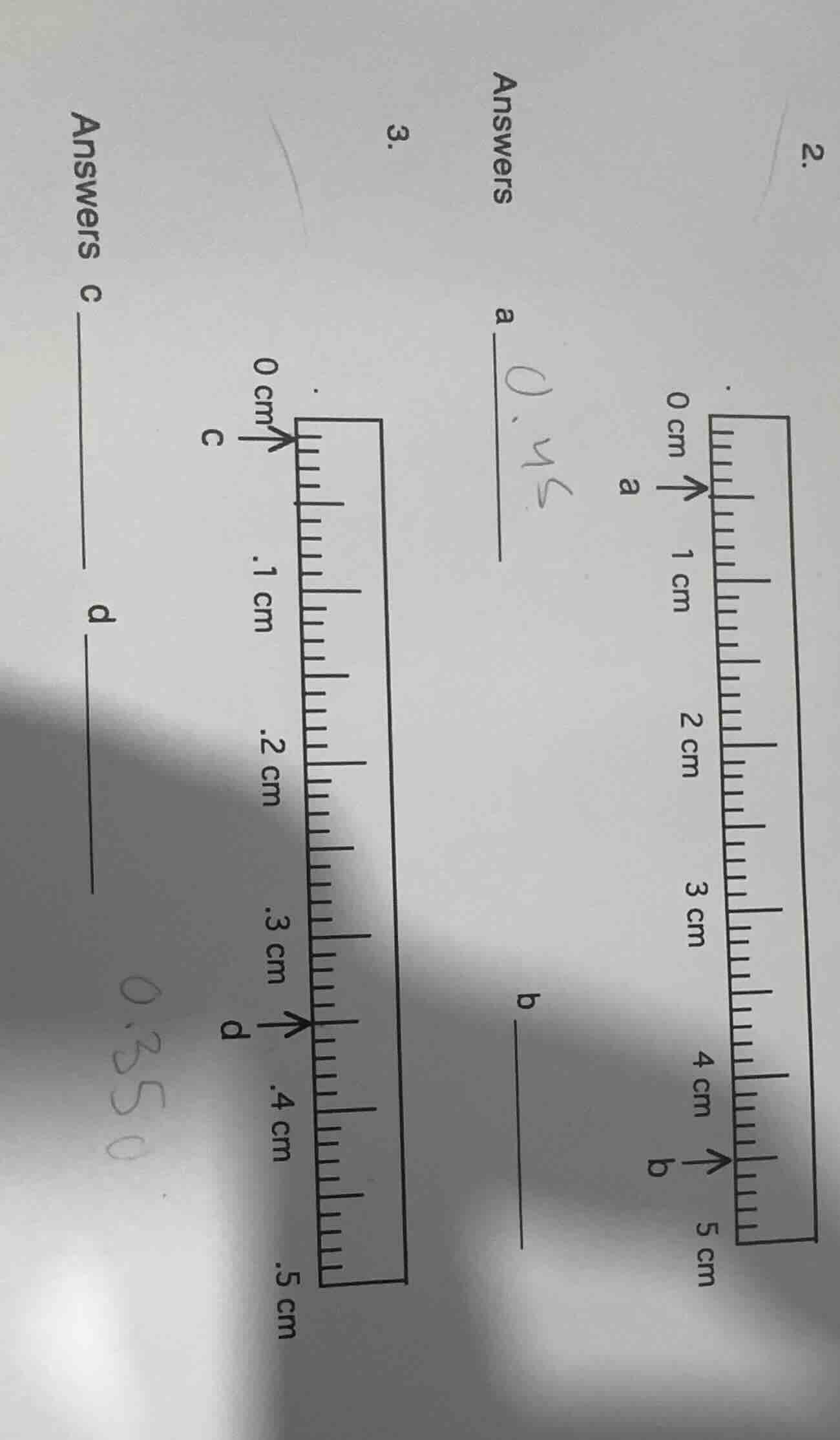
2.
answers
a
b
3.
answers c
d
Problem 2 (Ruler with 0 - 5 cm, major ticks at 1,2,3,4 cm, minor ticks between)
Part a
Step1: Identify the scale
The ruler has major ticks at 1 cm intervals, and between each major tick, there are 10 minor ticks (since from 0 to 1 cm, there are 10 small divisions). So each minor tick is \( \frac{1\ cm}{10}=0.1\ cm \).
Step2: Read the position of a
The arrow for a is at the 5th minor tick after 0 cm (since 0.5 cm is 5 * 0.1 cm). So the length is \( 0.5\ cm \).
Part b
Step1: Identify the scale (same as above, 0.1 cm per minor tick)
Step2: Read the position of b
The arrow for b is at the 45th minor tick? Wait, no. Wait, from 0 cm, each major tick is 1 cm. Let's see: 4 cm is a major tick, then after 4 cm, how many minor ticks? Wait, the arrow is at 4.5 cm? Wait, no, let's count. Wait, the ruler has 0,1,2,3,4,5 cm. Between 4 and 5 cm, there are 10 minor ticks. Wait, the arrow for b is at 4.5 cm? Wait, no, let's check again. Wait, the first ruler (problem 2) has 0,1,2,3,4,5 cm. The arrow for a is at 0.5 cm (5 mm), and arrow for b is at 4.5 cm? Wait, no, maybe I misread. Wait, the user's handwritten note for a is 0.45? Wait, no, the image shows a handwritten "0.45" for a? Wait, maybe the scale is different. Wait, maybe each major tick is 1 cm, and between each major tick, there are 20 minor ticks? Wait, no, let's look at the ruler: from 0 to 1 cm, how many minor ticks? If the arrow for a is at 0.45 cm, then maybe each minor tick is 0.05 cm (since 0.45 / 0.05 = 9 ticks). Wait, maybe the ruler has 20 divisions per cm (so each division is 0.05 cm). Let's re - evaluate.
Wait, let's take problem 2a: the arrow is at 0.45 cm? Wait, the handwritten note next to a is "0.45". Let's assume that the ruler has 0.05 cm per minor tick (since 0.45 is 9 * 0.05). So for part a:
Step1: Determine the scale
If between 0 and 1 cm, there are 20 minor ticks, then each tick is \( \frac{1\ cm}{20}=0.05\ cm \).
Step2: Read the position of a
The arrow is at the 9th tick (9 * 0.05 = 0.45 cm).
For part b:
Step1: Determine the scale (0.05 cm per minor tick)
Step2: Read the position of b
The arrow is at 4.5 cm? Wait, no, 4.5 cm is 45 0.1 cm, but if the scale is 0.05 cm per tick, then 4.5 cm is 90 0.05 cm. Wait, maybe the ruler for problem 2 has 0.05 cm (0.5 mm) per minor division. So:
- For a: The arrow is at 0.45 cm (9 * 0.05 cm)
- For b: The arrow is at 4.45 cm? No, the handwritten note next to b is blank. Wait, maybe I made a mistake. Let's move to problem 3.
Problem 3 (Ruler with 0 - 0.5 cm, major ticks at 0.1, 0.2, 0.3, 0.4, 0.5 cm)
Part c
Step1: Identify the scale
The ruler has major ticks at 0.1 cm intervals, and between each major tick, there are 10 minor ticks (since from 0 to 0.1 cm, there are 10 small divisions). So each minor tick is \( \frac{0.1\ cm}{10}=0.01\ cm \).
Step2: Read the position of c
The arrow for c is at 0 cm (since it's at the 0 mark). Wait, no, the arrow is at 0.00 cm? Wait, the ruler starts at 0 cm, and the arrow for c is at the 0 mark. Wait, but the handwritten note next to c is blank, and next to d is 0.350. Wait, maybe the scale is 0.01 cm per minor tick. For part c:
The arrow is at 0.00 cm (or 0 cm).
Part d

Snap & solve any problem in the app
Get step-by-step solutions on Sovi AI
Photo-based solutions with guided steps
Explore more problems and detailed explanations
0.45 cm