QUESTION IMAGE
Question
ap world
name
china review up to 1750
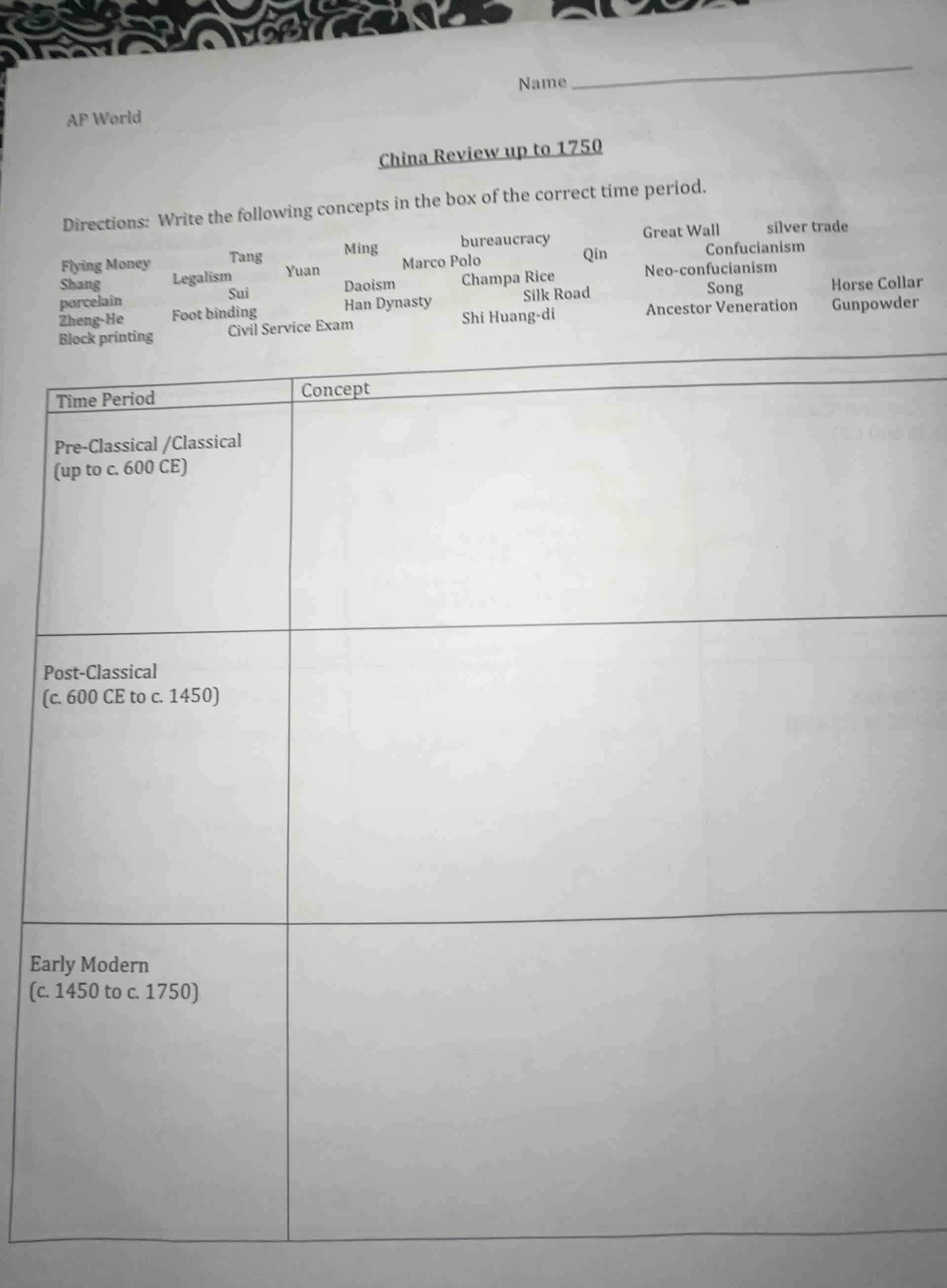
directions: write the following concepts in the box of the correct time period.
flying money tang ming bureaucracy great wall silver trade
shang legalism yuan marco polo qin confucianism
porcelain sui daoism champa rice neo - confucianism
zheng - he foot binding han dynasty silk road song horse collar
block printing civil service exam shi huang - di ancestor veneration gunpowder
| time period | concept |
|---|---|
| post - classical (c. 600 ce to c. 1450) | |
| early modern (c. 1450 to c. 1750) |
Response
Pre - Classical / Classical (up to c. 600 CE)
- Shang: One of the earliest Chinese dynasties, existing well before 600 CE.
- Legalism: Developed during the Warring States period, which was before 600 CE.
- Daoism: Originated in the pre - 600 CE era, with Laozi as a key figure.
- Qin: The Qin Dynasty (221 - 207 BCE) is within the pre - 600 CE time frame.
- Great Wall (Qin - era construction): The initial construction of the Great Wall was during the Qin Dynasty.
- Confucianism: Founded by Confucius (551 - 479 BCE), so it belongs to this period.
- Han Dynasty: The Han Dynasty (202 BCE - 220 CE) is within the pre - 600 CE period.
- Bureaucracy (Han - era development): The Han Dynasty further developed the bureaucratic system.
- Horse Collar: Developed in ancient China, well before 600 CE.
- Ancestor Veneration: A practice that has ancient roots in Chinese culture, predating 600 CE.
Post - Classical (c. 600 CE to c. 1450)
- Sui: The Sui Dynasty (581 - 618 CE) is at the start of this period.
- Tang: The Tang Dynasty (618 - 907 CE) is a major dynasty in this time frame.
- Song: The Song Dynasty (960 - 1279 CE) is within this period.
- Flying Money: A form of early credit in the Tang - Song period.
- Block printing: Developed during the Tang Dynasty.
- Champa Rice: Introduced to China during the Song Dynasty.
- Silk Road (Post - Classical developments): The Silk Road continued to be important during this period, with new trade dynamics.
- Foot binding: Became more prevalent during the Tang - Song period.
- Civil Service Exam (Tang - Song development): The civil service exam system was further developed during the Tang and Song dynasties.
- Yuan: The Yuan Dynasty (1271 - 1368 CE) is within this period.
- Marco Polo: Visited China during the Yuan Dynasty.
- Neo - Confucianism: Developed during the Song and Yuan periods.
- Gunpowder (military use development): Gunpowder was increasingly used in warfare during this period.
- Porcelain (Tang - Song excellence): Tang and Song dynasties were known for their porcelain production.
Early Modern (c. 1450 to c. 1750)
- Ming: The Ming Dynasty (1368 - 1644 CE) is within this period.
- Zheng - He: Zheng He's voyages (1405 - 1433) were during the early Ming Dynasty.
- Silver Trade: The global silver trade, with China's involvement, became significant during the Ming Dynasty (especially with the influx of New World silver).
- Neo - Confucianism (Ming - era influence): Neo - Confucianism continued to be influential during the Ming Dynasty.
- Civil Service Exam (Ming - era): The civil service exam system was still in use during the Ming Dynasty.
Filling the Table
| Time Period | Concept |
|---|---|
| Post - Classical (c. 600 CE to c. 1450) | Sui, Tang, Song, Flying Money, Block printing, Champa Rice, Silk Road, Foot binding, Civil Service Exam, Yuan, Marco Polo, Neo - Confucianism, Gunpowder, Porcelain |
| Early Modern (c. 1450 to c. 1750) | Ming, Zheng - He, Silver Trade, Neo - Confucianism, Civil Service Exam |

Snap & solve any problem in the app
Get step-by-step solutions on Sovi AI
Photo-based solutions with guided steps
Explore more problems and detailed explanations
Pre - Classical / Classical (up to c. 600 CE)
- Shang: One of the earliest Chinese dynasties, existing well before 600 CE.
- Legalism: Developed during the Warring States period, which was before 600 CE.
- Daoism: Originated in the pre - 600 CE era, with Laozi as a key figure.
- Qin: The Qin Dynasty (221 - 207 BCE) is within the pre - 600 CE time frame.
- Great Wall (Qin - era construction): The initial construction of the Great Wall was during the Qin Dynasty.
- Confucianism: Founded by Confucius (551 - 479 BCE), so it belongs to this period.
- Han Dynasty: The Han Dynasty (202 BCE - 220 CE) is within the pre - 600 CE period.
- Bureaucracy (Han - era development): The Han Dynasty further developed the bureaucratic system.
- Horse Collar: Developed in ancient China, well before 600 CE.
- Ancestor Veneration: A practice that has ancient roots in Chinese culture, predating 600 CE.
Post - Classical (c. 600 CE to c. 1450)
- Sui: The Sui Dynasty (581 - 618 CE) is at the start of this period.
- Tang: The Tang Dynasty (618 - 907 CE) is a major dynasty in this time frame.
- Song: The Song Dynasty (960 - 1279 CE) is within this period.
- Flying Money: A form of early credit in the Tang - Song period.
- Block printing: Developed during the Tang Dynasty.
- Champa Rice: Introduced to China during the Song Dynasty.
- Silk Road (Post - Classical developments): The Silk Road continued to be important during this period, with new trade dynamics.
- Foot binding: Became more prevalent during the Tang - Song period.
- Civil Service Exam (Tang - Song development): The civil service exam system was further developed during the Tang and Song dynasties.
- Yuan: The Yuan Dynasty (1271 - 1368 CE) is within this period.
- Marco Polo: Visited China during the Yuan Dynasty.
- Neo - Confucianism: Developed during the Song and Yuan periods.
- Gunpowder (military use development): Gunpowder was increasingly used in warfare during this period.
- Porcelain (Tang - Song excellence): Tang and Song dynasties were known for their porcelain production.
Early Modern (c. 1450 to c. 1750)
- Ming: The Ming Dynasty (1368 - 1644 CE) is within this period.
- Zheng - He: Zheng He's voyages (1405 - 1433) were during the early Ming Dynasty.
- Silver Trade: The global silver trade, with China's involvement, became significant during the Ming Dynasty (especially with the influx of New World silver).
- Neo - Confucianism (Ming - era influence): Neo - Confucianism continued to be influential during the Ming Dynasty.
- Civil Service Exam (Ming - era): The civil service exam system was still in use during the Ming Dynasty.
Filling the Table
| Time Period | Concept |
|---|---|
| Post - Classical (c. 600 CE to c. 1450) | Sui, Tang, Song, Flying Money, Block printing, Champa Rice, Silk Road, Foot binding, Civil Service Exam, Yuan, Marco Polo, Neo - Confucianism, Gunpowder, Porcelain |
| Early Modern (c. 1450 to c. 1750) | Ming, Zheng - He, Silver Trade, Neo - Confucianism, Civil Service Exam |