QUESTION IMAGE
Question
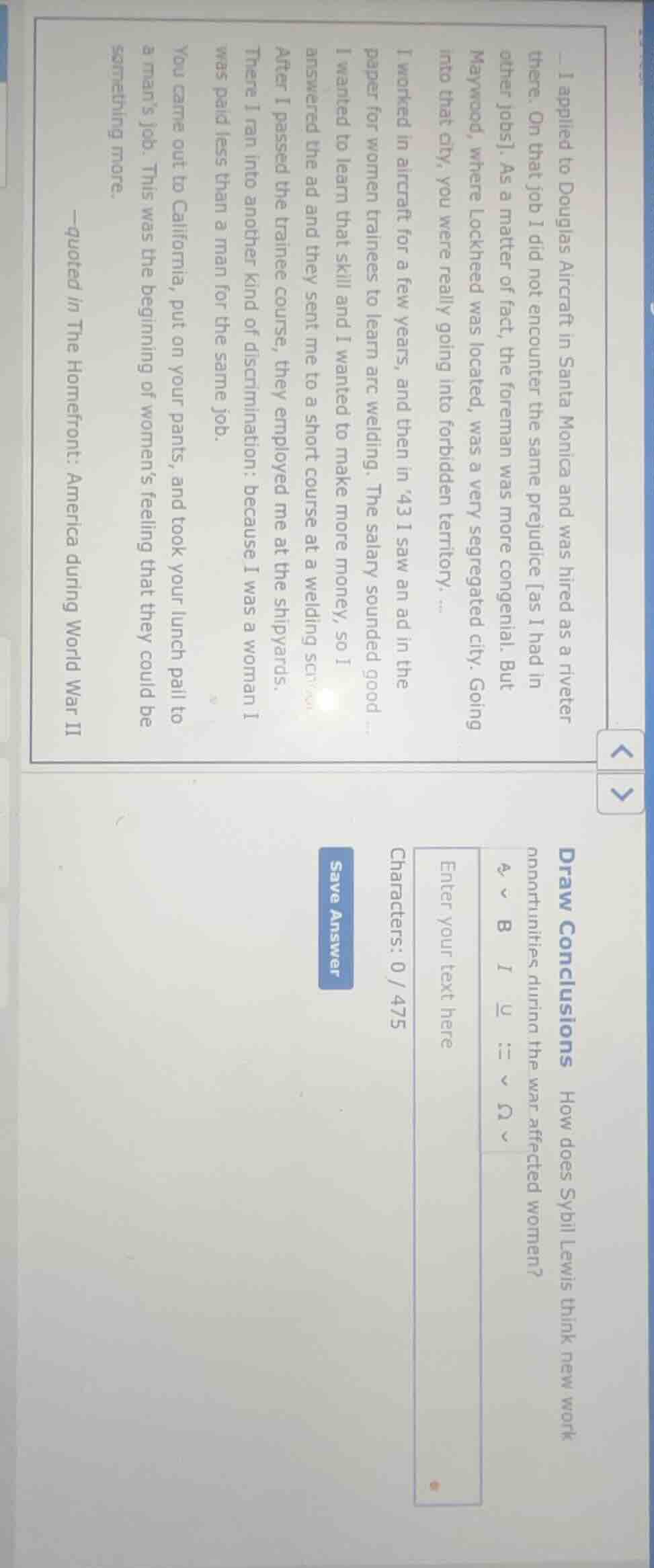
i applied to douglas aircraft in santa monica and was hired as a riveter there. on that job i did not encounter the same prejudice as i had in other jobs. as a matter of fact, the foreman was more congenial. but maywood, where lockheed was located, was a very segregated city. going into that city, you were really going into forbidden territory. ...
i worked in aircraft for a few years, and then in 43 i saw an ad in the paper for women trainees to learn arc welding. the salary sounded good i wanted to learn that skill and i wanted to make more money, so i answered the ad and they sent me to a short course at a welding sc... after i passed the trainee course, they employed me at the shipyards. there i ran into another kind of discrimination: because i was a woman i was paid less than a man for the same job.
you came out to california, put on your pants, and took your lunch pail to a mans job. this was the beginning of womens feeling that they could be something more.
—quoted in the homefront: america during world war ii
draw conclusions how does sybil lewis think new work opportunities during the war affected women?
Sybil Lewis saw new war work opportunities as a path to better pay and expanded skills, but noted they still came with gender discrimination (lower pay than men for the same job) and some segregated environments. However, these roles also marked a new beginning, letting women take on non-traditional "men's jobs" and gain a sense of greater capability.

Snap & solve any problem in the app
Get step-by-step solutions on Sovi AI
Photo-based solutions with guided steps
Explore more problems and detailed explanations
Sybil Lewis views new war work opportunities for women as a mixed experience: they provided access to higher-paying, skilled roles (like riveting and arc welding) that let women take on non-traditional jobs and build a sense of expanded capability, but these opportunities were still marred by gender discrimination (lower pay than men for identical work) and segregated work environments. Overall, she saw this as a new starting point for women to prove they could succeed in more roles.