QUESTION IMAGE
Question
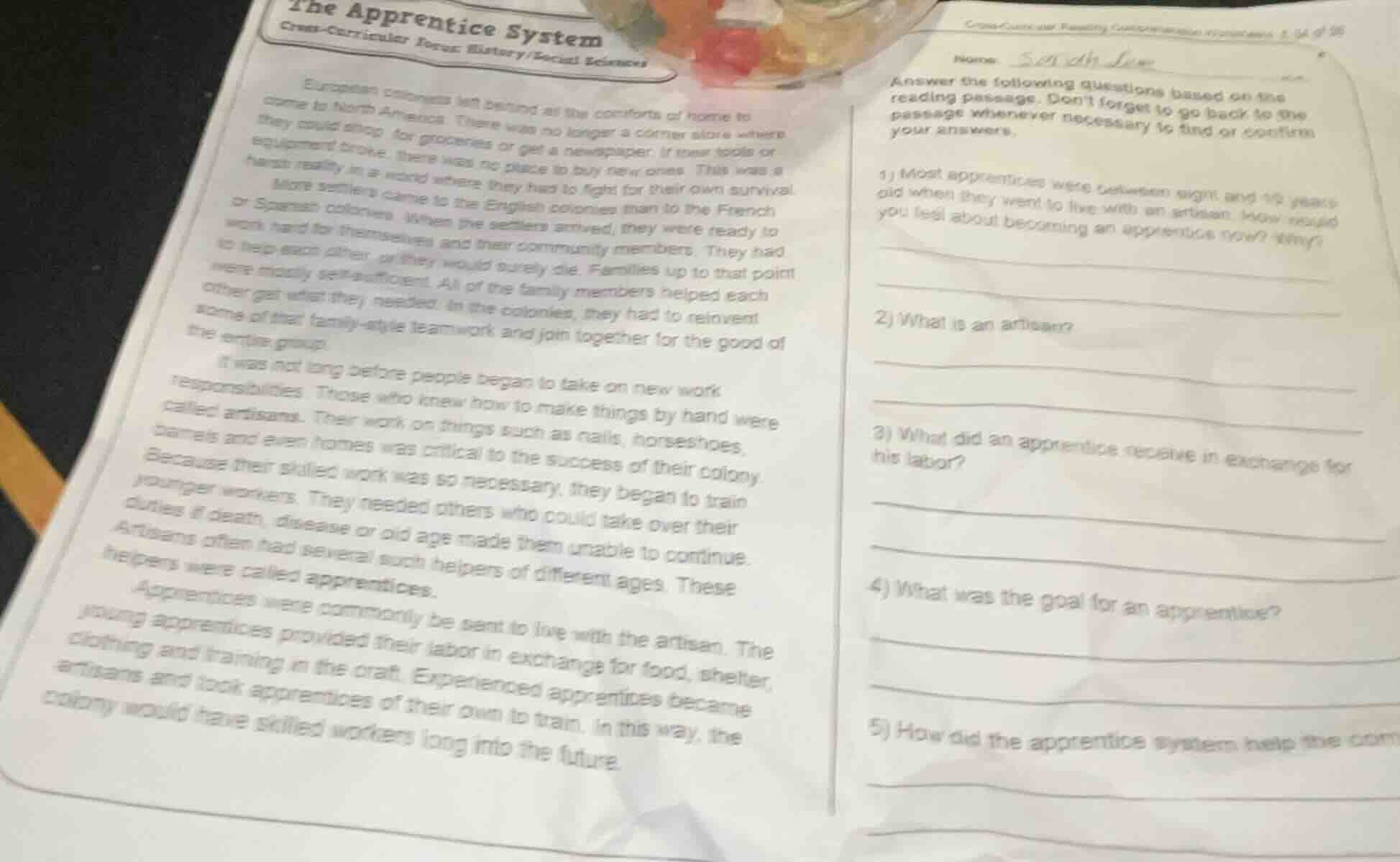
the apprentice system
cross - curricular focus: history/social sciences
european colonists left behind all the comforts of home to come to north america. there was no longer a corner store where they could shop for groceries or get a newspaper. if their tools or equipment broke, there was no place to buy new ones. this was a harsh reality in a world where they had to fight for their own survival.
more settlers came to the english colonies than to the french or spanish colonies. when the settlers arrived, they were ready to work hard for themselves and their community members. they had to help each other, or they would surely die. families up to that point were mostly self - sufficient. all of the family members helped each other get what they needed. in the colonies, they had to reinvent some of that family - style teamwork and join together for the good of the entire group.
it was not long before people began to take on new work responsibilities. those who knew how to make things by hand were called artisans. their work on things such as nails, horseshoes, barrels and even homes was critical to the success of their colony. because their skilled work was so necessary, they began to train younger workers. they needed others who could take over their duties if death, disease or old age made them unable to continue. artisans often had several such helpers of different ages. these helpers were called apprentices.
apprentices were commonly be sent to live with the artisan. the young apprentices provided their labor in exchange for food, shelter, clothing and training in the craft. experienced apprentices became artisans and took apprentices of their own to train. in this way, the colony would have skilled workers long into the future.
name:
answer the following questions based on the reading passage. dont forget to go back to the passage whenever necessary to find or confirm your answers.
- most apprentices were between eight and 19 years old when they went to live with an artisan. how would you feel about becoming an apprentice now? why?
- what is an artisan?
- what did an apprentice receive in exchange for his labor?
- what was the goal for an apprentice?
- how did the apprentice system help the col
Question 1
To answer this, we analyze the idea of being an apprentice now. First, consider the historical context (living with artisan, labor for training) and compare to modern feelings. For example, one might feel excited for learning a skill but hesitant about leaving home young. The key is to connect the historical apprentice experience (work for training, living with artisan) to personal feelings, explaining why (e.g., opportunity to learn a craft vs. loss of independence).
From the passage, find the definition of an artisan. The text says "Those who knew how to make things by hand were called artisans" and their work (nails, horseshoes, homes) was critical. So we extract that: someone who makes things by hand, with skilled manual labor, essential to the colony.
Locate the relevant sentence: "The young apprentices provided their labor in exchange for food, shelter, clothing and training in the craft." So we extract these items: food, shelter, clothing, and training in the craft.

Snap & solve any problem in the app
Get step-by-step solutions on Sovi AI
Photo-based solutions with guided steps
Explore more problems and detailed explanations
(Example) I would feel a mix of excitement and nervousness. Excited because I'd learn a valuable craft like blacksmithing or carpentry, but nervous about leaving home and the hard work. The historical apprentices were young, so the commitment and new environment would be challenging, but the skill gain is appealing.