QUESTION IMAGE
Question
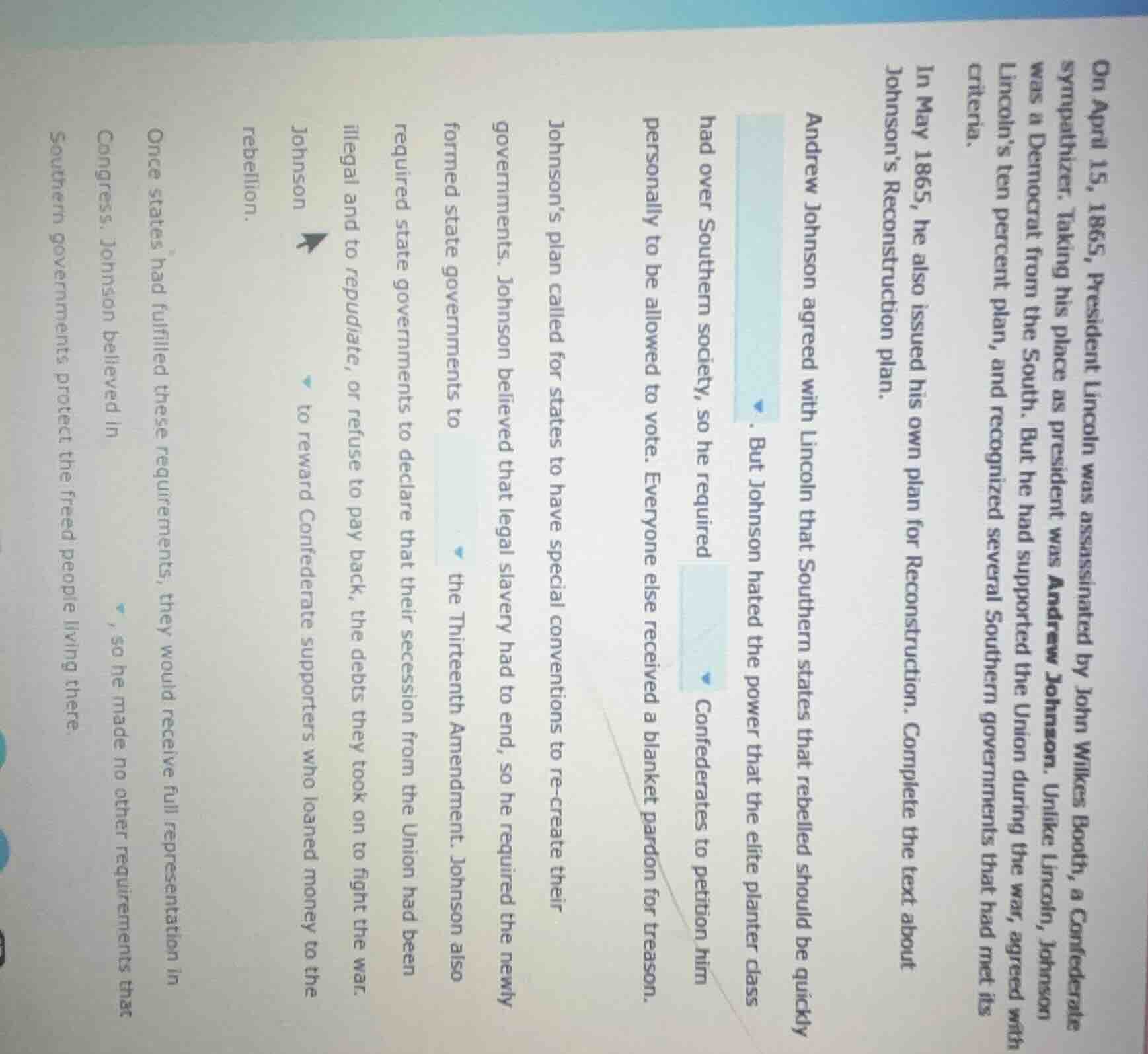
on april 15, 1865, president lincoln was assassinated by john wilkes booth, a confederate sympathizer. taking his place as president was andrew johnson. unlike lincoln, johnson was a democrat from the south. but he had supported the union during the war, agreed with lincoln’s ten percent plan, and recognized several southern governments that had met its criteria. in may 1865, he also issued his own plan for reconstruction. complete the text about johnson’s reconstruction plan. andrew johnson agreed with lincoln that southern states that rebelled should be quickly. but johnson hated the power that the elite planter class had over southern society, so he required confederates to petition him personally to be allowed to vote. everyone else received a blanket pardon for treason. johnson’s plan called for states to have special conventions to re - create their governments. johnson believed that legal slavery had to end, so he required the newly formed state governments to the thirteenth amendment. johnson also required state governments to declare that their secession from the union had been illegal and to repudiate, or refuse to pay back, the debts they took on to fight the war. johnson to reward confederate supporters who loaned money to the rebellion. once states had fulfilled these requirements, they would receive full representation in congress. johnson believed in southern governments protect the freed people living there.
- The first blank relates to Johnson's exception to his general pardon for Southerners; he targeted the elite planter class, so the phrase is "only the highest-ranking" (to specify the limited group excluded from automatic pardon).
- The second blank refers to the key constitutional amendment ending slavery that Southern states had to ratify, which is "ratify".
- The third blank describes Johnson's action toward Confederate supporters who loaned money to the rebellion, which is "refused" (he refused to reward them).
- The fourth blank reflects Johnson's core belief about Southern governments and freed people, which is "states' rights" (he prioritized state authority over federal protection of freed people).

Snap & solve any problem in the app
Get step-by-step solutions on Sovi AI
Photo-based solutions with guided steps
Explore more problems and detailed explanations
- First blank: only the highest-ranking
- Second blank: ratify
- Third blank: refused
- Fourth blank: states' rights
Full completed text segments:
- "But Johnson hated the power that the elite planter class had over Southern society, so he required only the highest-ranking Confederates to petition him personally to be allowed to vote."
- "Johnson believed that legal slavery had to end, so he required the newly formed state governments to ratify the Thirteenth Amendment."
- "Johnson refused to reward Confederate supporters who loaned money to the rebellion."
- "Johnson believed in states' rights, so he made no other requirements that Southern governments protect the freed people living there."