QUESTION IMAGE
Question
area of compound figures
page 2
keep going! find the area of each figure.
⑤
⑥
25 m
28 yd.
9 yd.
17 yd.
9 yd.
8 m
21 yd.
11 m
11 m
11 m
17 yd.
6 m
11 m
⑦
⑧
6 cm
6 ft.
15 cm
18 ft.
7 ft.
12 cm
5 ft.
12 ft.
12 cm
5 ft.
7 ft.
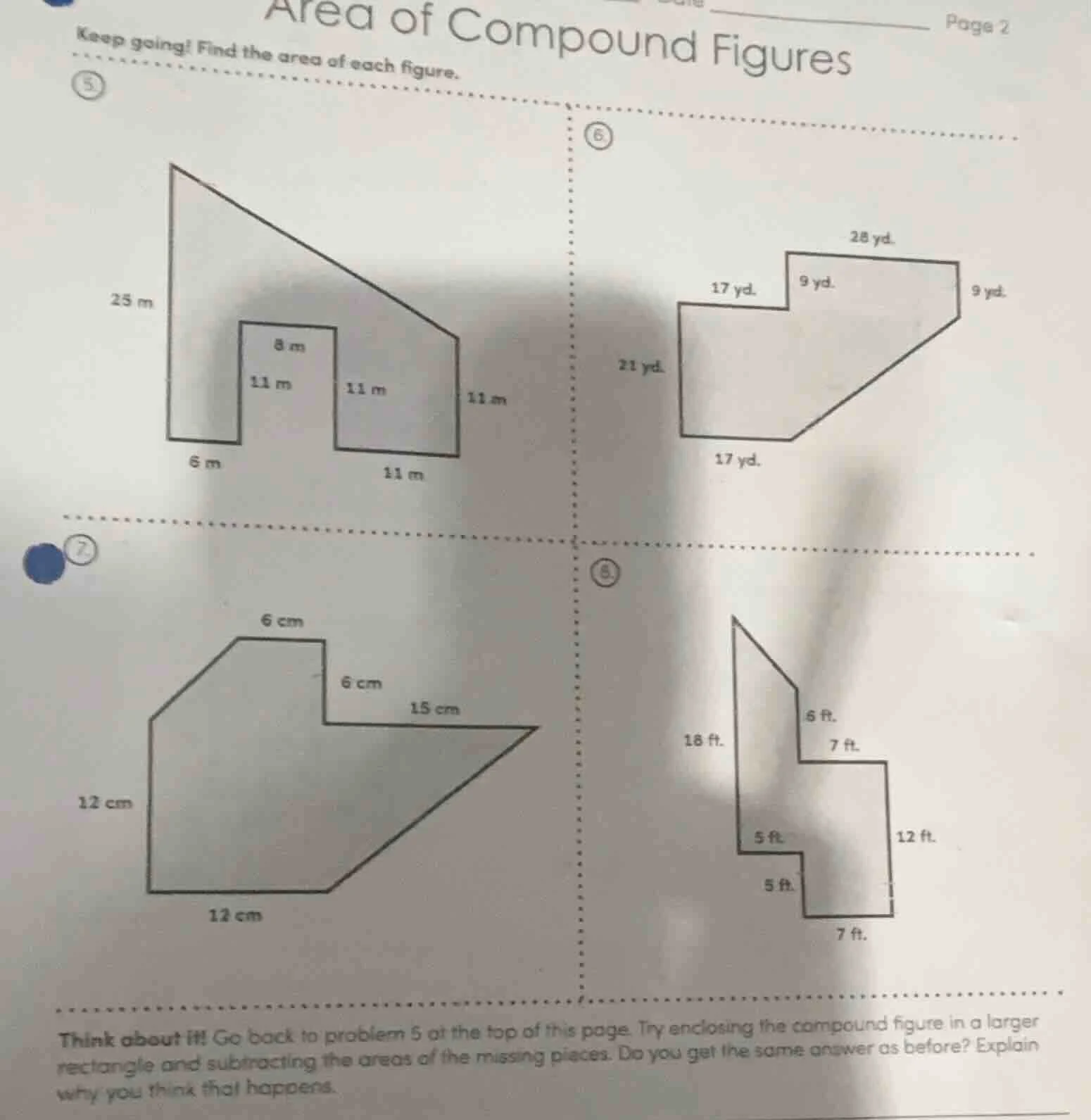
think about it! go back to problem 5 at the top of this page. try enclosing the compound figure in a larger rectangle and subtracting the areas of the missing pieces. do you get the same answer as before? explain why you think that happens.
Problem 5
Step1: Find base of outer trapezoid
Base = $6 + 8 + 11 = 25$ m
Step2: Calculate area of outer trapezoid
Area = $\frac{1}{2} \times (11 + 25) \times 25 = 450$ m²
Step3: Calculate area of inner rectangle
Area = $8 \times 11 = 88$ m²
Step4: Subtract inner from outer area
Area = $450 - 88 = 362$ m²
Problem 6
Step1: Split into rectangle + trapezoid
Rectangle: $17 \times 21$, Trapezoid bases: $17+9=26$, $28$
Step2: Calculate rectangle area
Area = $17 \times 21 = 357$ yd²
Step3: Calculate trapezoid area
Area = $\frac{1}{2} \times (26 + 28) \times 9 = 243$ yd²
Step4: Sum the two areas
Area = $357 + 243 = 600$ yd²
Problem 7
Step1: Split into rectangle + trapezoid
Rectangle: $12 \times 12$, Trapezoid bases: $6$, $12$, height: $15$
Step2: Calculate rectangle area
Area = $12 \times 12 = 144$ cm²
Step3: Calculate trapezoid area
Area = $\frac{1}{2} \times (6 + 12) \times 15 = 135$ cm²
Step4: Sum the two areas
Area = $144 + 135 = 279$ cm²
Problem 8
Step1: Split into trapezoid + 2 rectangles
Trapezoid bases: $12-5=7$, $18$, height: $5$; Rect1: $7 \times 7$, Rect2: $5 \times 7$
Step2: Calculate trapezoid area
Area = $\frac{1}{2} \times (7 + 18) \times 5 = 62.5$ ft²
Step3: Calculate rectangle areas
Area1 = $7 \times 7 = 49$ ft², Area2 = $5 \times 7 = 35$ ft²
Step4: Sum all areas
Area = $62.5 + 49 + 35 = 146.5$ ft²
Think about It (Problem 5)
Step1: Enclose in large rectangle
Dimensions: $25 \times 25 = 625$ m²
Step2: Calculate missing areas
2 triangles + inner rectangle:
Tri1: $\frac{1}{2} \times 14 \times 25 = 175$ m², Tri2: $\frac{1}{2} \times 14 \times 25 = 175$ m², Inner: $88$ m²
Total missing: $175+175+88=438$ m²
Step3: Subtract missing from large rectangle
Area = $625 - 438 = 362$ m²
Step4: Explain equivalence
Both methods calculate the same enclosed space, just using addition of parts vs subtraction of missing parts from a whole.

Snap & solve any problem in the app
Get step-by-step solutions on Sovi AI
Photo-based solutions with guided steps
Explore more problems and detailed explanations
- Problem 5: $\boldsymbol{362}$ square meters
- Problem 6: $\boldsymbol{600}$ square yards
- Problem 7: $\boldsymbol{279}$ square centimeters
- Problem 8: $\boldsymbol{146.5}$ square feet
- Think about It: Yes, the answer is the same (362 m²). Both methods measure the exact same shaded region—one adds the areas of the two outer sections, the other subtracts the unshaded regions from a larger enclosing shape, so they yield identical results.