QUESTION IMAGE
Question
assessment: orders
assessment: patient
implementation: medication retrieval
implementation: in - room medication checks
implementation: patient teaching and administration
implementation: documentation
evaluation: outcomes
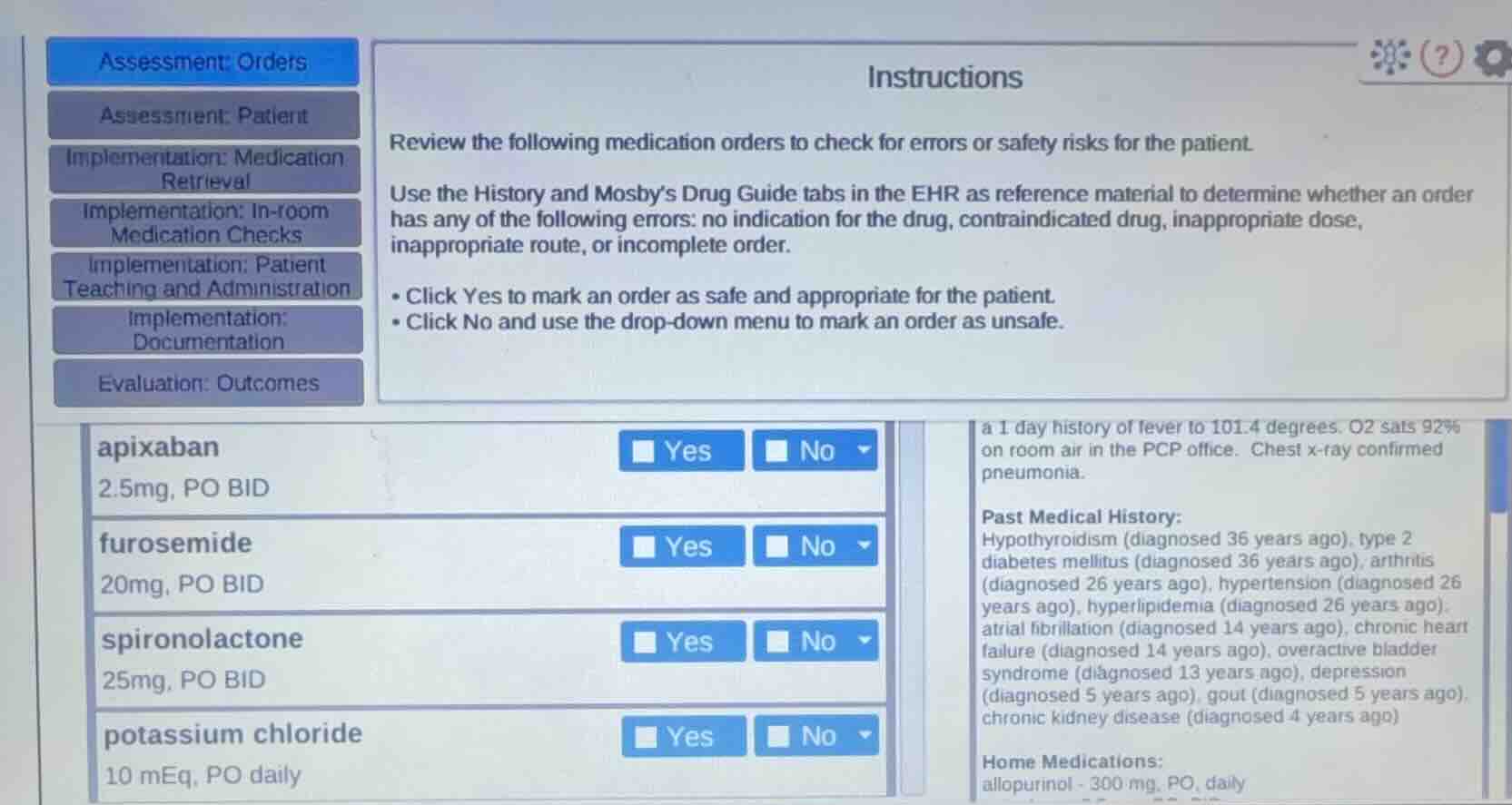
instructions
review the following medication orders to check for errors or safety risks for the patient.
use the history and mosbys drug guide tabs in the ehr as reference material to determine whether an order has any of the following errors: no indication for the drug, contraindicated drug, inappropriate dose, inappropriate route, or incomplete order.
- click yes to mark an order as safe and appropriate for the patient.
- click no and use the drop - down menu to mark an order as unsafe.
apixaban
2.5mg, po bid □ yes □ no ▼
furosemide
20mg, po bid □ yes □ no ▼
spironolactone
25mg, po bid □ yes □ no ▼
potassium chloride
10 meq, po daily □ yes □ no ▼
a 1 day history of fever to 101.4 degrees. o2 sats 92% on room air in the pcp office. chest x - ray confirmed pneumonia.
past medical history:
hypothyroidism (diagnosed 36 years ago), type 2 diabetes mellitus (diagnosed 36 years ago), arthritis (diagnosed 26 years ago), hypertension (diagnosed 26 years ago), hyperlipidemia (diagnosed 26 years ago), atrial fibrillation (diagnosed 14 years ago), chronic heart failure (diagnosed 14 years ago), overactive bladder syndrome (diagnosed 13 years ago), depression (diagnosed 5 years ago), gout (diagnosed 5 years ago), chronic kidney disease (diagnosed 4 years ago)
home medications:
allopurinol - 300 mg, po, daily
To determine the safety of each medication order, we analyze based on the patient's history:
1. Apixaban (2.5 mg, PO BID)
- Indication: Patient has atrial fibrillation (a condition where anticoagulants like apixaban are indicated to reduce stroke risk).
- Contraindications/Dose/Route: No obvious contraindication (e.g., severe renal impairment? Patient has chronic kidney disease, but apixaban can be used with caution; dose 2.5 mg BID is appropriate for some renal or stroke - risk profiles; PO route is standard).
- Decision: Safe → Click "Yes".
2. Furosemide (20 mg, PO BID)
- Indication: Patient has chronic heart failure (diuretics like furosemide manage fluid overload in heart failure).
- Contraindications/Dose/Route: No contraindication (hypothyroidism, diabetes, etc., do not contraindicate furosemide; 20 mg PO BID is a reasonable starting dose; PO route is appropriate).
- Decision: Safe → Click "Yes".
3. Spironolactone (25 mg, PO BID)
- Indication: Patient has chronic heart failure (spironolactone is used in heart failure to reduce morbidity/mortality, especially in combination with other diuretics).
- Contraindications/Dose/Route: No contraindication (gout? Spironolactone can cause hyperkalemia, but patient is on potassium chloride—need to monitor, but dose 25 mg BID is reasonable; PO route is standard).
- Decision: Safe → Click "Yes".
4. Potassium Chloride (10 mEq, PO daily)
- Indication: Patient is on diuretics (furosemide, spironolactone) which can cause potassium loss (furosemide is a loop diuretic, spironolactone is a potassium - sparing diuretic, but combined use may still require potassium supplementation; chronic kidney disease also affects potassium balance).
- Contraindications/Dose/Route: No contraindication (dose 10 mEq PO daily is reasonable for supplementation; PO route is standard).
- Decision: Safe → Click "Yes".
(Note: If there were specific contraindications (e.g., hyperkalemia, which is not indicated here) or inappropriate doses/routes, the decision would change. Based on the provided history, all orders appear safe.)

Snap & solve any problem in the app
Get step-by-step solutions on Sovi AI
Photo-based solutions with guided steps
Explore more problems and detailed explanations
s (for each medication, mark "Yes"):
- Apixaban: Yes
- Furosemide: Yes
- Spironolactone: Yes
- Potassium Chloride: Yes