QUESTION IMAGE
Question
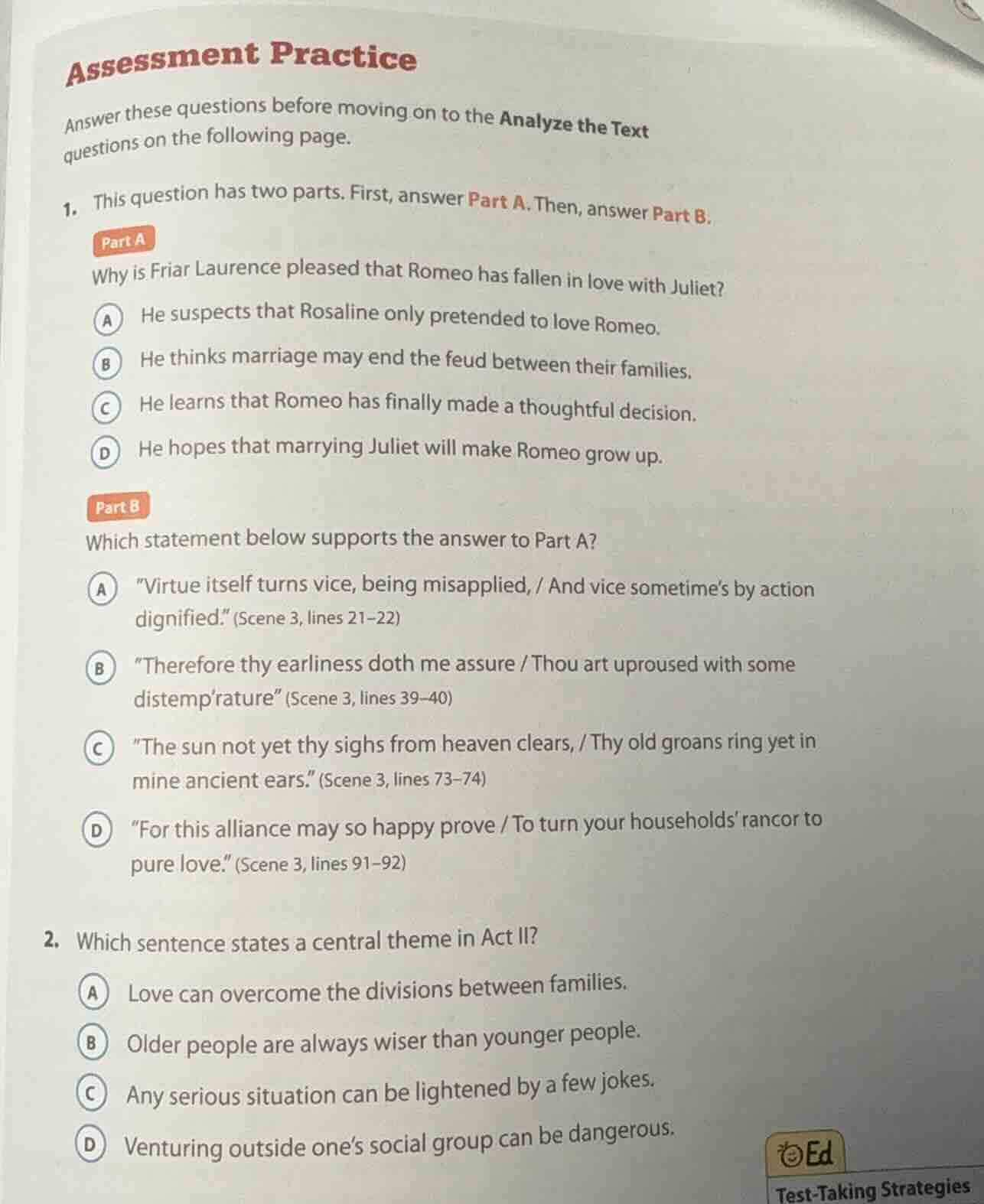
assessment practice
answer these questions before moving on to the analyze the text
questions on the following page.
- this question has two parts. first, answer part a. then, answer part b.
part a
why is friar laurence pleased that romeo has fallen in love with juliet?
a he suspects that rosaline only pretended to love romeo.
b he thinks marriage may end the feud between their families.
c he learns that romeo has finally made a thoughtful decision.
d he hopes that marrying juliet will make romeo grow up.
part b
which statement below supports the answer to part a?
a \virtue itself turns vice, being misapplied, / and vice sometimes by action dignified.\ (scene 3, lines 21-22)
b \therefore thy earliness doth me assure / thou art uproused with some distemprature\ (scene 3, lines 39-40)
c \the sun not yet thy sighs from heaven clears, / thy old groans ring yet in mine ancient ears.\ (scene 3, lines 73-74)
d \for this alliance may so happy prove / to turn your households rancor to pure love.\ (scene 3, lines 91-92)
- which sentence states a central theme in act ii?
a love can overcome the divisions between families.
b older people are always wiser than younger people.
c any serious situation can be lightened by a few jokes.
d venturing outside ones social group can be dangerous.
- Part A: In Romeo and Juliet, Friar Laurence is aware of the deadly feud between the Montagues and Capulets. He sees Romeo and Juliet's love as a chance to reconcile the two families.
- Part B: The quote directly references the alliance (Romeo and Juliet's marriage) turning the families' hatred into love, which aligns with the reason in Part A.
- Question 2: Act II centers on Romeo and Juliet's cross-family love, which seeks to bridge the long-standing division between their households, making this the central theme.

Snap & solve any problem in the app
Get step-by-step solutions on Sovi AI
Photo-based solutions with guided steps
Explore more problems and detailed explanations
- Part A: B. He thinks marriage may end the feud between their families.
Part B: D. "For this alliance may so happy prove / To turn your households' rancor to pure love." (Scene 3, lines 91-92)
- A. Love can overcome the divisions between families.