QUESTION IMAGE
Question
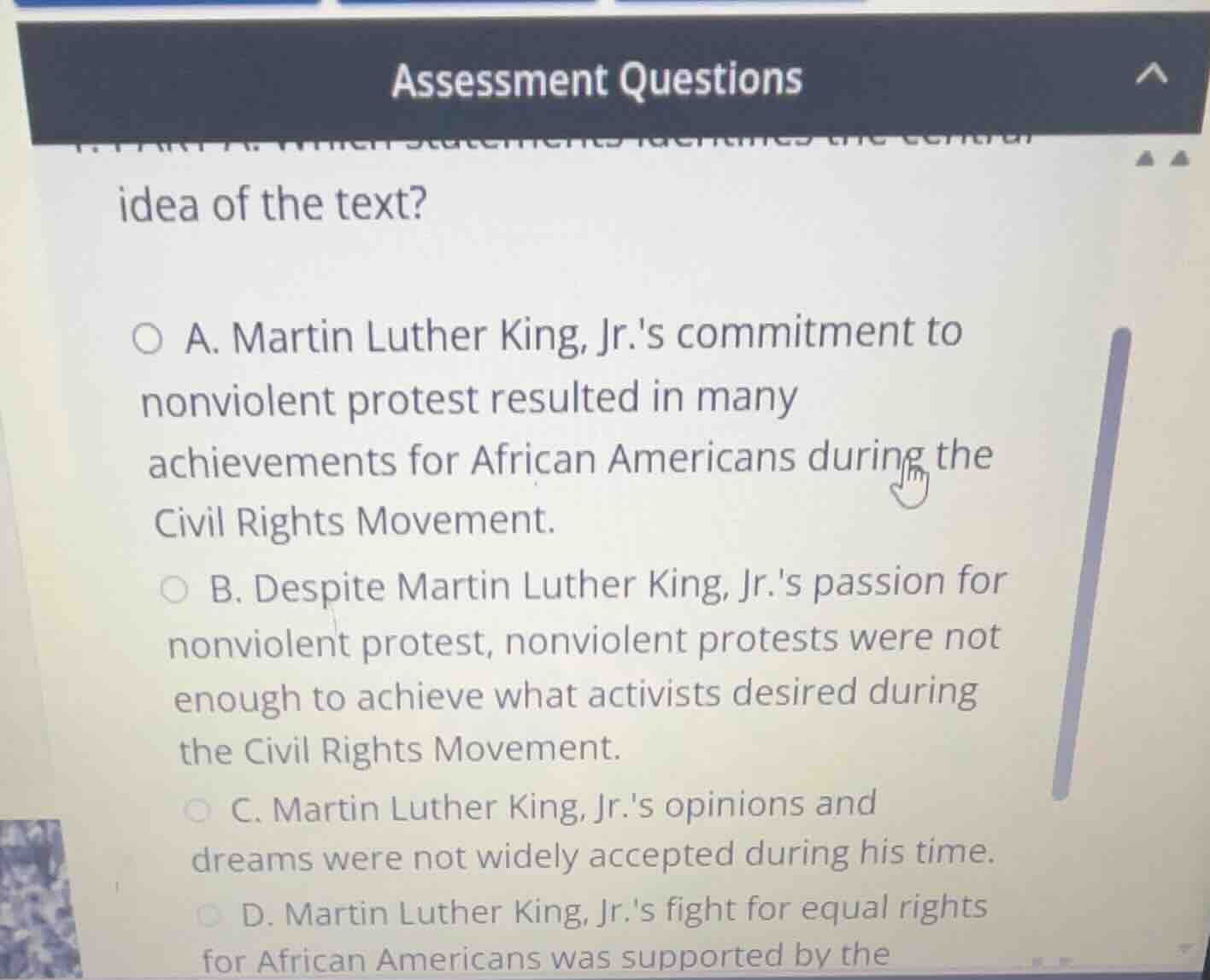
assessment questions idea of the text? a. martin luther king, jr.s commitment to nonviolent protest resulted in many achievements for african americans during the civil rights movement. b. despite martin luther king, jr.s passion for nonviolent protest, nonviolent protests were not enough to achieve what activists desired during the civil rights movement. c. martin luther king, jr.s opinions and dreams were not widely accepted during his time. d. martin luther king, jr.s fight for equal rights for african americans was supported by the
To determine the central idea about Martin Luther King, Jr. and the Civil Rights Movement:
- Option A: Highlights MLK's commitment to nonviolent protest and its positive outcomes (achievements for African Americans) during the Civil Rights Movement. This aligns with historical knowledge of MLK's successful nonviolent efforts (e.g., Montgomery Bus Boycott, March on Washington) that advanced civil rights.
- Option B: Claims nonviolent protests were insufficient, which contradicts the significant gains (e.g., Civil Rights Act, Voting Rights Act) achieved through nonviolent means led by MLK.
- Option C: States his opinions/dreams were not widely accepted, but MLK's ideas (like the "I Have a Dream" speech) had broad support and became iconic for the movement.
- Option D: The option is cut off, but from the visible part, it starts to mention support, which is not the core focus of identifying the central idea about his nonviolent protest and its results.
To identify the central idea, we analyze each option:
- Option A emphasizes MLK’s nonviolent protest and its achievements for African Americans during the Civil Rights Movement, consistent with historical context (e.g., successful civil rights gains from his nonviolent efforts).
- Option B incorrectly claims nonviolent protests were insufficient, contradicting historical outcomes (e.g., Civil Rights Act, Voting Rights Act).
- Option C is inaccurate, as MLK’s ideas (e.g., “I Have a Dream”) were widely accepted and influential.
- Option D is incomplete, and its visible portion does not focus on the core theme of nonviolent protest and its results.

Snap & solve any problem in the app
Get step-by-step solutions on Sovi AI
Photo-based solutions with guided steps
Explore more problems and detailed explanations
A. Martin Luther King, Jr.'s commitment to nonviolent protest resulted in many achievements for African Americans during the Civil Rights Movement.