QUESTION IMAGE
Question
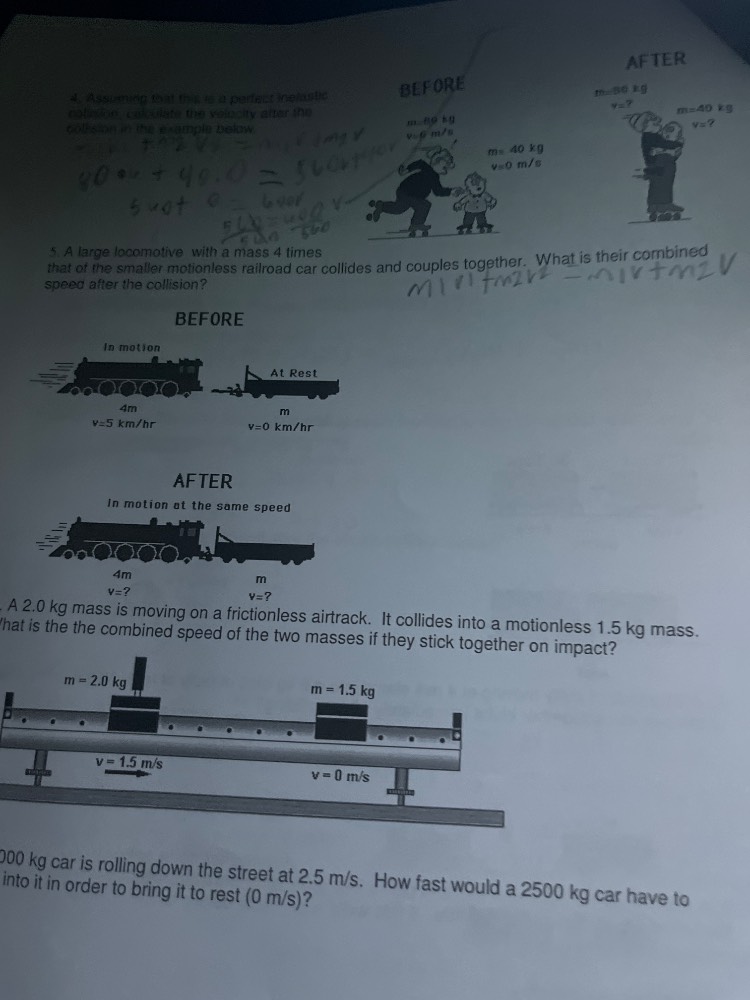
- assuming that this is a perfectly inelastic collision, calculate the velocity after the collision in the example below
before
m=80 kg
v=6 m/s
m=40 kg
v=0 m/s
after
m=80 kg
v=?
m=40 kg
v=?
- a large locomotive with a mass 4 times that of the smaller motionless railroad car collides and couples together. what is their combined speed after the collision?
before
in motion
4m
v=5 km/hr
at rest
m
v=0 km/hr
after
in motion at the same speed
4m
v=?
m
v=?
a 2.0 kg mass is moving on a frictionless airtrack. it collides into a motionless 1.5 kg mass. what is the the combined speed of the two masses if they stick together on impact?
m = 2.0 kg
v = 1.5 m/s
m = 1.5 kg
v = 0 m/s
000 kg car is rolling down the street at 2.5 m/s. how fast would a 2500 kg car have to into it in order to bring it to rest (0 m/s)?
Step1: Define conservation of momentum
For perfectly inelastic collisions, total momentum before collision equals total momentum after collision: $m_1v_1 + m_2v_2 = (m_1+m_2)v_f$
---
Problem 4
Step1: List given values
$m_1=80\ \text{kg}, v_1=6\ \text{m/s}; m_2=40\ \text{kg}, v_2=0\ \text{m/s}$
Step2: Substitute into momentum formula
$80\times6 + 40\times0 = (80+40)v_f$
Step3: Solve for $v_f$
$480 = 120v_f \implies v_f=\frac{480}{120}$

Snap & solve any problem in the app
Get step-by-step solutions on Sovi AI
Photo-based solutions with guided steps
Explore more problems and detailed explanations
(Problem 4):
$4\ \text{m/s}$
---
Problem 5
Step1: List given values
$m_1=4m, v_1=5\ \text{km/hr}; m_2=m, v_2=0\ \text{km/hr}$
Step2: Substitute into momentum formula
$4m\times5 + m\times0 = (4m+m)v_f$
Step3: Simplify and solve for $v_f$
$20m = 5mv_f \implies v_f=\frac{20m}{5m}$