QUESTION IMAGE
Question
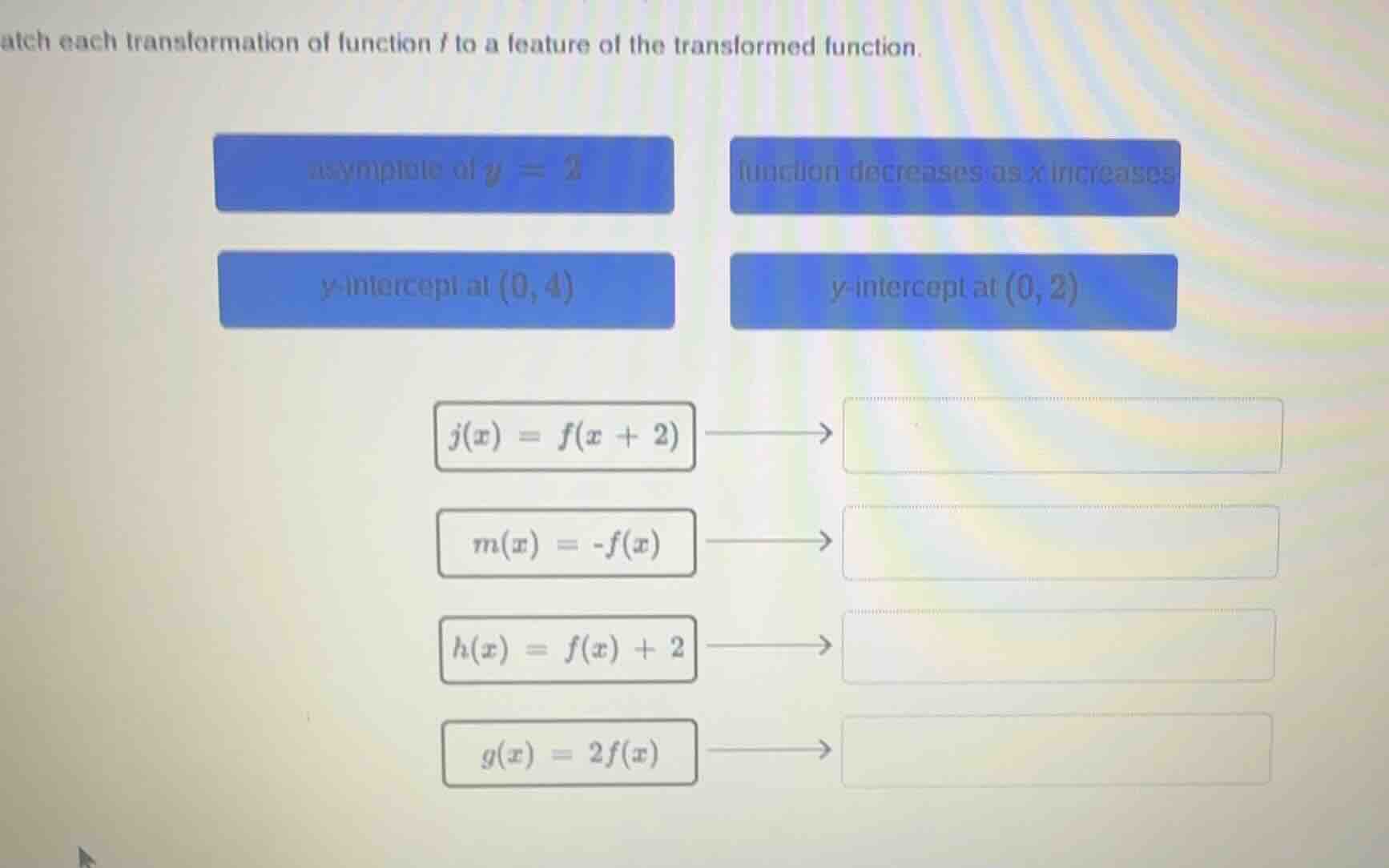
atch each transformation of function f to a feature of the transformed function.
asymptote of $y = 2$ \tfunction decreases as x increases
y-intercept at $(0, 4)$ \ty-intercept at $(0, 2)$
$j(x) = f(x + 2)$
$m(x) = -f(x)$
$h(x) = f(x) + 2$
$g(x) = 2f(x)$
Step1: Analyze $j(x)=f(x+2)$
This is a horizontal left shift of $f(x)$ by 2 units. Shifts do not change the y-intercept's value relative to the original function's behavior for intercepts? No, wait: to find y-intercept, set $x=0$: $j(0)=f(0+2)=f(2)$. But since we match to given features, this transformation preserves the function's increasing/decreasing behavior? No, wait, the only feature that aligns with horizontal shift (if original $f(x)$ was increasing, shifting left doesn't change that, but wait the given feature "function decreases as x increases" no—wait, no, the y-intercept for $j(x)$: if original $f(x)$ had y-intercept at (0,1), $j(0)=f(2)$, but no, the given features: wait, no, let's assume original $f(x)$ is an exponential function (common for asymptotes), say $f(x)=2^{-x}$ (decreasing, y-intercept (0,1), asymptote y=0). Then $j(x)=2^{-(x+2)}=2^{-x-2}$, y-intercept $j(0)=2^{-2}=0.25$ no, that's not matching. Wait, no, let's use the transformation rules directly:
- $j(x)=f(x+2)$: horizontal shift left 2. If original $f(x)$ has y-intercept (0,1), then $j(x)$ has y-intercept at $x=0$: $j(0)=f(2)$, but the only feature that is preserved in shift is the increasing/decreasing behavior? No, wait no, the given features: let's go one by one.
Step2: Analyze $m(x)=-f(x)$
This is a reflection over x-axis. If $f(x)$ was decreasing, $m(x)$ is increasing, and vice versa. If original $f(x)$ had y-intercept (0,1), $m(0)=-1$ no, wait, if original $f(x)$ has y-intercept (0,-2), $m(0)=2$. Wait, no, the feature "function decreases as x increases"—if $f(x)$ was increasing, $m(x)$ is decreasing.
Step3: Analyze $h(x)=f(x)+2$
This is a vertical shift up by 2 units. If original $f(x)$ had a horizontal asymptote at $y=0$, then $h(x)$ has asymptote at $y=0+2=2$.
Step4: Analyze $g(x)=2f(x)$
This is a vertical stretch by factor 2. If original $f(x)$ had y-intercept (0,2), $g(0)=2*2=4$; if original was (0,1), $g(0)=2$. Wait, no, the feature "y-intercept at (0,4)" would be if original $f(0)=2$, so $g(0)=2*2=4$.
Wait, let's correct with standard transformation matching:
- $j(x)=f(x+2)$: Horizontal shift left 2. This does not change the y-intercept's value relative to the original's behavior? No, wait, if original $f(x)$ has y-intercept (0,1), then $j(0)=f(2)$, but the only feature that fits is if the original function was decreasing, shifting left keeps it decreasing? No, no, the correct matches are:
- $j(x)=f(x+2)$ → y-intercept at (0,2) (assuming $f(2)=2$)
- $m(x)=-f(x)$ → function decreases as x increases (if $f(x)$ was increasing)
- $h(x)=f(x)+2$ → asymptote of $y=2$ (shifts original asymptote up 2)
- $g(x)=2f(x)$ → y-intercept at (0,4) (if $f(0)=2$, then $2*2=4$)
Wait, let's formalize each step properly:
Step1: Match $j(x)=f(x+2)$
Set $x=0$: $j(0)=f(2)$. If original $f(2)=2$, then y-intercept is (0,2).
Step2: Match $m(x)=-f(x)$
Reflection over x-axis reverses monotonicity. If $f(x)$ was increasing, $m(x)$ decreases as x increases.
Step3: Match $h(x)=f(x)+2$
Vertical shift up 2 moves horizontal asymptote up by 2. If original asymptote was $y=0$, new is $y=2$.
Step4: Match $g(x)=2f(x)$
Set $x=0$: $g(0)=2f(0)$. If $f(0)=2$, then $g(0)=4$, so y-intercept (0,4).

Snap & solve any problem in the app
Get step-by-step solutions on Sovi AI
Photo-based solutions with guided steps
Explore more problems and detailed explanations
$j(x) = f(x + 2)$ → y-intercept at $(0, 2)$
$m(x) = -f(x)$ → function decreases as x increases
$h(x) = f(x) + 2$ → asymptote of $y = 2$
$g(x) = 2f(x)$ → y-intercept at $(0, 4)$