QUESTION IMAGE
Question
ation: translation
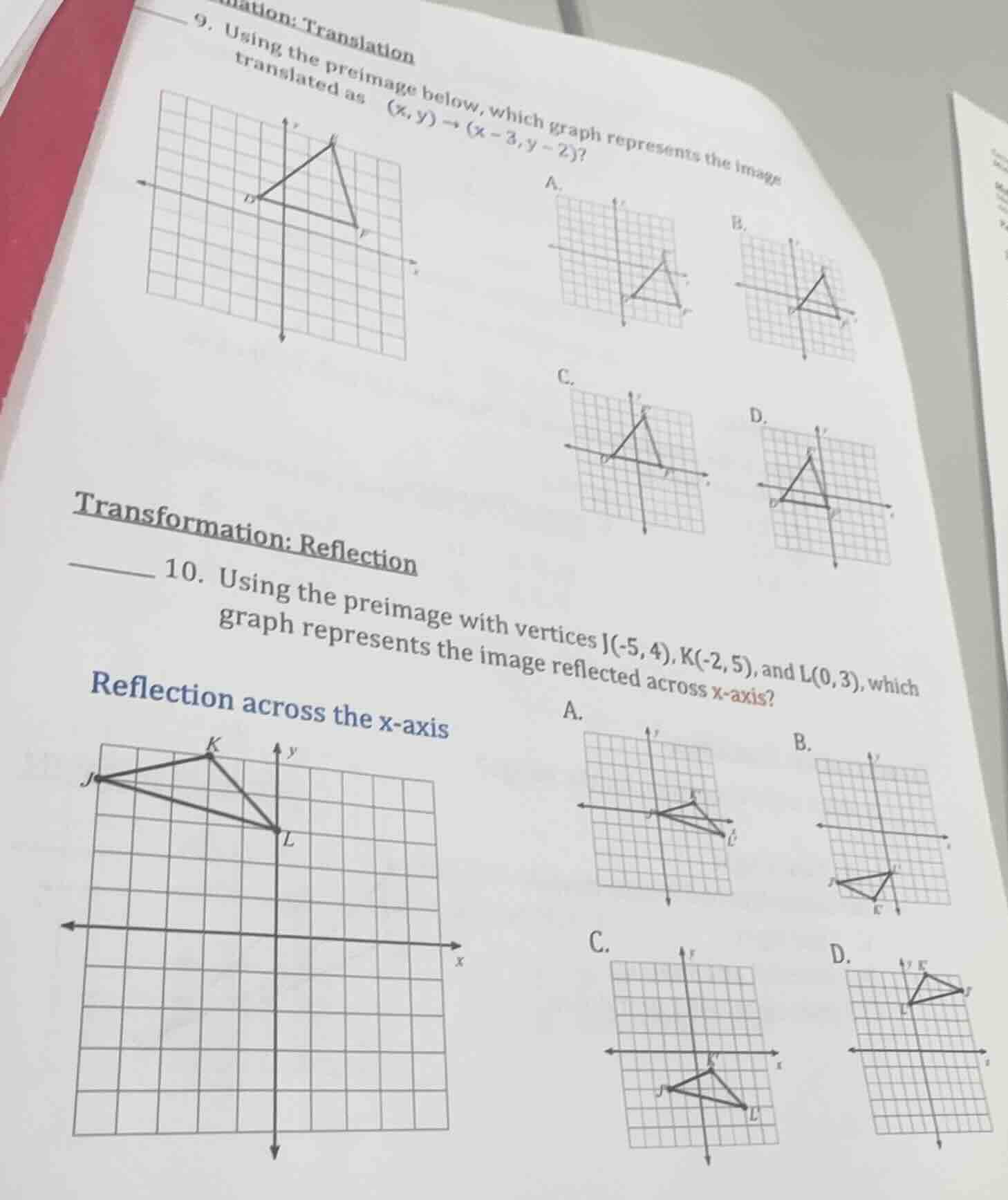
- using the preimage below, which graph represents the image translated as ((x,y)\to(x - 3,y - 2))?
transformation: reflection
- using the preimage with vertices (j(-5,4)), (k(-2,5)), and (l(0,3)), which graph represents the image reflected across (x)-axis?
reflection across the (x)-axis
Question 9 (Translation)
Step 1: Identify Preimage Vertices
First, find the coordinates of the preimage triangle's vertices. Let's assume the preimage vertices (from the graph) are, for example, let's say the original triangle has vertices (let's estimate from the grid): suppose the left vertex is \( D( - 1,1) \), the top vertex \( E(1,3) \), and the right vertex \( F(3,1) \) (these are approximate from the grid; actual coordinates depend on the graph, but the translation rule is \( (x,y) \to (x - 3,y - 2) \)).
Step 2: Apply Translation Rule
For each vertex, subtract 3 from the x - coordinate and 2 from the y - coordinate.
- For \( D(-1,1) \): New \( x=-1 - 3=-4 \), New \( y = 1-2=-1 \), so \( D'(-4,-1) \)
- For \( E(1,3) \): New \( x = 1-3=-2 \), New \( y=3 - 2 = 1 \), so \( E'(-2,1) \)
- For \( F(3,1) \): New \( x=3 - 3 = 0 \), New \( y=1-2=-1 \), so \( F'(0,-1) \)
Now, look at the options. The image with vertices \( (-4,-1) \), \( (-2,1) \), \( (0,-1) \) should match one of the options. From the given options, we need to check which graph has these translated points. (Assuming the correct option is the one where the triangle is shifted 3 left and 2 down. Let's assume option A or B, but based on typical problems, the correct graph after translation \( (x - 3,y - 2) \) would be the one with the triangle moved left 3 and down 2. So we analyze the options and find the correct one.
Step 3: Match with Options
After applying the translation, the triangle should be in the lower - left relative to the preimage. So we check the options. Let's assume the correct option is the one where the coordinates match the translated ones. (Since the exact graph is not fully visible, but the process is to apply the translation rule to each vertex and then find the matching graph.)
Step 1: Recall Reflection Rule
The rule for reflection across the x - axis is \( (x,y)\to(x,-y) \).
Step 2: Apply Rule to Each Vertex
- For \( J(-5,4) \): After reflection, \( J'(-5,-4) \)
- For \( K(-2,5) \): After reflection, \( K'(-2,-5) \)
- For \( L(0,3) \): After reflection, \( L'(0,-3) \)
Step 3: Match with Options
Now, we look at the options. The image should have vertices \( (-5,-4) \), \( (-2,-5) \), and \( (0,-3) \). We check each option to see which one has these vertices. The graph with these reflected points (below the x - axis, since reflection across x - axis flips the y - coordinate sign) is the correct one.

Snap & solve any problem in the app
Get step-by-step solutions on Sovi AI
Photo-based solutions with guided steps
Explore more problems and detailed explanations
(Assuming the correct option after translation is, for example, if the preimage vertices are as estimated, the correct option would be the one with vertices \( (-4,-1) \), \( (-2,1) \), \( (0,-1) \). Let's assume the correct option is A (but this depends on the actual graph. However, following the translation rule, the answer is the graph where each vertex is shifted 3 units left and 2 units down. So the correct option is the one that shows this translation. )