QUESTION IMAGE
Question
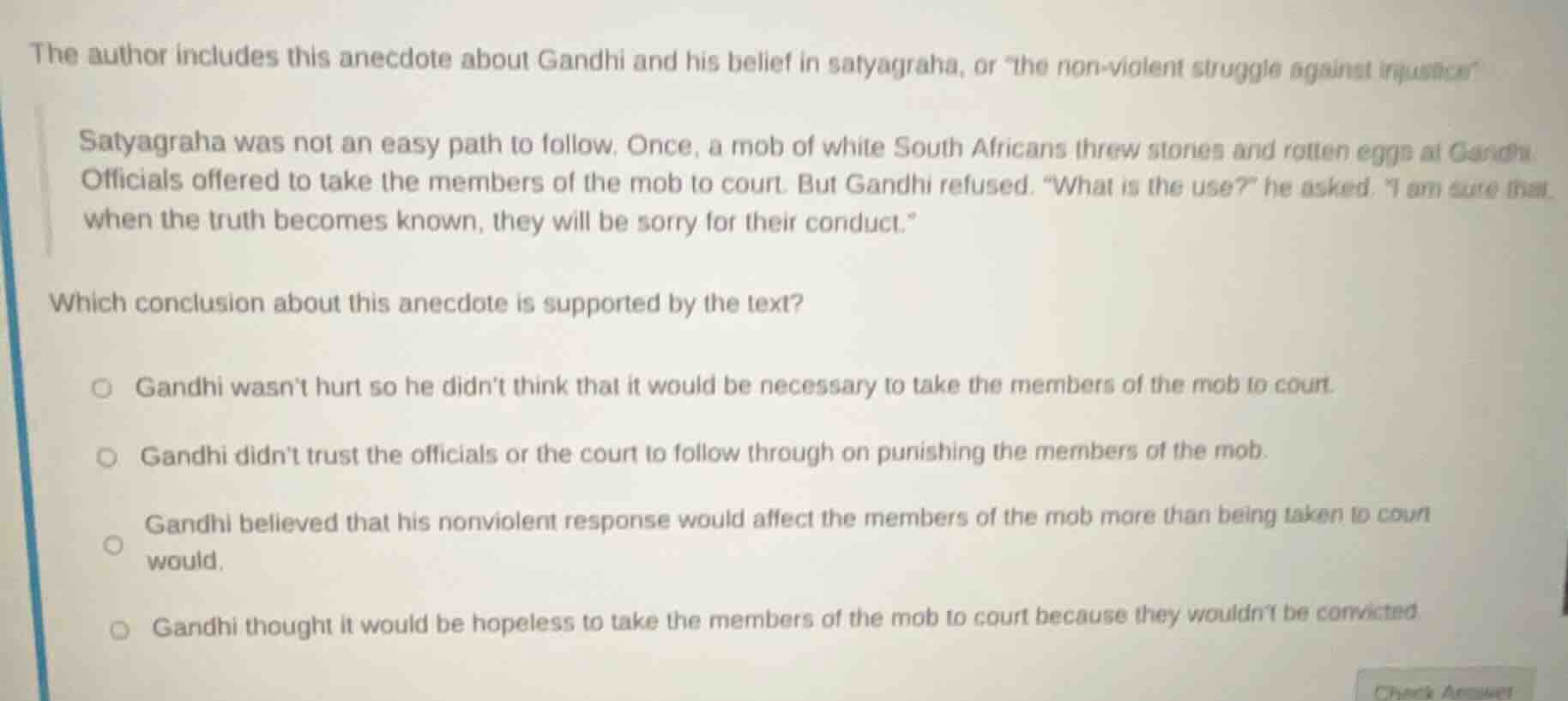
the author includes this anecdote about gandhi and his belief in satyagraha, or \the non - violent struggle against injustice\. satyagraha was not an easy path to follow. once, a mob of white south africans threw stones and rotten eggs at gandhi. officials offered to take the members of the mob to court. but gandhi refused. \what is the use?\ he asked. \i am sure that when the truth becomes known, they will be sorry for their conduct.\ which conclusion about this anecdote is supported by the text? ○ gandhi wasnt hurt so he didnt think that it would be necessary to take the members of the mob to court. ○ gandhi didnt trust the officials or the court to follow through on punishing the members of the mob. ○ gandhi believed that his nonviolent response would affect the members of the mob more than being taken to court would. ○ gandhi thought it would be hopeless to take the members of the mob to court because they wouldnt be convicted.
The text states Gandhi refused legal action against the mob, believing they would feel remorse once the truth was known. This aligns with his satyagraha (non-violent struggle) principle, where he thought non-violence would have a greater impact than court punishment. The other options are unsupported: the text does not mention if he was hurt, does not state distrust of officials/courts, and does not reference lack of conviction hope.

Snap & solve any problem in the app
Get step-by-step solutions on Sovi AI
Photo-based solutions with guided steps
Explore more problems and detailed explanations
Gandhi believed that his nonviolent response would affect the members of the mob more than being taken to court would.