QUESTION IMAGE
Question
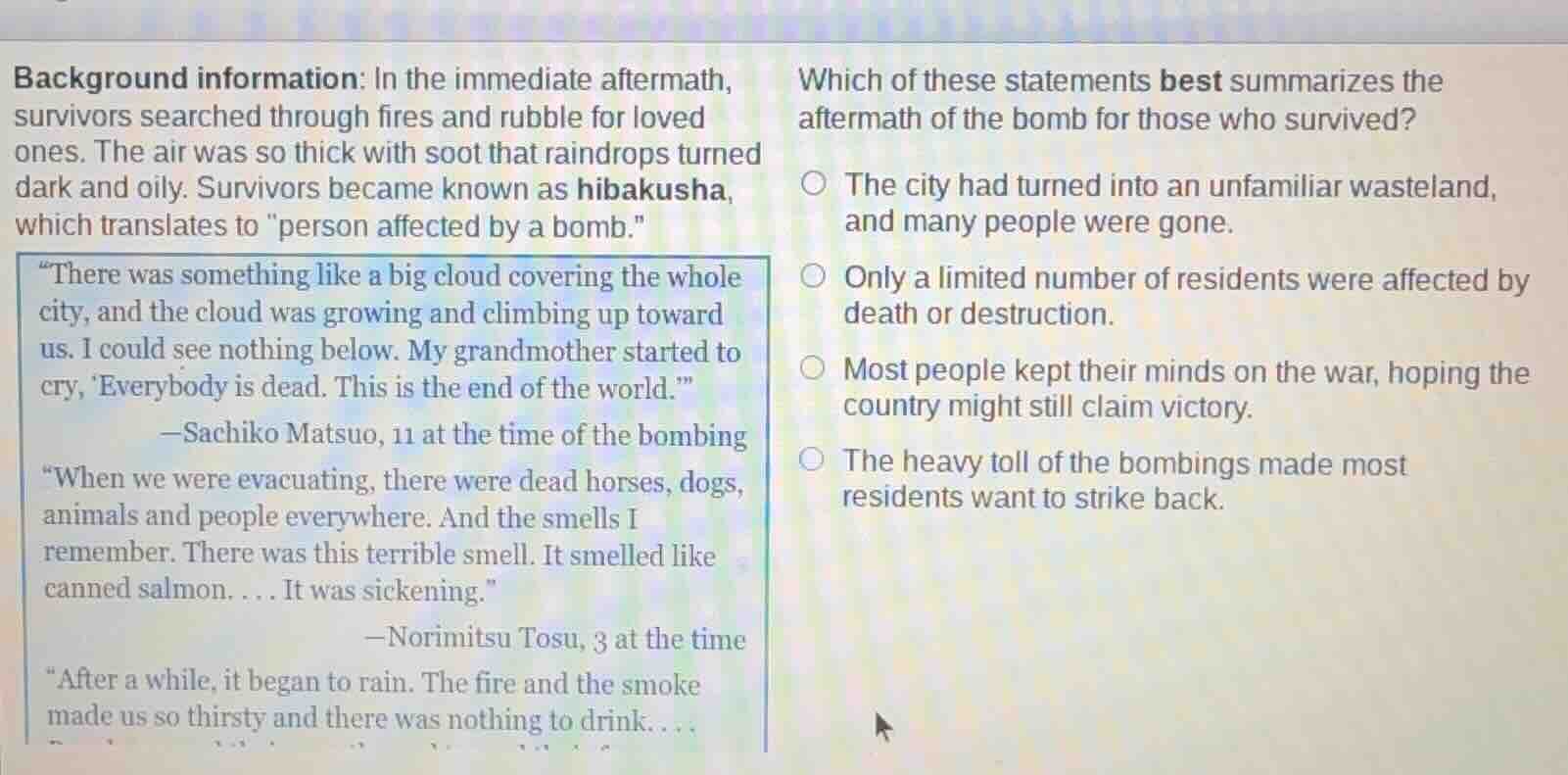
background information: in the immediate aftermath, survivors searched through fires and rubble for loved ones. the air was so thick with soot that raindrops turned dark and oily. survivors became known as hibakusha, which translates to \person affected by a bomb.\
\there was something like a big cloud covering the whole city, and the cloud was growing and climbing up toward us. i could see nothing below. my grandmother started to cry, everybody is dead. this is the end of the world.\
—sachiko matsuo, 11 at the time of the bombing
\when we were evacuating, there were dead horses, dogs, animals and people everywhere. and the smells i remember. there was this terrible smell. it smelled like canned salmon. . . . it was sickening.\
—norimitsu tosu, 3 at the time
\after a while, it began to rain. the fire and the smoke made us so thirsty and there was nothing to drink. . . .
which of these statements best summarizes the aftermath of the bomb for those who survived?
○ the city had turned into an unfamiliar wasteland, and many people were gone.
○ only a limited number of residents were affected by death or destruction.
○ most people kept their minds on the war, hoping the country might still claim victory.
○ the heavy toll of the bombings made most residents want to strike back.
The background and firsthand accounts describe a devastated city filled with death, debris, and an unrecognizable landscape, with many people lost. Option 2 is incorrect because the accounts show widespread, not limited, destruction. Option 3 is irrelevant as no focus on war victory hope is mentioned. Option 4 is wrong since there is no mention of residents wanting to strike back.

Snap & solve any problem in the app
Get step-by-step solutions on Sovi AI
Photo-based solutions with guided steps
Explore more problems and detailed explanations
A. The city had turned into an unfamiliar wasteland, and many people were gone.