QUESTION IMAGE
Question
- a ball is dropped from rest from a tower and strikes the ground 110 m below. approximately how many seconds does it take the ball to strike the ground after being dropped? neglect air resistance.
a) 2.50 s
b) 3.50 s
c) 4.74 s
d) 12.5 s
e) 16.0 s
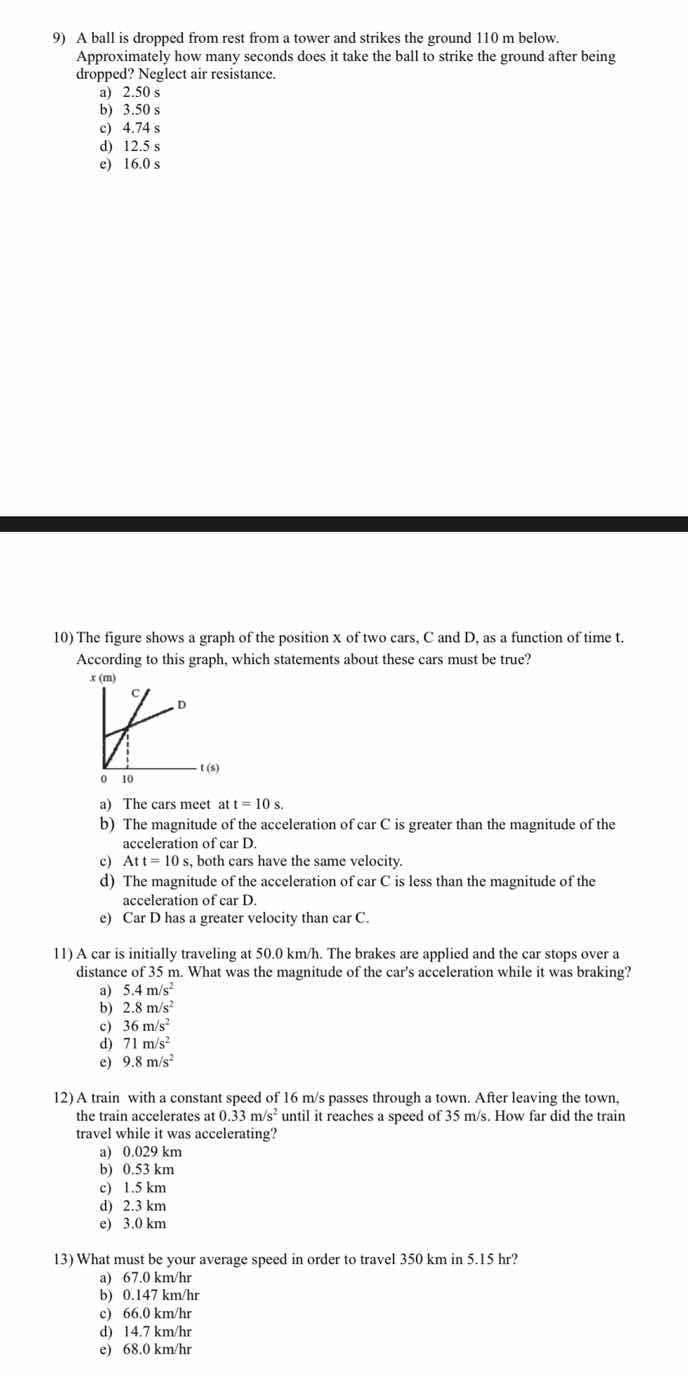
- the figure shows a graph of the position x of two cars, c and d, as a function of time t. according to this graph, which statements about these cars must be true?
a) the cars meet at t = 10 s.
b) the magnitude of the acceleration of car c is greater than the magnitude of the acceleration of car d.
c) at t = 10 s, both cars have the same velocity.
d) the magnitude of the acceleration of car c is less than the magnitude of the acceleration of car d.
e) car d has a greater velocity than car c.
- a car is initially traveling at 50.0 km/h. the brakes are applied and the car stops over a distance of 35 m. what was the magnitude of the cars acceleration while it was braking?
a) 5.4 m/s²
b) 2.8 m/s²
c) 36 m/s²
d) 71 m/s²
e) 9.8 m/s²
- a train with a constant speed of 16 m/s passes through a town. after leaving the town, the train accelerates at 0.33 m/s² until it reaches a speed of 35 m/s. how far did the train travel while it was accelerating?
a) 0.029 km
b) 0.53 km
c) 1.5 km
d) 2.3 km
e) 3.0 km
- what must be your average speed in order to travel 350 km in 5.15 hr?
a) 67.0 km/hr
b) 0.147 km/hr
c) 66.0 km/hr
d) 14.7 km/hr
e) 68.0 km/hr
Problem 9
Step1: List known values
Initial velocity $v_0 = 0$ m/s, displacement $x = 110$ m, acceleration $a = g = 9.8$ m/s²
Step2: Use kinematic equation
$x = v_0 t + \frac{1}{2} a t^2$
Substitute $v_0=0$: $110 = 0 + \frac{1}{2} \times 9.8 \times t^2$
Step3: Solve for $t$
$t^2 = \frac{2 \times 110}{9.8} = \frac{220}{9.8} \approx 22.45$
$t = \sqrt{22.45} \approx 4.74$ s
- For position-time graphs, slope = velocity, curvature = acceleration.
- At $t=10$s, the graphs cross, so cars meet (a is true).
- Car C has a steeper increasing slope (greater velocity change, higher acceleration magnitude) than D (b is true, d false).
- At $t=10$s, slopes differ, so velocities differ (c false).
- At $t=10$s, C's slope is steeper, so C has greater velocity (e false).
Step1: Convert units
Initial velocity $v_0 = 50.0$ km/h = $50.0 \times \frac{1000}{3600} \approx 13.89$ m/s; final velocity $v=0$; distance $x=35$ m
Step2: Use kinematic equation
$v^2 = v_0^2 + 2 a x$
Step3: Solve for $a$
$0 = (13.89)^2 + 2 \times a \times 35$
$a = -\frac{(13.89)^2}{70} \approx -\frac{192.9}{70} \approx -2.76$ m/s², magnitude ≈ 2.8 m/s²

Snap & solve any problem in the app
Get step-by-step solutions on Sovi AI
Photo-based solutions with guided steps
Explore more problems and detailed explanations
c) 4.74 s
---